

Drug, mental health and veterans courts could close without more funding
Kentucky judges and advocates warned Thursday that specialty courts across the state could shut down without increased funding in the judicial branch budget.
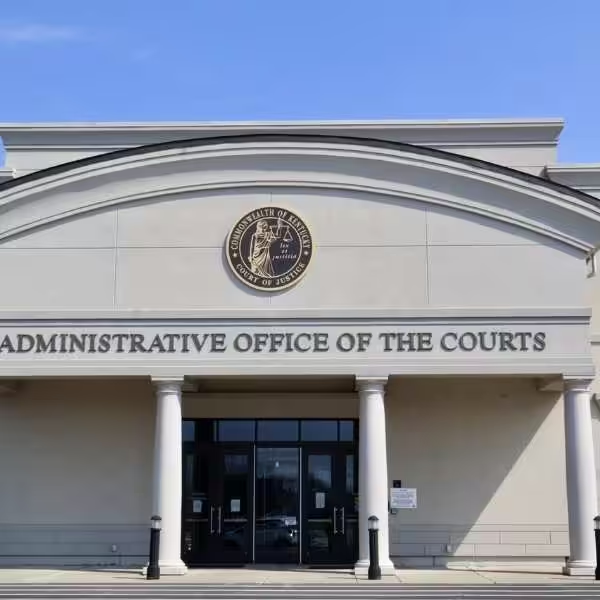
The Administrative Office of the Courts said the General Assembly’s proposed two-year budget would leave court operations underfunded by $33 million.
Programs at risk include drug courts, mental health courts, and veterans treatment courts, according to a news release issued Thursday, the 54th day of the 60-day legislative session.
Kentucky Supreme Court Chief Justice Debra Hembree Lambert said the proposed funding would only cover constitutionally required judicial operations.
“The Judicial Branch already operates with a lean budget, with about 90% devoted to personnel and the basic costs required to keep courthouses open and functioning,” Lambert said.
“When cuts of this magnitude occur, there is simply no way to absorb them through small efficiencies or administrative changes,” she added. “The only viable option we have is to eliminate programs that are not constitutionally required, including Drug, Mental Health and Veterans Treatment Courts. These programs change lives every day, but without adequate funding, we cannot continue them.”
These specialty courts focus on treatment-based supervision for individuals whose criminal behavior is linked to substance use disorders or serious mental illness. Participants must complete intensive programs that include treatment, frequent drug testing, and close court oversight.
The Administrative Office of the Courts said the current version of House Bill 504 would underfund operations by about $14 million in fiscal year 2027 and nearly $19 million in fiscal year 2028. Lawmakers are still negotiating final budget terms.
“There are robust discussions around all three branch budgets,” Senate President Pro Tempore David Givens said. “I appreciate the role the judicial branch plays. I also appreciate them finding efficiencies within that system. They play a vital role, but they’ve got to do it within the confines of what the taxpayers provide.”
Funding proposals have shifted during the legislative process. The House initially proposed about $657 million annually, later increasing it to $687 million. The Senate version included nearly $693 million per year, while the current version stands at $687 million annually.
A former drug court participant said the program changed her life.
Laura Crawford, now working with the Administrative Office of the Courts, said she was facing a 25-year sentence in 2013 before entering a drug court program in Breckinridge County.
“I went in scared to death, terrified. I was living a life in full active addiction. I was addicted to opioids. I was also addicted to methamphetamines,” Crawford said.
She said the program required her to complete a 12-step plan, find employment, keep a journal, attend classes, and learn about addiction triggers.
“All those drug court requirements taught me how to be accountable,” she said.
Crawford graduated in 2016 and now trains specialty court staff, helping others in recovery.
“What drug court did for me completely turned my life around,” she said. “My son had a mom who was not only a mom that was there just because I was a biological mother, but was able to be there physically, mentally, emotionally.”
Circuit Judge Kathryn H. Gabhart warned that eliminating these courts would increase incarceration rates.
“We see not only individuals stop violating the law; stop using drugs,” Gabhart said. “We see individuals becoming stable on medications. They start paying child support. They support their families, pay fines, and get jobs.”
Without these programs, she said, more individuals would be sent to jail, increasing costs in a system already under strain.
“If we as judges don’t have the option of placing someone into drug court or mental health court or veterans treatment court, the only alternative is to serve their sentence,” Gabhart said. “They would have to go to jail.”
According to court data, Kentucky’s specialty courts have produced significant outcomes. As of August 2025, 5,110 participants secured jobs, 555 achieved educational goals, and 1,621 improved housing stability.
Drug courts operate in all 120 counties with about 2,500 active participants. Mental health courts serve 270 participants in 17 counties, while veterans treatment courts operate in eight counties with 92 participants.






Leave a Reply