

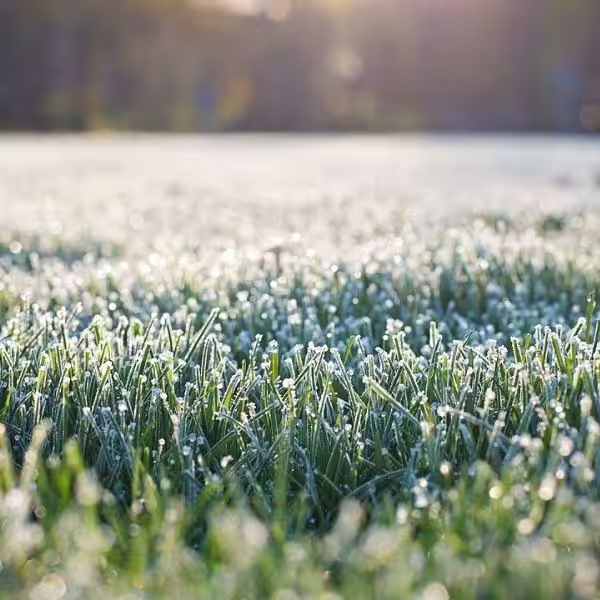
Some people across Kentucky may feel tempted to start planting spring flowers and vegetables soon as warm temperatures and rainy weather move through the region. The National Weather Service in Louisville forecasts highs reaching the 70s in the coming days, but experts warn not to celebrate too early.
Those warmer conditions likely won’t last. It’s still technically winter, and the final spring freeze — the last day temperatures fall to 32 degrees — usually doesn’t occur in early March.
Here’s what you should know.
Is Kentucky experiencing a ‘false spring’?
“This can be classified as a false spring coming up, especially from the central Plains to the East Coast,” AccuWeather meteorologist Paul Pastelok said in an email to USA TODAY.
False spring refers to a stretch of unusually warm weather that can make it seem like winter has ended, according to Homes and Gardens. In the Louisville area, temperatures are expected to stay in the 60s and 70s for the next several days, based on National Weather Service forecasts, before dropping again.
So if you’re planning to brighten your yard with colorful flowers, it may be wise to keep Kentucky’s final freeze dates in mind. Planting too early could damage your plants.
When does Kentucky usually see its final freeze?
Historical National Weather Service records — some dating back to the late 1800s — show the average final spring freeze dates for Lexington and Louisville. These records include the earliest and latest occurrences of spring freezes:
Lexington: Earliest final spring freeze: March 17, 1929; Latest spring freeze: May 20, 1894.
Louisville: Earliest final spring freeze: March 5, 1927; Latest spring freeze: May 10, 1966.
You can check frost dates for your ZIP code using The Old Farmer’s Almanac. The site notes that the data comes from the nearest official weather station. Even after these dates pass, frost can still occur, so keeping an eye on local forecasts remains important.
When is the first day of spring in 2026?
For meteorologists, spring began on March 1. Meteorological spring includes the months of March, April, and May because it makes weather record-keeping easier.
However, the first day of spring is different for those who track the seasons based on Earth’s position relative to the sun.
Astronomical spring in the Northern Hemisphere begins on March 20, 2026. This marks the vernal equinox, when the sun shines directly over Earth’s equator, bringing roughly 12 hours of daylight and 12 hours of night worldwide.
In the Southern Hemisphere, the seasons are reversed. Countries like Australia, New Zealand, and Brazil begin autumn at that time.
Season start dates for 2026
March 20: First day of spring 2026
June 21: First day of summer 2026
Sept. 22: First day of fall 2026
Dec. 21: First day of winter 2026




Leave a Reply