

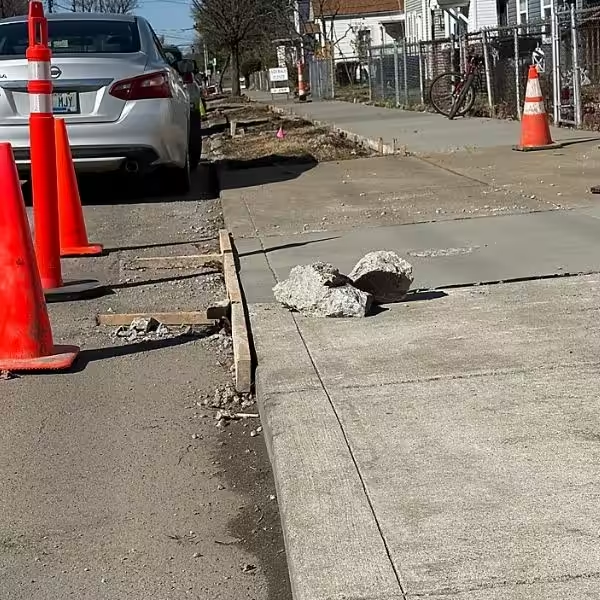
LOUISVILLE, Ky. — Many people may overlook how vital sidewalks are to a community, but in Louisville, they play a crucial role in daily life.
What You Need To Know
-
Louisville uses a 0–5 rating scale and 311 complaints to prioritize sidewalk repairs
-
The city spends about $2 million annually on sidewalks across 26 districts
-
Older areas like downtown, the West End and the South End face the most issues
-
Since 2021, crews have repaired more than 190,000 linear feet of sidewalks, but a backlog remains
For residents like Angie Hall, sidewalks mean more than convenience in her Beechmont neighborhood — especially after a winter storm left some impassable.
“We’ve got a lot of walkers you will see during the day and at nighttime, people walking their dogs, small children,” she said. “We now have a few children that live in the neighborhood as well, and they play on the sidewalk.”
Hall has lived in the area for 20 years. Although tree roots can sometimes shift sidewalks, she appreciates living where they are properly maintained.
“One of the main reasons why I bought this house was because it had sidewalks. I will always live somewhere where there are sidewalks,” she said. “I have had no problems with these sidewalks, and I’ve never had my neighbor say anything about it either.”
Maintaining sidewalks falls under the responsibility of the Department of Public Works.
According to Bill Bell, director of the Louisville Metro Department of Transportation, the city uses a zero-to-five rating scale to determine repair priorities.
Crews conduct inspections after residents submit complaints through the city’s 311 system. Sidewalks rated four or five require the most urgent attention.
“Unfortunately, we’ve got a multimillion-dollar backlog of sidewalk repairs to be made,” Bell said. “We were budgeted about $2 million per year for sidewalk repairs.”
The $2 million budget is divided among all 26 Metro Council districts, and repair costs vary based on severity.
Bell explained that fixing sidewalks rated zero through three may cost only a few hundred dollars, while repairs for fours and fives typically range from $2,000 to $5,000.
He identified older neighborhoods — including downtown, the West End and the South End — as the primary trouble spots.
Metro Council members can also allocate discretionary funding to accelerate projects. District 21 representative Betsy Ruhe said her district uses Community Infrastructure Funds (CRF) for improvements.
“In our district we’ve got what are called CRF funds, community infrastructure funds, and those are used for speed humps, sidewalks, maybe individual paving projects, things like that,” Ruhe said.
Her district operates with a $100,000 budget, but she noted that contractor shortages remain a significant challenge.
Most importantly, she emphasized that residents must report issues to see them resolved.
“As a Metro Council member, I can’t be everywhere. I can’t see everything,” Ruhe said. “I depend on my constituents and my neighbors to report things. And please don’t ever think that you’re going to get in trouble if you tell us about something, because we can’t fix what we don’t know.”
The Department of Public Works reports that since 2021, the city has repaired more than 190,000 linear feet of sidewalks.



Leave a Reply