

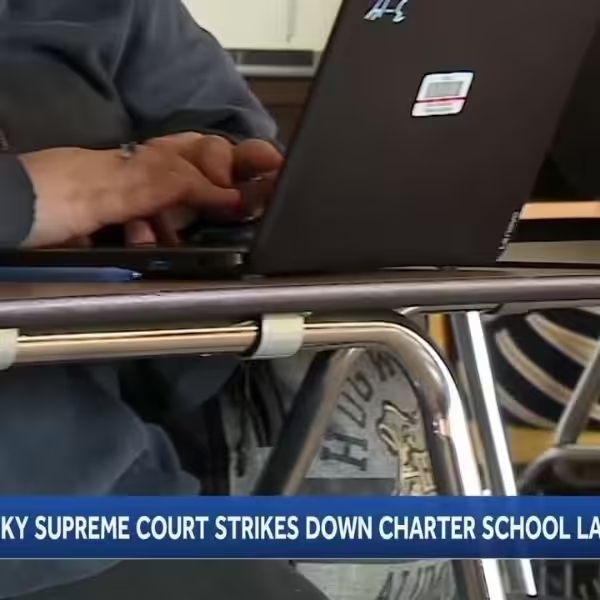
(LEX 18) — The Kentucky Supreme Court unanimously ruled that Kentucky’s charter school funding law violates the state constitution, delivering a major setback to school choice supporters and reinforcing strict protections for public education funding.
The justices focused on the Kentucky Constitution’s requirement that public education funds may only support “common schools” unless voters approve spending on other educational programs through a referendum.
“The Constitution binds us to a fixed standard,” Justice Keller wrote in the opinion. “Public money may support education outside the common school system only with a Section 184-compliant, voter-approved tax, or if the beneficiary program could have been truly situated inside the common school system.”
Kentucky’s Constitution includes firm financial safeguards for education funding, dating back to 1891, when lawmakers repeatedly diverted school funds to non-educational purposes, according to court filings. The framers intentionally “locked up” K-12 funding after years of raids and diversions from the state’s education fund.
Section 184 states that education funds “shall be appropriated to the common schools, and to no other purpose,” and requires voter approval before any money can be “raised or collected for education other than in common schools.”
The court determined that charter schools would divert funding from the public school system while operating outside its oversight framework. Under House Bill 9, charter schools could use state tax dollars to purchase buildings, but those properties would not become assets of local districts or the Kentucky Department of Education.
“The statutory examples illustrated above make clear the repeated dilution of public school funding of resources that would occur under the proposed parallel system,” the court wrote.
The ruling follows Kentucky voters’ overwhelming rejection of a constitutional amendment in November 2024 that would have allowed state funding for students outside public schools. All 120 counties voted against Amendment 2, which the court said reinforced the constitutional protection of funding for the common-school system.
The justices noted that Kentucky’s constitutional language differs from that of many neighboring states that allow charter schools, pointing out that most states use broader definitions of “common school” and lack an explicit voter-approval requirement for spending outside the system.
In a concurring opinion, Chief Justice Lambert raised concerns about oversight, writing that charter schools could operate for at least five years without meaningful public accountability for how taxpayer dollars are spent.
“What would prevent a school operator, acting in bad faith, from misappropriating our public tax dollars perhaps, for example, by purchasing a shoddy building or acting in some self-dealing fashion?” Lambert wrote.
The court emphasized that its decision addressed constitutional funding requirements — not the potential effectiveness of charter schools.
“We leave public policy evaluations to the Commonwealth’s designated policy makers — the General Assembly,” the court stated. “Nevertheless, the Constitution as it stands is clear that it does not permit funneling public education funds outside the common public school system.”
Following the decision, Brigitte Blom, president and CEO of the Prichard Committee for Academic Excellence, praised the ruling.
“Today, the Kentucky Supreme Court rightly struck down House Bill 9, upholding Kentucky’s forward-thinking Constitution that protects public education as an essential public good,” Blom said. She added that the unanimous decision, grounded in Rose v. Council for Better Education, safeguards the integrity of Kentucky’s public education system and ensures accountability to taxpayers.
House Democratic leaders, including Floor Leader Pamela Stevenson, Caucus Chair Lindsey Burke and Whip Joshua Watkins, also applauded the ruling. In a joint statement, they said the decision checks what they described as a multi-year effort by Republican lawmakers to undermine public education in favor of unaccountable charter schools.
The Kentucky Education Association also released a statement, noting that voters rejected a constitutional amendment last year by a 2-to-1 margin that would have allowed public funds to support voucher-style programs.
“The people and the courts of Kentucky have clearly spoken on this issue,” the association said. “Hopefully, legislators will focus on investing in our public schools to provide the best quality public education for Kentucky students now and in the future.”












Leave a Reply