

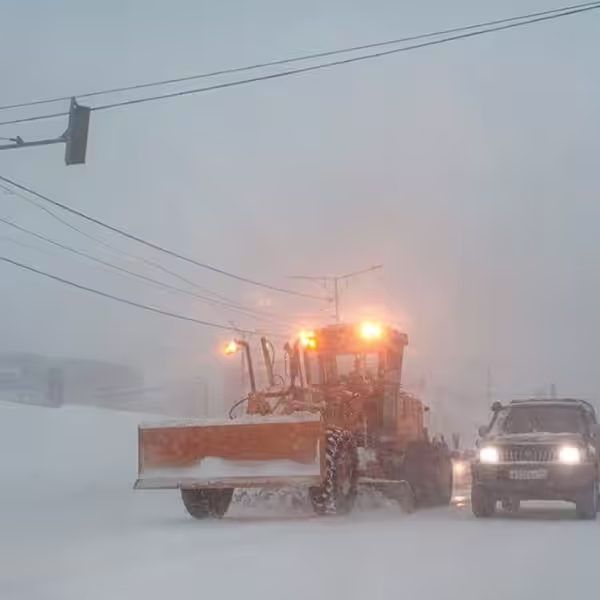
A powerful winter storm swept across the Kamchatka Peninsula overnight on January 13, 2026, delivering nearly 30% of the region’s average monthly precipitation within a single day. Small avalanches were reported in snow-covered neighborhoods, as the storm added to already heavy accumulations from earlier systems. One of those previous storms produced the heaviest snowfall on record in Moscow between January 8 and 9.
The city of Petropavlovsk-Kamchatsky and the town of Vilyuchinsk, located on the southeastern edge of the peninsula, were among the hardest hit. According to the Emergency Situations Ministry, 39 mm (1.5 inches) of precipitation fell in less than 24 hours between January 12 and 13.
Overall, Kamchatka received about 30% of its monthly precipitation total in just 24 hours through January 13, as wind gusts reached speeds of up to 180 km/h (112 mph). In some locations, snow reportedly piled as high as second-story windows or higher.
Blizzard conditions and extremely hazardous roads followed, forcing residents and traffic police to work together to free vehicles stuck or sliding on snow-covered streets.
The winter of 2025–2026 has been unusually snowy in Kamchatka, with at least five major storms striking the peninsula since mid-November. In southern Kamchatka alone, more than 300% of the average monthly precipitation was recorded during December.
Kamchatgidromet reported that the heavy snowfall on January 13 was caused by a storm system that moved in from the Sea of Okhotsk.
Farther west, the region around Vladivostok continued to struggle with the effects of what forecasters described as the heaviest snowfall in 11 years, marking a third consecutive day of disruptions, according to TASS.
For two straight days, Vladivostok has been paralyzed by severe traffic congestion, with 10-point traffic jams reported during both morning and evening rush hours. Snow-clearing equipment and crews have been working nonstop, and Mayor Konstantin Shestakov said it could take up to five days to fully clear the city’s roads and sidewalks.
City officials announced school closures through the end of the week, effectively extending the New Year holidays for students. Regular buses have been unable to operate on many routes, prompting authorities to deploy high-clearance off-road trucks to transport residents along major streets.
Governor Vladimir Solodov said that despite significant strain on the power grid, authorities were able to maintain heating and electricity service in most areas.
These developments follow one of the most severe snowstorms on record in Moscow, which struck on January 9. Between January 8 and 9, the capital received about 42% of its average monthly precipitation. Russia’s Hydrometeorological Center said the snowfall ranked among the five heaviest recorded in Moscow’s 146-year weather history.
“Moscow’s main weather station at the Exhibition Centre of the National Economy recorded 22 mm (0.8 inches) of precipitation in a single day, equivalent to 42% of the monthly norm. Overnight, snowfall eased, with an additional 2 mm (0.08 inches) recorded by morning,” said Tishkovets, as reported by The Business Standard.
The snowfall added to weeks of prior storms since November 2025, pushing snow depth in Moscow beyond 65 cm (26 inches) by January 9.
Moscow’s Sheremetyevo International Airport reported clearing more than 1 million cubic meters (35 million cubic feet) of snow in the past 24 hours. Russia’s Ministry of Transport said 78 flights at the capital’s four major airports were delayed by more than two hours, while 35 flights were canceled.
Moscow Railway also reported removing approximately 70,000 cubic meters (24 million cubic feet) of snow from railway infrastructure over the same period.





Leave a Reply