

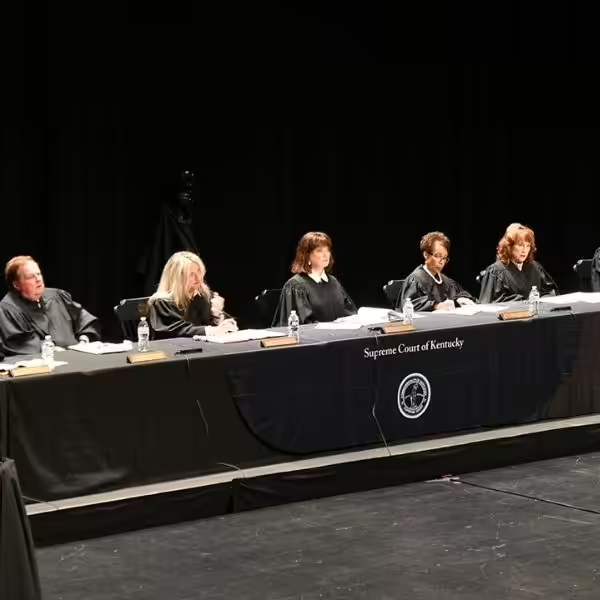
The Kentucky Supreme Court has reversed a previous decision and ruled unconstitutional a law that would have applied only to Jefferson County Public Schools, marking a major shift nearly a year after the court initially upheld the measure.
In a 4–3 decision issued Thursday morning, the court struck down a 2022 law that targeted JCPS through narrowly defined criteria. The legislation, passed by the Republican-controlled General Assembly, would have transferred authority from the district’s elected school board to the appointed superintendent.
The case was reheard after the court agreed in April to reconsider its earlier ruling at the request of the Jefferson County Board of Education. Oral arguments took place in August after the court’s composition changed earlier this year.
Majority: Law violates Kentucky Constitution
Writing for the majority, Justice Angela McCormick Bisig said the court was not declaring that lawmakers can never pass legislation affecting only one type of county or government structure, but that such laws must be reasonable under the state Constitution. She was joined by Justices Michelle Keller, Kelly Thompson, and Pamela Goodwine.
Bisig emphasized that the ruling was not a judgment on legislative policy, but rather a constitutional analysis.
“Our limited duty is solely to consider whether the statute complies with or violates the Kentucky Constitution,” she wrote, concluding that the law failed that test.
She added that while the court respects the General Assembly’s authority and presumes laws are constitutional, it also has a responsibility to protect citizens’ rights under the Constitution.
Bisig also addressed criticism surrounding the rehearing, acknowledging that some might argue the outcome resulted from a change in the court’s makeup. However, she said the case raised issues of statewide importance, including unequal treatment of school districts and superintendents across Kentucky.
Dissent criticizes rehearing decision
In a dissenting opinion, Justice Shea Nickell strongly criticized the court’s decision to rehear the case, arguing that the original ruling followed proper legal standards. Chief Justice Debra Lambert and Deputy Chief Justice Robert Conley joined the dissent.
Nickell accused the majority of engaging in result-oriented decision-making and warned that the move could undermine confidence in judicial stability. He wrote that judges should interpret laws, not respond to political pressure or election outcomes.
Reactions from officials and lawmakers
JCPS school board chair Corrie Shull welcomed the ruling, saying it ensures Jefferson County voters and taxpayers retain the same local control as residents in other districts.
“We look forward to working collaboratively with the legislature and all stakeholders to focus on policy solutions that work, so that all Kentucky schoolchildren will benefit,” Shull said.
Republican Attorney General Russell Coleman criticized the decision, calling it “stunning” and arguing that it leaves JCPS students in a struggling system. House Speaker David Osborne echoed those concerns, saying the ruling raises serious questions about judicial independence and public trust.
The decision also drew renewed attention to Justice Goodwine, who joined the court this year after winning election in November 2024 with support from Democratic Gov. Andy Beshear and a political action committee. Republican officials have questioned her participation in the case, including a failed effort to seek her impeachment for not recusing herself.
Law officially struck down
With Thursday’s ruling, the 2022 law is no longer valid, restoring full authority to the elected Jefferson County Board of Education and preventing the legislature from enforcing the statute as written. The decision reinforces constitutional limits on special legislation targeting a single locality, while setting the stage for continued political and legal debate over the future of JCPS governance.
This article has been carefully fact-checked by our editorial team to ensure accuracy and eliminate any misleading information. We are committed to maintaining the highest standards of integrity in our content.












Leave a Reply