

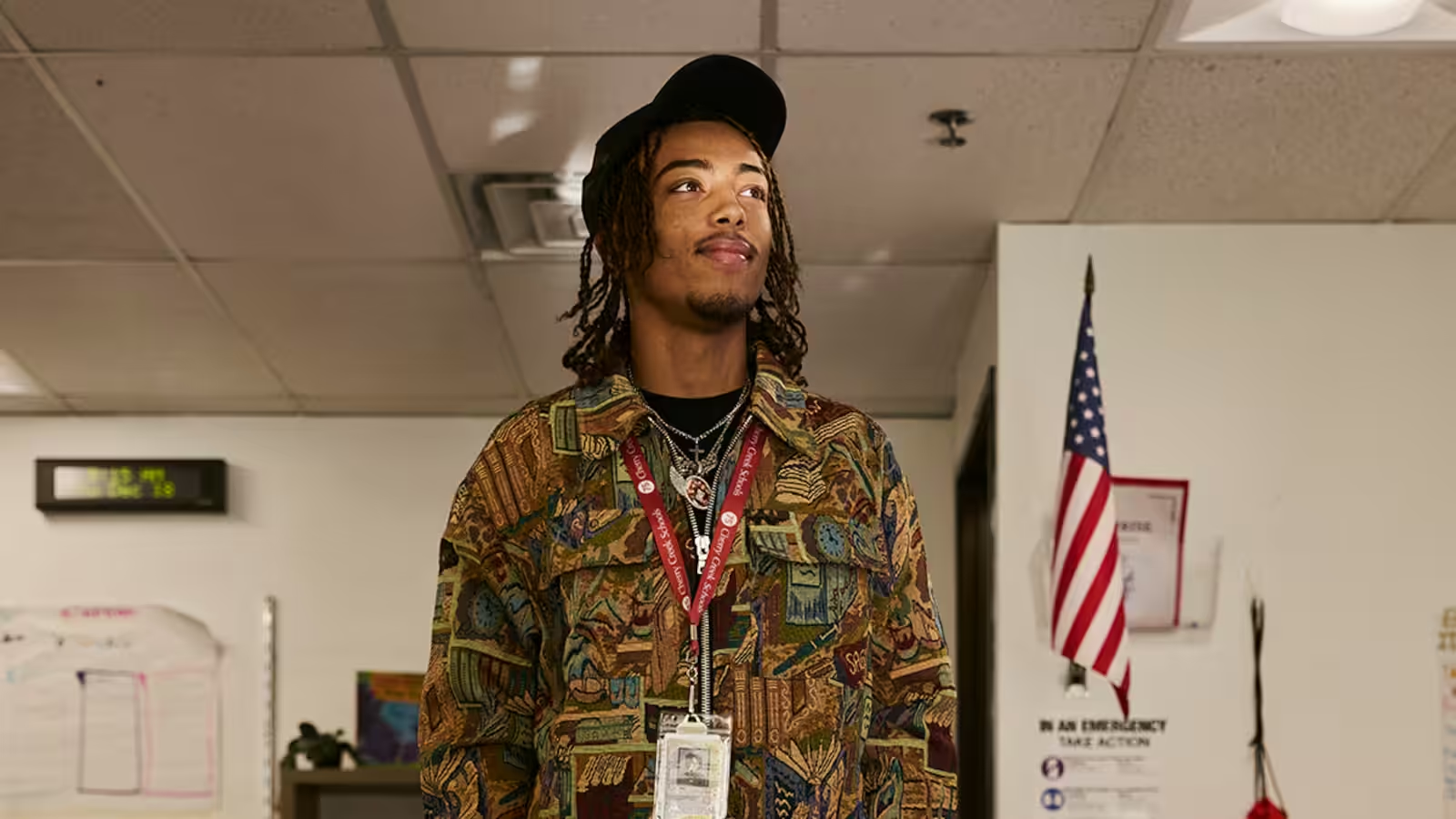
Treyvon Greenwood had a clear plan after graduation: enter the trades. The Aurora senior at Smoky Hill High School had his sights set on becoming a heating, ventilation, and air conditioning technician.
Then his English teacher overheard him talking about how much he loved tutoring classmates. That teacher passed the word to his school counselor, who nudged Greenwood toward a teaching apprenticeship instead.
He was skeptical at first. But now, the 18-year-old has grown to love dividing his time between his classes at Smoky Hill High and an apprenticeship in a fifth grade classroom at nearby Sunrise Elementary School. He works much like a student teacher and earns more than $18 an hour.
“I help them with their writing, and I just feel like they trust me,” Greenwood said of the fifth graders. “I think they know that if I’m struggling with something, I can come straight to Mr. Trey.”
Greenwood’s journey is exactly what state and business leaders had in mind when they launched the CareerWise Colorado youth apprenticeship program in 2016. But it’s also the exception. Only 1,200 students statewide have participated in CareerWise programs — far short of the 20,000 its founder had envisioned for the program’s first decade.
The organization also claims credit for roughly 2,000 additional apprentices who joined programs that CareerWise originally started or inspired. Even counting those students, the program still fell short by about 16,800 apprentices.
The reasons are many: some businesses discovered they weren’t equipped to work with teenagers and walked away. School officials across the state say they’ve had a hard time persuading families to see the value in apprenticeships, which ask students to commit two to three years to juggling school and work. On top of that, apprenticeships face stiff competition from a growing range of other options — college prep, internships, and less demanding career education programs among them.
Noel Ginsburg, the Colorado businessman who founded CareerWise, described his original participation targets as “well-intentioned and ill-informed.”
A decade in, CareerWise stands as a telling case study in how difficult it is to deliver meaningful on-the-job training at scale for high school students — an idea that enjoys broad bipartisan support and growing investment from both the public and private sectors, yet remains hard to execute at size.
Backed by $9.5 million from JP Morgan Chase and Bloomberg Philanthropies, Ginsburg imagined training students across fields like healthcare, banking, finance, and the trades. (Bloomberg Philanthropies is a supporter of Chalkbeat.)
Juniors and seniors would leave high school with their diploma, job training, and valuable industry certifications — or time credited toward a two-year college degree. A post-graduation year would add more work experience, with the option to enroll in college. The program aimed to build a skilled workforce in Colorado while giving some students a less costly path than a two- or four-year degree. Others, like Greenwood, might discover an unexpected career interest — one that could still lead them to college, just by a different route.
The idea behind CareerWise originated in Switzerland, where youth apprenticeships are woven into the national fabric. Roughly two out of every three young people participate, and businesses actively compete to recruit students across nearly 250 different occupations.
Ginsburg traveled to Switzerland in 2015 to observe the model firsthand. At the time, he ran Intertech Plastics, a Denver-based plastics manufacturer he had founded, and he was struggling to hire skilled mid-level workers.
So impressed was Ginsburg by what he witnessed that the following year he led a delegation of 50 Colorado business and civic leaders — including then-Gov. John Hickenlooper — on the same journey. That trip laid the groundwork for CareerWise.
Youth apprenticeships weren’t new to the United States; Wisconsin had pioneered its own program back in 1991. But by the end of the trip, Hickenlooper said Ginsburg’s dedication and vision had convinced him that Colorado could lead the way.
“If we do this properly, in three years there should be as deep a foundation and rooting of this that it will have its own natural momentum,” Hickenlooper said in a video documenting the trip.
Ginsburg didn’t want CareerWise Colorado, the nonprofit he ultimately created, to run the programs itself. Instead, he wanted it to connect schools and employers with the expertise needed to build and sustain two- to three-year apprenticeship programs — and to help them earn the federal recognition that signals program quality but is notoriously difficult to obtain.
Students in four school districts — Denver Public Schools, Cherry Creek School District, Jeffco Public Schools, and Mesa County Valley School District 51 — began apprenticing in 2017.
Today, only three of those four districts remain involved with CareerWise, and results differ widely. District 51 still offers youth apprenticeship programs through a local chamber partnership, though without CareerWise’s support for the past two years. About 65 apprentices have completed Jeffco’s program. Denver has put 272 students through apprenticeships but is currently reworking its agreement with CareerWise.
Cherry Creek runs some of the most robust CareerWise offerings, spanning information technology, advanced manufacturing, hospitality, and teaching.
Even so, drawing students into apprenticeships is a challenge — even for a district as accomplished as Cherry Creek, school counselors say.
“I do think that parents sometimes have reservations, just because they’ve grown up in this: They should go to college,” said Cady Hobbs, a counseling coordinator at Grandview High School.
Some apprenticeships do lead to college, as is the case for Greenwood, who plans to attend Metropolitan State University of Denver and enter a program for Black educators. But that kind of pathway isn’t always easy for parents to recognize.
At the same time, districts like Denver and Cherry Creek offer such a wide array of career-related opportunities — from exploratory classes to summer internships — that they end up competing with their own apprenticeship programs.
“This landscape is a lot broader than I think anyone may have realized in 2016 or 2017,” said Theress Pidick, the Denver district’s youth career development director.
Another significant obstacle to growth has been the constant turnover among businesses willing and able to host and train a high schooler.
At an April roundtable, Ginsburg said keeping businesses engaged has been one of CareerWise’s steepest challenges.
“What we don’t have are the companies that see this as not just an imperative to do the right thing for their community but how important this is to their bottom line,” he said.
CareerWise launched with roughly 45 employers. By the second year, about 25 came back. Employer numbers have risen and fallen ever since, with 29 currently working with apprentices. The reasons for dropping out vary widely.
Some, like Mikron Denver, now run their own programs independently from CareerWise.
Eagle County Paramedic Services tried CareerWise for a year before discovering that students needed certain certifications only available to those 18 and older. Insurance requirements also barred student ambulance drivers.
“I think we really did go into it with the best intentions, but there’s no way to know everything it’s going to take,” said Katie Coakley, the organization’s marketing and communications specialist.
John Halloran, a regional manager with construction firm RA Nelson, said his Eagle County company genuinely valued having an apprentice. The student put in full-time hours over the summer, but once the school year began, balancing coursework with the unpredictable rhythms of construction proved too difficult to manage.
“The hours and the pace didn’t really align,” Halloran said. “But I’d love to try it again and see if we can make it work.”
Vinz Koller, vice president of the Center for Apprenticeship and Work-Based Learning at Jobs for the Future — a nonprofit focused on expanding economic opportunity — agrees that too few businesses recognize the value, unlike their counterparts in Switzerland.
“The chicken and egg challenge we have is until you have enough opportunities, it’s going to be very hard for the youth and for parents to feel like this is an option,” Koller said.
Some communities have found a way through. In Eagle County, which has been part of the program since 2017, the commitment of a single employee — a former teacher who coordinates business participation through the local chamber of commerce — has moved the needle. CareerWise Eagle County and the school district have also trimmed the program from three years to two, so students no longer have to choose between an apprenticeship and college.
Warren Barker, a supply chain logistics manager at Vail Health Hospital, views his company’s involvement in CareerWise as an investment in Eagle County itself. Vail Health has taken on 27 apprentices to date, though not every student finishes the program.
“The best thing I get to do in my job, by far, is seeing the caliber of students who go through the program,” he said. “And then being able to help get them focused into whatever is next for them, be it with Vail Health, hopefully, or anything else that they want to do.”
Facing these ongoing challenges — and responding to rising demand for workforce training — CareerWise has shifted its approach.
Rather than focusing exclusively on 16- to 18-year-olds, CareerWise now offers pre-apprenticeships that prepare younger students for the full program. It has also begun expanding post-high school apprenticeships for young adults up to age 24, mirroring the Swiss model, Ginsburg said.
One example is a partnership with CoorsTek, a Golden-based manufacturing company that produces ceramic components used in computers, military armor, wind turbines, and more. With CareerWise’s support and a $4.58 million state grant, CoorsTek is using its in-house CoorsTek Academy — launched in 2021 as a regional training hub — to train apprentices between the ages of 18 and 24. The first cohort of five began last year, learning the skills needed to become mid-level Computer Numerical Control, or CNC, operators.
Graduates will leave equipped to troubleshoot complex problems, repair machinery, and handle programming — capabilities that translate directly into higher pay.
Andrew Sutliff, a 19-year-old CoorsTek apprentice who graduated from Cherry Creek’s school district last year, says the pace of learning has been intense.
“It feels like they’re cramming a lot that some people who have been here for four years don’t even begin to learn,” he said.
Even if CoorsTek doesn’t bring him on full time, Sutliff sees the experience as a way to make himself more attractive to other employers.
CareerWise has also moved away from trying to build one large program in Colorado, instead seeding smaller programs across other states. Ginsburg has helped establish apprenticeship programs in New York and Elkhart County, Indiana, with more locations expected to follow.
A $12.5 million federal grant funded the launch of the Future Ready Apprenticeship Center in 2025. The center distributes $200,000 grants to help other states apply lessons learned in Colorado and elsewhere, covering program design, policy guidance, and funding strategies.
Beyond government support, CareerWise is drawing more philanthropic backing than at any point in its history, including a $7 million contribution from MacKenzie Scott’s YieldGiving foundation in 2023.
Despite falling short of his original participation targets, Ginsburg has not lost faith in the broader potential of youth apprenticeships across Colorado. He believes the decade ahead will bring not just hard-earned lessons, but real opportunities to expand the programs.
His timeline, however, has shifted.
“We have a long way to go,” he said.












Leave a Reply