

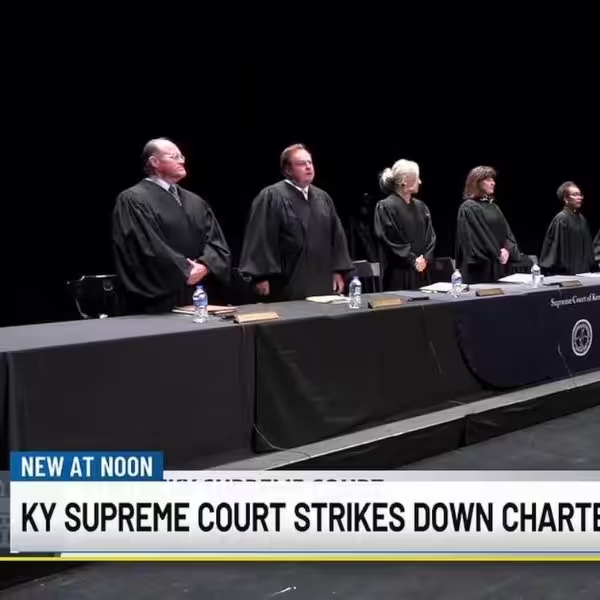
The Kentucky Supreme Court heard arguments in a case with potentially broad implications for public access to internal government communications stored on private devices. (Administrative Office of the Courts / KPR)
The Kentucky Supreme Court issued a unanimous ruling Thursday declaring that a 2022 law permitting public funds to support charter schools violates the state constitution.
“The Constitution as it stands is clear that it does not permit funneling public education funds outside the common public school system,” Justice Michelle Keller wrote in an opinion joined by the full court.
The case centered on a 2022 bill passed by the Kentucky General Assembly that established a funding structure for charter schools.
The Council for Better Education, representing a coalition of school districts, along with the Kentucky Board of Education, filed suit arguing that charter schools differ fundamentally from traditional public schools and that the constitution bars funding outside the system of “common schools.”
A lower court struck down the law in 2023 on those grounds. The Kentucky Office of the Attorney General appealed, contending that charter schools remain part of the public education system even though independent boards manage them.
In her opinion, Keller sided with the plaintiffs, ruling that the law violated three separate constitutional provisions related to common schools. She also noted that voters have the authority to change the constitution if they choose.
“Section 184 of the Kentucky Constitution provides an avenue for funding charter schools should a majority of voters be convinced that charter schools are for the betterment of efficient, effective education for all Kentuckians,” Keller wrote.
As referenced in the opinion, Kentucky voters rejected a proposed constitutional amendment in 2024 that would have allowed public funds to flow outside the common school system to private education.
“By a sweeping state-wide rejection in all 120 counties, Kentucky voters steeled the constitutional backbone of educational funding as strictly reserved for the common-school system,” Keller wrote. “The result fortified that Sections 184 and 186 made clear the charter debate is a constitutional one, not merely legislative: education funding requires either classification inside the common school system or voter consent.”
Chief Justice Debra Lambert, in a separate concurring opinion, emphasized that “if our common and public educational system is going to be altered in the way directed by these statutes, that alteration must come in the form of a constitutional amendment” approved by voters.
Attorney General Russell Coleman responded to the decision, stating that it “to limit educational choices marks a sad day for Kentucky’s children.”
“The General Assembly has repeatedly passed bold initiatives to help our kids succeed,” Coleman said. “But once again, Kentucky is on the outside looking as families in 45 other states get the very real benefits of charter schools.”
Reaction from Kentucky Officials and Advocates
Republican House Speaker David Osborne of Prospect criticized the ruling, saying the courts had “once again” overstepped the authority of the Republican-led legislature and protected the existing system instead of allowing lawmakers to pursue reforms.
“The measure of success in education should not be whether we have preserved institutions and bureaucracies, but whether a child can read at grade level, graduate prepared, and pursue a meaningful future,” Osborne said. “This ruling hits hardest on low-income families in communities like Louisville, condemning children who already face significant barriers to remain in underperforming schools that quite simply fail to educate them.”
The National Alliance for Public Charter Schools described the unanimous ruling as “the most poorly reasoned legal opinion in the 35 years of the charter school movement.” In contrast, the Kentucky Education Association, the statewide labor union representing public K-12 teachers, said the decision confirms that both voters and the courts have settled the issue and urged lawmakers to “focus on investing in our public schools.”
Democratic Gov. Andy Beshear, who vetoed the legislation in 2022 before lawmakers overrode his veto, praised the outcome.
“Taxpayer dollars should stay with our already underfunded public schools, and now they will. This is a win for our kids and our future,” Beshear said.









Leave a Reply