

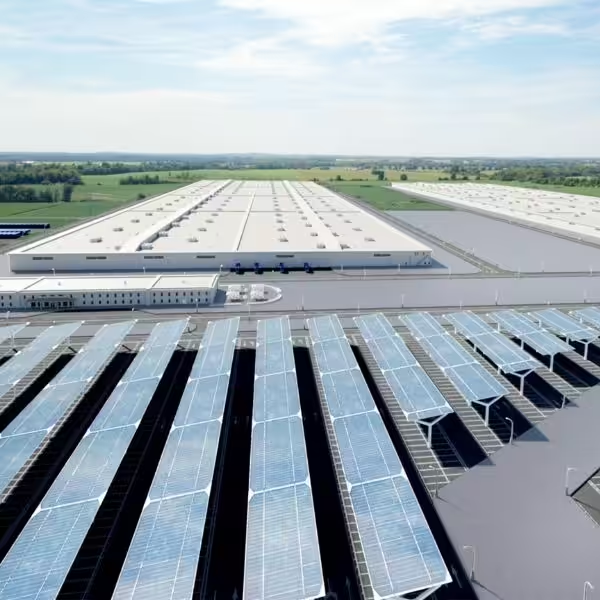
Ford Motor Company is ending its battery plant partnership in Kentucky and taking full ownership of two facilities it once promoted as major job creators, a move that has sparked sharp backlash from workers now facing layoffs and uncertainty. On Dec. 9, 2025, the automaker signed a Joint Venture Disposition Agreement with SK On, SK Battery America, and BlueOval SK to take control of the Glendale, Kentucky, plants, while also announcing plans to redirect the facilities toward a different product line. For roughly 1,600 employees who built their futures around these roles, the strategic pivot feels like a broken promise.
The Glendale facilities were initially billed as a cornerstone of Ford’s electric-vehicle strategy, set to produce battery cells for a new wave of cars and trucks. Now, the company is dismantling the joint venture structure and repositioning the site for a different segment of the energy transition. The change highlights how quickly corporate strategies can shift in a volatile EV market—and how deeply those shifts affect communities that were encouraged to see themselves as long-term partners in industrial growth.
A $3 Billion Write-Down and a Strategic Reset
Ford disclosed the breakup in a filing with the Securities and Exchange Commission, stating that a subsidiary will acquire the two Kentucky plants from BlueOval SK, with the deal expected to close in the first half of 2026. The filing also outlines anticipated pre-tax charges of approximately $3 billion tied to the BlueOval SK impairment, signaling how far the original investment fell short of expectations. This write-down represents more than accounting; it reflects a significant recalibration of Ford’s large-scale EV battery production strategy in Glendale.
In a related announcement, Ford said it will convert the Glendale operations to manufacture battery energy storage systems (BESS) instead of EV battery cells. The company outlined a $2 billion investment over two years, with plans to begin production within about 18 months and reach at least 20 gigawatt-hours of annual capacity by late 2027. Transitioning from vehicle batteries to grid-scale storage marks a fundamental shift in business focus, likely requiring different technical expertise, supply chains, and potentially a smaller or differently trained workforce than originally envisioned.
Frustration Builds in the Bluegrass State
The reaction in Kentucky has been especially intense because Ford had spent years building expectations around the project. The company also invested heavily in upgrading its Louisville Assembly Plant for EV production, positioning the state as a key player in America’s clean-energy future. State leaders highlighted the battery facilities and assembly upgrades as proof that Kentucky could secure high-wage manufacturing jobs in the evolving energy economy. Many workers relocated to Hardin County, signed leases, purchased homes, and enrolled children in new schools based on assurances of stable, long-term employment.
That optimism has now turned to frustration. Reports indicate that Ford halted work at the battery plant and laid off about 1,600 employees, leaving many residents directing their anger at the company rather than broader EV market challenges or shifting federal policies. For those who uprooted their lives, the disappointment feels personal. They point to recruitment efforts, workforce training programs, and celebratory groundbreakings that framed the plants as generational opportunities. Today, that gap between promise and reality translates into financial strain, depleted savings, and difficult decisions about whether to remain in the region.
Labor Disputes and Federal Scrutiny
Tensions between workers and management were already escalating before the joint venture dissolved. In August 2025, an unfair labor practice complaint was filed with the National Labor Relations Board under case number 09-CA-371773. The complaint alleges that BlueOval SK enforced coercive workplace policies in violation of Section 8(a)(1) of the National Labor Relations Act, which protects employees’ rights to organize and discuss working conditions. The filing suggests that workplace relations were deteriorating even before layoffs began.
Federal law also prohibits retaliation against workers who assert their rights. Guidance from the Equal Employment Opportunity Commission emphasizes that employers cannot take adverse action against employees for engaging in protected activity. Although public records do not indicate a final resolution of the NLRB case, its existence during a period of layoffs has heightened concerns among some workers that those who raised workplace issues could feel particularly vulnerable. Local media outlets have covered the fallout, amplifying voices from laid-off employees and community leaders questioning whether labor protections sufficiently safeguard workers amid high-profile industrial investments.
Energy Storage Ambitions vs. Job Stability
Ford has framed the Glendale transition as a forward-looking move aligned with long-term energy trends. In regulatory filings, the company highlights battery energy storage systems as a rapidly expanding market, critical for grid reliability, renewable integration, and backup power during extreme weather events. From a corporate standpoint, shifting to BESS may represent a strategic response to fluctuating EV demand, narrow profit margins, and fierce competition in automotive batteries. Selling storage systems to utilities and grid operators could diversify revenue streams and tap into federal and private investments aimed at grid modernization.
For the community, however, the equation looks different. Even if the retooled plants eventually generate new positions, the timing, job volume, compensation, and required skill sets remain unclear. BESS manufacturing could rely more heavily on automation or specialized technical roles, potentially limiting opportunities for former line workers. Many laid-off employees cannot afford to wait years for operations to scale up, nor can they easily pursue retraining without financial security or clear hiring commitments. As a result, promises of future high-tech employment offer little relief to households grappling with immediate economic hardship.
Kentucky’s Energy Transition at a Crossroads
The developments in Glendale raise broader questions about how Kentucky manages the risks tied to large-scale clean-energy investments. State officials attracted Ford and its partners with expectations of long-term industrial revitalization, but the rapid pivot underscores how dependent regional economies can become on corporate strategies beyond their control. As Ford reshapes its Kentucky operations, policymakers may face growing pressure to attach stronger job guarantees, retraining provisions, or clawback clauses to future incentive packages to ensure public investments yield lasting community benefits.
For workers, the road ahead remains uncertain. Some may find new roles within the evolving BESS operations or in other manufacturing sectors drawn to Kentucky’s infrastructure and labor force. Others may seek opportunities elsewhere, carrying their skills beyond state lines. Ford’s shift in Glendale will likely influence how communities approach future clean-energy projects, balancing optimism about technological progress with lessons learned about economic vulnerability. As the energy transition accelerates, the experience in Hardin County serves as a reminder that corporate reinvention can impose heavy costs when the workforce at the center of the transformation feels left behind.












Leave a Reply