

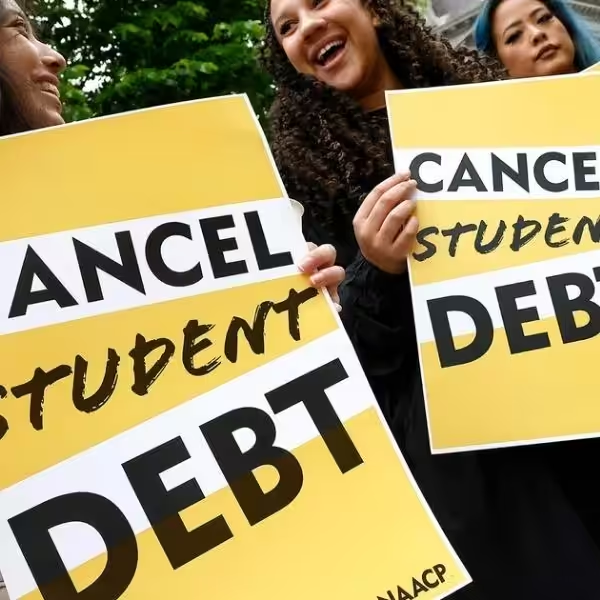
The federal student loan system has long balanced rigid bureaucracy with life-changing relief. That tension surfaced again when a missed internal deadline at the Department of Education accidentally triggered full loan cancellation for thousands of borrowers who had waited years for decisions. What appeared to be a clerical error instead revealed a deeper story of mismanagement, legal pressure, and rising political stakes around student debt.
The unexpected discharges stemmed from a court-enforced timeline the Department of Education failed to meet, turning administrative delay into mandatory forgiveness. For borrowers stuck in limbo, the outcome felt less like a bonus and more like long-overdue accountability, highlighting how fragile the system remains for those still waiting.
How a missed deadline turned into real money
The immediate cause of the surprise relief was a court order tied to the Sweet borrower defense case, which imposed a firm deadline for resolving certain claims. In January, the court ruled that if the Department of Education failed to act on specific borrower defense applications by the cutoff date, the loans would be automatically discharged. When the deadline passed without action, the legal trigger took effect, and thousands of borrowers saw their balances erased.
Advocates had cautioned for months that the agency was moving too slowly, and events confirmed those warnings. Updates showed that the Department of Education missed the court-ordered deadline for a group of post-class applicants from Exhibit C schools, setting off automatic relief. Other coverage described the situation as a “deadline slip-up,” underscoring how a single administrative failure can lead to billions of dollars in real-world consequences.
A pattern of costly errors inside the Department of Education
This was not the first high-stakes stumble within the federal student loan system. A Government Accountability Office review found that the Education Department had miscalculated the long-term costs of income-driven repayment plans, resulting in what critics described as a $311 billion budget mistake. The review concluded that the department had consistently underestimated how much borrowers would repay, leaving taxpayers responsible for far more than projected.
Lawmakers later echoed those concerns, calling the same $311 billion budget blunder evidence that the agency failed to track how repayment behavior and economic changes were reshaping the loan portfolio. When an institution can misstate its finances by hundreds of billions, missing a court deadline and unintentionally canceling debts becomes less surprising.
Relief for borrowers from predatory schools
Even before the Sweet case, the Department of Education had begun addressing harm caused by predatory colleges. In a major action, officials announced the cancellation of $5.8 billion in federal loans for former Corinthian Colleges students, after determining the chain had misled borrowers about job placement rates and earnings. That decision erased balances for students promised incomes they never achieved and showed how widespread misconduct could justify broad relief.
Similar steps followed for other for-profit institutions. The department later discharged loans for former ITT Technical Institute students, canceling debt for 208,000 borrowers who were misled by the school’s programs. Around the same time, the Biden administration approved another $5.8 billion in relief for students of a fraudulent college, with Education Secretary Miguel Cardona describing the move as a correction for years of deception. These actions helped establish the framework that ultimately shaped the Sweet settlement.
Borrower defense, Sweet v. Cardona, and automatic cancellations
The legal foundation for the recent accidental relief lies in borrower defense, which allows students to seek loan cancellation when schools break the law. The Sweet v. Cardona class action covers 290,000 borrowers who submitted borrower defense claims under penalty of perjury and then waited years for responses. The $6 billion settlement required the Department of Education to issue timely decisions and imposed strict deadlines the agency is now struggling to meet.
As those deadlines approached, advocates warned that hundreds of borrowers could receive automatic cancellations if the department failed to act. Reports noted that hundreds of thousands of borrowers were on track for full discharge within days due to a key settlement deadline. Guidance circulated widely stating that if the Department of Education did not rule on applications by January 28, 2026, borrowers would qualify for full relief. When the agency missed one of those deadlines, the resulting cancellations were not optional but a court-mandated outcome.
Human error, mixed messages, and the risk of reversal
For borrowers, the most unsettling issue is uncertainty over which notices can be trusted. Earlier in the Biden administration, about 9 million Americans mistakenly received emails saying their student debt forgiveness had been approved, only to later learn the messages were sent in error. Reports described how borrowers received conflicting updates due to what officials called human error.
The Department of Education later issued follow-up messages to clarify the situation, noting that millions had applied for forgiveness before the program was halted by a federal court. With roughly 26 million applications submitted, many borrowers were left waiting for guidance after the program stalled. The pattern remains consistent: even when relief is legitimate, communication surrounding student debt forgiveness is often confusing and unreliable.









Leave a Reply