

Under a bill advancing in the Kentucky Senate, parents convicted of certain nonviolent felonies could avoid prison if judges determine it would be better for them to remain in the community on probation while continuing to care for their dependent children.
The Senate Judiciary Committee voted 6-1 on Thursday to approve Senate Bill 122 from Sen. Julie Raque Adams, R-Louisville, sending it to the full Senate for consideration.
The proposal, known as the Family Preservation and Accountability Act, would allow alternative sentencing if defendants request it and judges agree.
Before sentencing, judges would review a family-impact statement explaining how the defendant serves as a caretaker for children and how probation, along with services such as addiction treatment, counseling, parenting classes, and financial and literacy training, could be beneficial.
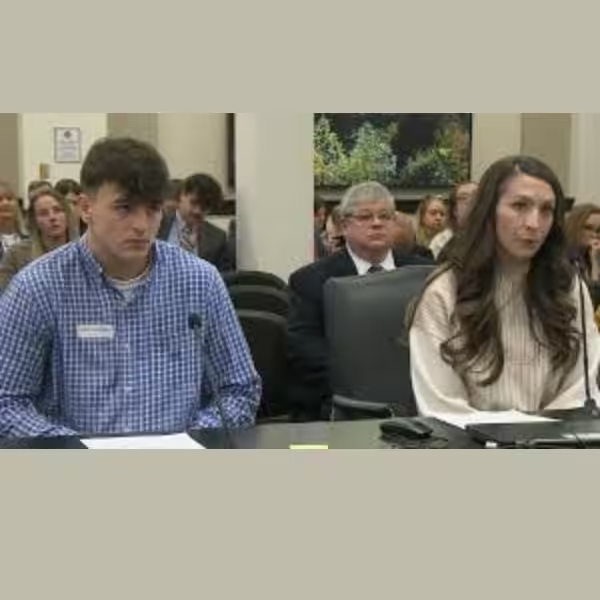
Testifying before the committee, Brittany Herrington of Greenup County said incarceration for drug-related crimes caused her to miss much of her young son Gavin’s childhood. She said she repeatedly asked to be placed in residential addiction treatment so she could remain present for her son, but those requests were denied.
“Every single time I entered a courtroom, I begged a judge for intervention,” Herrington told lawmakers. “The words from the judge were, ‘You should have thought about your child prior to committing your crime.’ And while that’s true, I was very sick.”
Herrington said she will mark 16 years of recovery in March and now works as a peer program coordinator supporting other mothers in addiction recovery.
“The years of destruction — the years of generational damage that incarceration causes to families — is worth a few minutes of consideration inside of a courtroom,” she said.
Her son Gavin, now 19, also testified, recalling how he kissed his mother’s photograph every night while living with his grandmother because she was in jail.
“My mom wasn’t a bad mom. She was sick,” he said. “And the punishment she received didn’t just sentence her, it sentenced me, too.”
State Rep. Nick Wilson, R-Williamsburg, also spoke in support of the bill, saying he introduced similar legislation last year after witnessing families devastated by opioid addiction in Eastern Kentucky. His House bill passed unanimously but stalled in the Senate Families and Children Committee.
“I’m a kid of the ’90s,” Wilson said.
“In the ’90s and 2000s, Oxycontin prescriptions were out of control,” he said. “And to put it bluntly, it destroyed our society — the familial structure which is the backbone of our society. So here we are 20, 30 years later, still dealing with the fallout of this opioid epidemic.”
Wilson said many people struggling with addiction are motivated to recover by the desire to be better parents, and the Senate bill builds on that motivation rather than separating families through incarceration.
The bill also drew concerns from some lawmakers. State Sen. Phillip Wheeler, R-Pikeville, who ultimately voted in favor, said he worried the measure could create a two-tier justice system that favors defendants with children.
“Let’s just say hypothetically I’m a drug addict, you’re a drug addict. But you have two kids and I don’t,” Wheeler said.
“You’re going to be eligible for a program that keeps you out of the clink, while myself who — perhaps arguably — is more responsible because I’ve not brought a bunch of people into the world who might be on social services and everything else,” he said. “I gotta go to jail, but you don’t.”
Wilson pushed back on that concern, noting that judges already consider family circumstances during sentencing. He also said the bill would not provide leniency simply for having children, as it requires proof that defendants have taken responsibility for their children’s housing, health, education, and safety.
Two circuit judges who testified echoed that point, saying they already factor childcare responsibilities into sentencing decisions. They argued the bill could add unnecessary hearings, paperwork, and prosecutorial involvement.
Campbell Circuit Judge Julie Reinhardt Ward also raised concerns about funding for the treatment and counseling programs required under probation.
“If the idea of the bill is that we would be able to provide some sort of counseling, or we would be able to have parenting classes, and you all would fund that, I’m in,” Ward told the committee. “We’re all in. We would love to have those kinds of services available to us.”
“But we don’t have those services readily available in all of our communities, and if they are available, they’re not free,” she said. “Defendants have to pay for that.”










Leave a Reply