

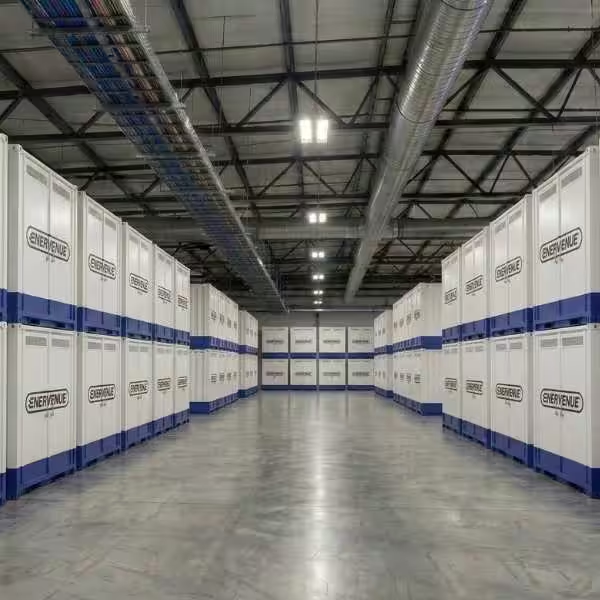
Battery startup EnerVenue is making an unconventional move. After scrapping plans to build a U.S. factory in Kentucky, the company has secured $300 million in new funding and is moving forward with a manufacturing strategy centered in China—going against the broader trend of expanding domestic battery production.
EnerVenue aims to commercialize a version of the pressurized nickel-hydrogen energy storage system originally used by NASA on the International Space Station and the Hubble Space Telescope. While the original technology was too expensive for widespread use, the company says it replaced the platinum catalyst with a more affordable material. It claims its batteries can last up to 30,000 cycles with minimal degradation and offer improved fire safety compared to lithium-ion batteries.
The Silicon Valley-based firm previously raised $12 million in seed funding in 2020 and $100 million in a Series A round in 2021 from investors including Saudi Aramco Energy Ventures and Schlumberger New Energy. In 2023, EnerVenue announced plans to invest $264 million in a Kentucky factory, targeting production by the end of that year.
However, the company abandoned those plans in 2024. Instead, it will use the newly announced funding—an extension of a $308 million Series B round—to build a factory in Changzhou, China, which it describes as a global hub for battery manufacturing. EnerVenue also plans to expand operations across Asia, the Middle East, and Europe.
“We see ourselves still as an American company,” said CEO Henning Rath, who took over in March. “We’re going to become a global player.”
Rath said the company realized during early work on the Kentucky site that its second-generation battery design was not ready for large-scale production. Building a first-of-its-kind facility there would have required significant capital.
After stepping back, EnerVenue spent nearly two more years refining its technology, reaching a fourth-generation design. It then chose China for its initial scale-up to take advantage of the country’s established battery manufacturing ecosystem.
The company has already launched a small research and development production line in Changzhou and plans to complete a 250-megawatt-hour annual production line by early fourth quarter this year. It aims to expand capacity to 1 gigawatt-hour by 2027, which Rath said would enable competitive costs and allow replication in other markets.
“We have to showcase scale first, in a very capital-efficient way,” Rath said. “That is the reason why we chose China to build the first scale-up.”
The decision comes with challenges. U.S. policies encourage domestic battery production through tax incentives and restrictions on foreign supply chains, particularly involving China. EnerVenue’s shift raises questions about whether its China-made batteries will qualify for those incentives, especially after receiving investment from Hong Kong-based entities.
Rath said the company expects clarity on tax credit eligibility within a couple of months.
Beyond policy concerns, EnerVenue must also convince customers to adopt a relatively unknown battery chemistry. Unlike many competitors promoting long-duration storage of up to 100 hours, EnerVenue focuses on durability. Its system can reportedly discharge multiple times daily for decades, operate across extreme temperatures, and maintain performance without significant degradation.
This capability could appeal to utilities in harsh environments or industries prioritizing safety. However, the high upfront cost means customers would need to use the batteries frequently to justify the investment—requiring a different business model than current lithium-ion systems.
After proving it can manufacture at scale, EnerVenue will need to demonstrate that customers are willing to adopt and pay for its technology.












Leave a Reply