

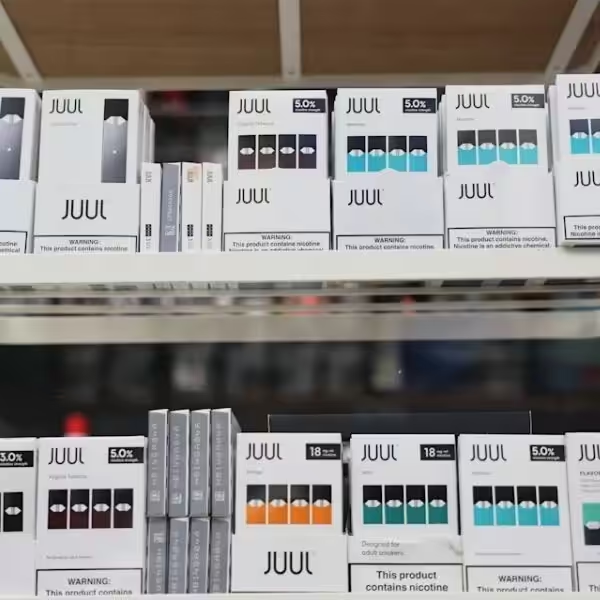
Tobacco and e-cigarette retailers in Louisville could face sting operations if they sell to underage customers.
As part of a new initiative to reduce youth use of vaping and tobacco products, the Louisville Metro Department of Public Health and Wellness is sending investigative aides into stores to check whether clerks verify IDs and refuse sales to minors.
The underage surveillance program, launched in October, is one of several efforts funded through a settlement with e-cigarette company Juul Labs, Inc.
In 2020, Louisville Metro Government filed a federal lawsuit seeking damages over the company’s role in increasing nicotine addiction, particularly among young people. The case was settled in 2023 for $2.8 million. After legal costs, the city received $2.6 million, according to officials. Of that, $1.2 million has been allocated to the health department for prevention and cessation programs, while the remaining funds have yet to be assigned.
“The main focus is obviously to reduce usage of vapes by children in the community, but it’s also to help children who are already vaping to get away from it,” said Patrick Rich, executive administrator for the Department of Public Health and Wellness.
Julia Mack, the department’s tobacco enforcement and licensing supervisor, oversees the program.
Under the initiative, Mack and an investigative aide between the ages of 18 and 20 visit stores multiple times each month to test compliance with laws requiring customers to be at least 21 to purchase tobacco products.
Before entering a store, the aide hands their ID to Mack to prevent any claim that identification was checked. If asked, the aide provides their real age or birthdate.
“Then they will either have a successful sale or not, and then they will come back out to the car, let me know that, yes, they did, no, they didn’t,” Mack said.
If the aide is able to purchase a product, Mack enters the store to begin enforcement action. Violating businesses can receive a $500 citation. Louisville currently has 888 licensed tobacco and e-cigarette retailers.
“I need for them to be on their toes,” Mack said. “You slip up and you don’t card someone, that could be that person and that could be that hefty fine.”
From October through the end of 2025, the department visited 38 locations and issued four citations. In 2026, officials have already visited 20 locations and issued four more citations.
“We’re going to try to get out to everybody and our hopes are that people catch on and say, ‘Hey, I’m not going to sell to children anymore. It costs me more money to sell to a child than I’m going to make off of a child,” Rich said.
Beyond enforcement, officials say the program aims to address a broader public health concern. According to Campaign for Tobacco-Free Kids, citing 2024 data from the Food and Drug Administration and Centers for Disease Control and Prevention, 19.7% of Kentucky high school students use e-cigarettes, while 5.3% smoke traditional cigarettes.
“We are concerned about somebody developing a lifelong addiction that’s going to affect their health for years to come,” Rich said.
Louisville’s lawsuit accused Juul of contributing to a “public health crisis” through its products and marketing. While the company did not admit fault as part of the settlement, the funding is supporting enforcement and prevention efforts.
Additional initiatives include developing technology platforms to improve transparency and efficiency, such as an online dashboard tracking licensed retailers and their enforcement history, as well as an internal system for reporting violations.
The department also plans to launch a youth-focused prevention marketing campaign in the coming months.
“We have to protect our youth,” Mack said.
Juul rose to prominence in 2016 as a major player in the e-cigarette market. While marketed as a smoking alternative for adults, the company has faced criticism for appealing to younger audiences with flavored products. Youth vaping rates surged in the late 2010s, prompting lawsuits from governments across the country.
Separately, Kentucky reached its own settlement with Juul worth more than $14 million under former Attorney General Daniel Cameron.
Two proposed bills in the 2026 legislative session — Senate Bill 74 and House Bill 187 — aim to create a trust fund to direct those settlement funds toward youth prevention and cessation programs, though neither has advanced as the session nears its end.










Leave a Reply