

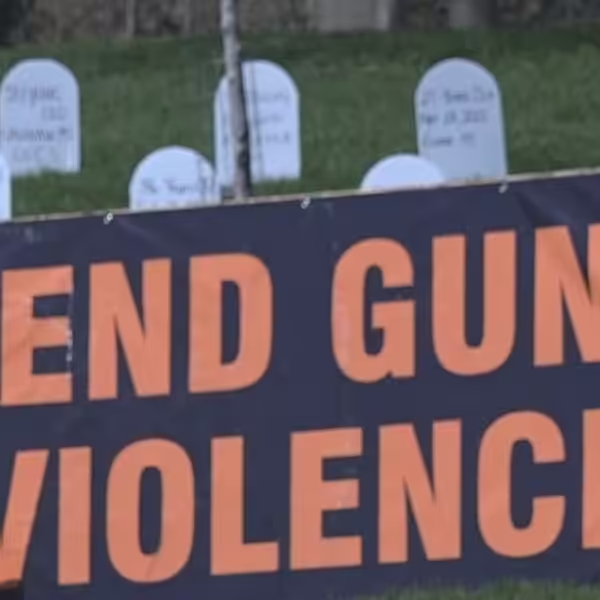
LOUISVILLE, Ky. (WDRB) — Louisville leaders say gangs play a major role in gun violence across the city, and a long-running prevention effort is now adding a powerful new voice to its front-line approach: families who have lost loved ones.
The city’s Group Violence Intervention program, launched in 2021, is bringing mothers of gun violence victims into “custom notifications,” which are in-person visits aimed at preventing future shootings. One of the mothers training for the program is Krista Gwynn, whose 19-year-old son, Christian, was killed in 2019.
“He will never be forgotten. Ever,” Krista Gwynn said.
Photos and their son’s ashes sit on the Gwynn family’s mantel. His parents describe Christian as generous and kind, even to strangers.
“I gave him my everything,” Christian’s father, Navada Gwynn, said. “Christian gave even strangers his all. He literally gave a stranger the shirt off his back,” his parents said.
Christian Gwynn was shot and killed in December 2019 while heading home after picking up food and trying to make his 10 p.m. curfew.
“A car drove past, rolled the windows down, proceeded to shoot my son,” Krista Gwynn said. “He never made it home for his 10:00 curfew.”
The Gwynns said the shooting was random and that their son had no ties to gangs.
“My son was never referenced in any sort of gang violence or anything,” Navada Gwynn said.
The family is among more than 1,000 in Louisville that have lost someone to gun violence over the past decade. The FBI estimates roughly 30 gangs operate in the city.
Joshua Crawford, who leads Louisville’s Group Violence Intervention program, said gang-related violence most often involves young men.
“It’s primarily a young man’s game — 25 and under — and male,” Crawford said.
Crawford said gangs in Louisville range from just a few members to a few dozen and are often divided by neighborhood. One of the program’s key strategies is custom notifications, during which law enforcement, social services, and community partners visit the homes of people police believe are involved in gangs but who have not been charged.
Nonprofit partners offer help leaving violent situations, including therapy, job training, and other support, while police also explain the consequences.
“Involvement in violence needs to stop or there will be swift and severe consequences,” Crawford said.
In 2025, the team conducted 76 custom notifications. Only seven of those individuals later committed a new violent or gun-related offense.
Victims’ families are now being included in those visits. Krista Gwynn said she hopes sharing her story will reach people before another family experiences the same loss.
“What we want to do is show you the face of your potential victim,” she said. “You don’t want that on your soul. You don’t want that on your heart.”
Another part of the program focuses on families facing immediate threats. Taxpayers fund up to $50,000 each year to relocate families considered at risk.
In 2025, four families, representing about 15 people, were relocated out of Louisville. According to the city, none have reoffended.
“I’m not under the illusion we will ever get to zero,” Crawford said. “But we will fight like hell to try to get to zero.”
For families like the Gwynns, each statistic represents a life lost.
“We can help you,” Krista Gwynn said. “Just because you live on 42nd and your neighbor wears blue or red or whatever, you don’t have to affiliate with that.”





Leave a Reply