

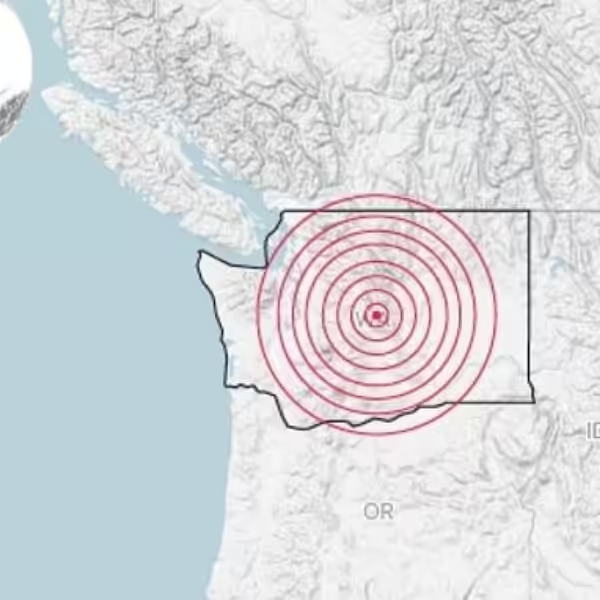
Reports of a massive explosion briefly sparked confusion and concern across Washington state and the Pacific Northwest on Monday morning.
Just before 11:30 a.m. ET, the U.S. Geological Survey (USGS) issued an alert claiming an explosion with the force of a magnitude 3.0 earthquake had occurred near the town of Concrete, roughly 70 miles north of Seattle.
USGS quickly retracted the alert, later clarifying that no explosion had occurred. The agency reclassified the event as a magnitude 2.9 earthquake. Earlier in the morning, at 10:06 a.m., sensors also detected a smaller magnitude 2.6 earthquake in the same area. No damage or injuries were reported from either event.
The second quake struck at a very shallow depth of less than 2,000 feet, increasing the likelihood that nearby residents felt the shaking. Reports indicate the tremors were limited to areas close to the epicenter and were not felt in Seattle.
Authorities confirmed there were no reports of any explosion near Concrete, dispelling fears triggered by the initial alert.
Small earthquakes are relatively common in Washington, which sits near the Cascadia Subduction Zone (CSZ), a nearly 700-mile fault line off the West Coast where the Juan de Fuca Plate is sliding beneath the North American Plate.
When USGS detects an explosion, it typically indicates a man-made blast, such as mining or quarry activity. For a seismic event to register as magnitude 3.0, it would require an explosion equivalent to roughly 10 to 100 tons of TNT. While large quarry blasts can occasionally approach that level, they usually register below magnitude 2.0 unless poorly contained.
Monday’s false alarm follows several recent seismic reporting errors. Less than two weeks ago, warning systems mistakenly alerted the public to a magnitude 5.9 earthquake in Nevada that never occurred, triggering notifications as far away as California’s Bay Area. On March 14, USGS also briefly posted an erroneous report of a magnitude 4.6 earthquake near Bombay Beach in Southern California before removing it hours later.
Although Washington is not as frequently associated with major earthquakes as California, scientists continue to warn about the long-term risk posed by the Cascadia Subduction Zone. An April 2025 study concluded there is a 37% chance of a massive CSZ earthquake occurring within the next 50 years and near certainty by the year 2100.
Experts warn that a magnitude 8.0 to 9.0 earthquake along the CSZ could trigger a tsunami as high as 100 feet, cause the coastline to drop nearly eight feet instantly, and devastate large portions of the Pacific Northwest.
According to FEMA estimates, such a disaster could result in approximately 5,800 deaths from the earthquake itself and another 8,000 from the resulting tsunami.
This article has been carefully fact-checked by our editorial team to ensure accuracy and eliminate any misleading information. We are committed to maintaining the highest standards of integrity in our content.










Leave a Reply