

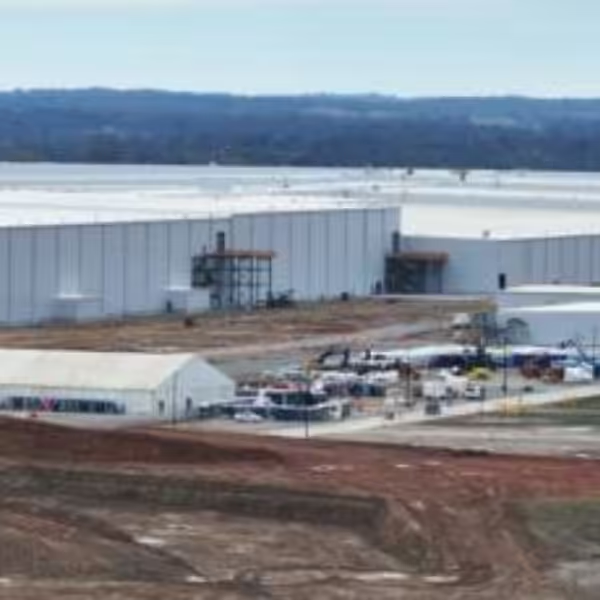
Ford’s decision to cancel its planned expansion of the BlueOval SK electric vehicle battery operation in Glendale, Kentucky, has sparked intense backlash from workers who had built their livelihoods around the project. The plant, supported by billions in federal financing and promoted as a cornerstone of domestic EV manufacturing, now stands at the center of a clash involving labor organizing, corporate pullback, and uncertain electric vehicle demand. For workers who had already voiced concerns about pay and safety, the cancellation has intensified tensions that were brewing long before the announcement.
Billions in Federal Backing, Then a Reversal
The scale of federal funding for BlueOval SK positioned the Glendale facility as one of the largest EV battery projects in the United States. The U.S. Department of Energy approved a $9.63 billion direct loan to the joint venture between Ford and SK On to support three battery plants in Tennessee and Kentucky, with projected annual production exceeding 120 gigawatt-hours. That loan formed part of a wider effort to expand clean-energy manufacturing through programs tracked on the department’s Genesis portal, which monitors major loan and grant-backed initiatives. The BlueOval SK financing cleared a formal environmental review process, with the DOE issuing a Finding of No Significant Impact for facilities in Glendale, Kentucky, and Stanton, Tennessee, effectively clearing the project to proceed at full pace.
The sudden cancellation now raises serious questions about the future of that federal investment and the communities that reshaped their economic plans around it. The official project summary stated that the loan aimed to expand U.S. EV battery manufacturing capacity and create thousands of jobs, and the Glendale plant had already begun production and hiring. Workers who relocated, pursued technical training, or committed to long-term careers at the site now face uncertainty despite the federal backing that appeared to secure the project’s future. The contrast between the scale of public funding and the speed of Ford’s retreat is stark, leaving unresolved whether taxpayer-supported funds will be recovered, restructured, or redirected within the DOE’s clean-energy portfolio.
Worker Anger Over Pay, Safety, and Broken Promises
Frustration at the Glendale plant had been growing even before the cancellation. Workers had expressed concerns about wages and safety, and the United Auto Workers union had launched a vote effort at the facility as part of a broader campaign to organize EV battery plants across the South, according to reporting from the Associated Press. The UAW viewed BlueOval SK as a key test of whether traditional autoworker unions could establish a presence within the largely non-union EV supply chain expanding across Southern states. That organizing push stemmed from specific complaints: workers said pay did not reflect the physical demands and risks of battery production, and promised wage progressions lagged behind standards at Ford’s unionized Midwest facilities.
Federal safety records add weight to those concerns. The Occupational Safety and Health Administration initiated a complaint inspection at the Glendale site on September 4, 2025, and closed it on October 22, 2025. The existence of a formal OSHA investigation during active operations indicates that safety concerns were substantive. Workers described exposure risks associated with chemicals used in cell manufacturing and pressure to sustain production despite equipment issues. Now facing potential job losses alongside unresolved workplace concerns, many employees view the cancellation as abandonment rather than a routine business decision.
Ford’s EV Losses and the Strategic Retreat
Ford’s move reflects broader financial challenges within its electric vehicle division. The company has acknowledged that its EV segment expects significant losses for several more years, making large-scale capital investments in new battery facilities harder to justify. Although Ford continues to promote future products, including a medium-size electric pickup projected at around a $30,000 price point later in the decade, a single model cannot absorb the output of a battery network designed to exceed 120 gigawatt-hours annually. The gap between Ford’s scaled-back EV ambitions and the expansive production capacity it previously outlined has become increasingly evident.
Much reporting on Ford’s EV retrenchment centers on corporate finances, but the issue also highlights structural challenges. Automakers developed battery strategies based on forecasts of rapid EV adoption, sustained incentives, and declining production costs. When consumer uptake slowed and losses mounted, companies reduced capacity instead of aggressively lowering prices or accelerating product improvements to drive demand. This cycle of expansion during peak optimism followed by contraction at the expense of workers and communities mirrors past manufacturing trends. What distinguishes this case is the magnitude of public investment and the infrastructure already committed, including transmission upgrades tracked through the DOE’s infrastructure exchange and technical planning archived in federal repositories. Those public assets do not retract as swiftly as corporate strategy shifts.
What the Cancellation Means for Southern Labor Organizing
The Glendale decision may ultimately strengthen the UAW’s organizing efforts across the South. The union’s campaign at BlueOval SK centered on the claim that non-union EV battery facilities offer lower pay and weaker protections than unionized auto plants. Ford’s withdrawal from a site backed by nearly $9.63 billion in federal loans reinforces that argument. If workers can face hazardous conditions and abrupt job uncertainty despite substantial public support, the case for collective bargaining gains credibility.
The broader context reinforces this dynamic. Companies concentrated EV battery facilities in Southern states due to lower labor costs, generous state incentives, and historically limited union presence. Glendale demonstrates that a non-union environment does not shield employees from corporate reversals and may heighten their vulnerability. For labor organizers, the lesson is clear: public subsidies and prominent corporate branding cannot replace enforceable contracts that define wages, safety standards, and job protections. As unions expand their efforts throughout the region, they are likely to cite Glendale as both a cautionary example of unmet promises and a signal that worker influence will shape the trajectory of clean-energy manufacturing alongside federal funding and corporate planning.












Leave a Reply