

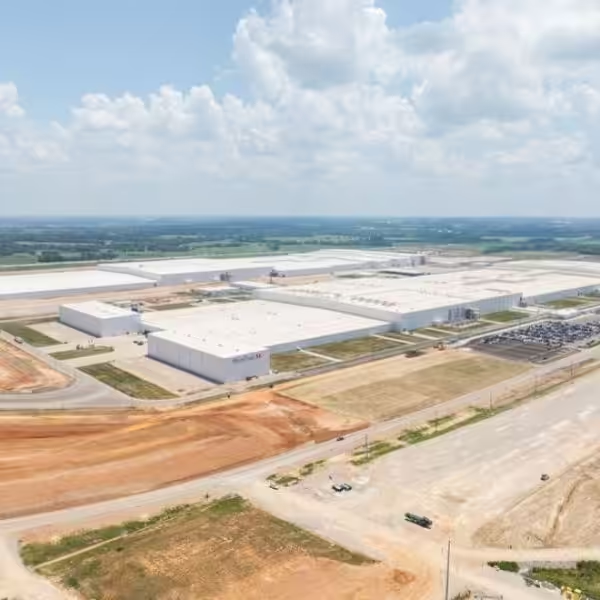
Five years ago, Kentucky lawmakers approved hundreds of millions of dollars in upfront forgivable loans to attract Ford’s massive electric vehicle battery plant to the state.
With the recent closure of the Glendale plant, lawmakers are now seeking clarity on whether — and how — Kentucky can recover those taxpayer funds.
Kentucky Cabinet for Economic Development Secretary Jeff Noel testified before the Senate budget committee Wednesday morning, updating lawmakers on ongoing negotiations with Ford regarding the Glendale facilities and upcoming deadlines tied to repayment of the loans.
Under the current loan agreement, Ford and its former South Korean partner are scheduled to make their first $10 million payment in March of next year, after failing to meet employment targets by the end of this year.
Noel echoed comments made by Gov. Andy Beshear in December following the plant’s closure, saying Ford has committed during negotiations to invest an additional $2 billion to convert the site into a battery energy storage manufacturing facility. The plan would create at least 2,100 jobs.
While Noel said he could not disclose all details of the negotiations, he noted it was encouraging that Ford has agreed to take responsibility for the entire $250 million loan, rather than splitting the obligation with its former partner. Ford also said it would not operate the second building at the site but would market it to another manufacturing company.
Noel added that the state wants Ford to honor its original commitment to eventually create 5,000 jobs at the site, though that may require “some type of adjusted schedule of repayment with the loan.”
Sen. Chris McDaniel, the Republican chair of the Senate budget committee from Ryland Heights, said lawmakers and the administration must ensure taxpayer dollars are used responsibly and loan terms are upheld. Given the circumstances, he said the cabinet is handling the situation as effectively as possible.
“I think their response is as realistic as it can be,” McDaniel said. “At this point, they’ve gotten more concessions out of Ford than they originally had obligations for.”
McDaniel noted that while Ford’s first repayment is not due for another year, discussions appear to be underway to restructure the agreement with firm commitments from the company.
The BlueOval SK project was announced in September 2021 as a joint venture between Ford and South Korean company SK On. The companies planned to invest $5.8 billion to build two large EV battery plants and employ at least 5,000 workers, making it the largest economic development project in Kentucky’s history.
That announcement followed a special legislative session in which lawmakers approved $410 million from the state’s budget reserve trust fund for an unnamed economic development project. Of that amount, $350 million was allocated for forgivable loans, $50 million for worker training and a new training facility, and $10 million to acquire property in Hardin County, where the Glendale plant is located.
Ford received $250 million of the forgivable loans upfront, while the remaining $100 million went to another EV battery plant in Bowling Green operated by Japan-based Envision AESC. Both projects were expected to share workforce training resources.
Although production never began in one of the two Glendale buildings, EV battery production started in the other facility in the summer of 2025. In December, Ford and SK On announced the end of their partnership. Ford assumed ownership of both buildings but said it would shut down operations and lay off workers while working to convert the plant into a battery energy storage facility, with plans to reopen in about 18 months.
So far, negotiations with Ford appear far smoother than the state’s earlier experience with Braidy Industries, which received a $15 million upfront loan in 2017 to build a $1.7 billion aluminum rolling mill near Ashland. That project failed, and the state eventually recovered the funds in 2022.
McDaniel, who led the effort to reclaim the Braidy loan, said Ford represents a far more reliable partner.
“Braidy was a highly speculative outfit run by a guy who’s proven to be nothing but a fraud,” McDaniel said. “But here you’re dealing with Ford, with a well-respected company across the United States that values its reputation and longevity. I don’t think this is the same deal.”
McDaniel said he expects Ford and the Beshear administration to reach a resolution by the end of the legislative session on April 15, allowing lawmakers to vote on any changes.
“I would struggle to see a scenario where Ford and the Cabinet aren’t back by the end of this session needing some help,” he said. “And I’m optimistic that they’ll get to a place where we have a willingness to do it.”
Any modification to the loan terms would require legislative approval. Noel added that the session deadline creates a “sense of urgency” that could benefit the state during negotiations. If no agreement is reached by April 15, the governor could call a special session to approve revised terms.
Ford’s closure of the EV battery plant comes as the electric vehicle industry has faced mounting challenges over the past year. Congress ended $7,500 consumer tax credits for EV purchases and revised manufacturing credit rules, denying incentives to projects owned by foreign entities.
After the closure was announced in December, Beshear criticized President Donald Trump and congressional Republicans — including Rep. Brett Guthrie, whose district includes Glendale — for backing the legislation.
“I’m still amazed that the President would push through such a job-killing bill,” Beshear said. “If people lose jobs or jobs aren’t created, your own congressman did it to you. Your governor is going to do his best to make sure we have as many jobs at those facilities as possible.”




Leave a Reply