

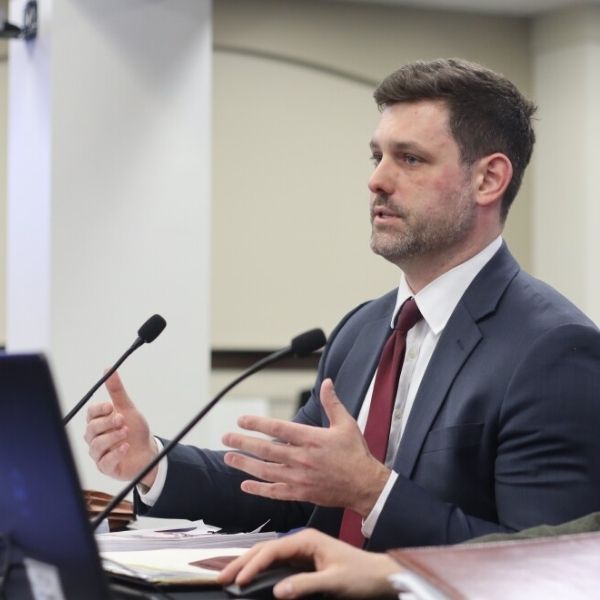
GOP Rep. Kim Banta said Gov. Andy Beshear’s proposal to expand pre-K to more Kentucky families will not be funded in its current form in the next two-year budget.
Democratic Gov. Andy Beshear has requested $50 million over two years to gradually expand public pre-K access for more Kentucky children. The proposal was not included in the “bare bones” Republican budget released in January, and Banta, a Republican from Fort Mitchell, said Tuesday it is unlikely to be added in the final version.
Banta, who chairs the House subcommittee overseeing education funding, said the plan would require major revisions before she could consider supporting it. She expressed concern that it could drive existing childcare providers out of business and lead to rising costs as facility and staffing needs increase. She also opposed using funds currently dedicated to paying down the state’s pension debt.
“We’re not going to take out of retirement. We’re not going to put small businesses out of jobs. We want to do something. But I’m not sure that this is exactly the answer,” Banta told reporters after hearing details of the governor’s Pre-K for All proposal. “We’re kind of talking about unicorns and rainbows right now. It’s hard, expensive.”
Kentucky currently funds public preschool for 4-year-olds from families earning up to 160% of the federal poverty line, as well as 3- and 4-year-olds with disabilities. The proposed budget would maintain funding for that program at $84.5 million, the same as the current fiscal year, serving about 14,200 children.
Sam Flynn, executive director of the governor’s Pre-K for All Advisory Committee, described the proposal as a cautious, phased approach to expanding access. He said the extended rollout, which would vary by district, was designed to address lawmakers’ concerns about cost. Flynn argued the state cannot afford not to invest in pre-K, citing benefits such as improved kindergarten readiness and increased workforce participation by parents.
“This is something that is happening in other parts of the country,” Flynn told the subcommittee Tuesday. “They are benefiting in terms of the educational output and kids being kindergarten ready.”
Flynn also referenced a 2025 Child Care Aware of Kentucky report that found many counties lack sufficient childcare capacity for children under 5.
In western Todd County, 925 children compete for just 129 available slots. In southeastern Floyd County, there are 1,923 children under 5 but only 425 slots.
GOP Rep. Josh Bray of Mount Vernon sharply criticized the proposal, pressing Flynn on projected costs related to staffing increases and construction needs, particularly in larger districts that could require multiple new classrooms. Bray also rejected the comparison between pre-K and childcare.
“Even with the runway, at some point, if we expand the number of kids in school, there will be budget requests to build new buildings, additional classrooms, and hire more staff,” Bray said.
Bray also challenged the idea of using sports wagering revenue to fund expanded pre-K. Those funds are currently directed by law into the state’s permanent pension fund. Flynn said the money is deposited into the account but is not actively being used to pay down pension debt.
Republican leadership has expressed skepticism or outright opposition to Beshear’s Pre-K for All initiative, arguing that now is not the time to launch new programs and questioning its effectiveness. Despite that resistance, the Democratic governor has continued to promote the plan statewide. On the same day Republicans raised concerns, Beshear held a press conference in Bowling Green with local leaders to advocate for the proposal.
Banta and at least one other Republican lawmaker, Rep. Scott Lewis of Hartford, said they would support expanding pre-K eligibility to 200% of the federal poverty line. That change would extend eligibility to a family of four earning about $66,000 in 2026. A similar expansion was approved by the General Assembly in 2016 but vetoed by then-Gov. Matt Bevin.
Lewis, who also serves as superintendent of Ohio County Public Schools and chairs the House education committee, said the expansion would help families who earn too much to qualify for free pre-K but still struggle to afford it. He said the move would cover about 5,500 additional children statewide.
“I don’t think districts with that number of students spread across the state would face building issues or anything like that,” Lewis said. “At least we would reach that next group of kids, and those parents are the ones who really need it.”






Leave a Reply