

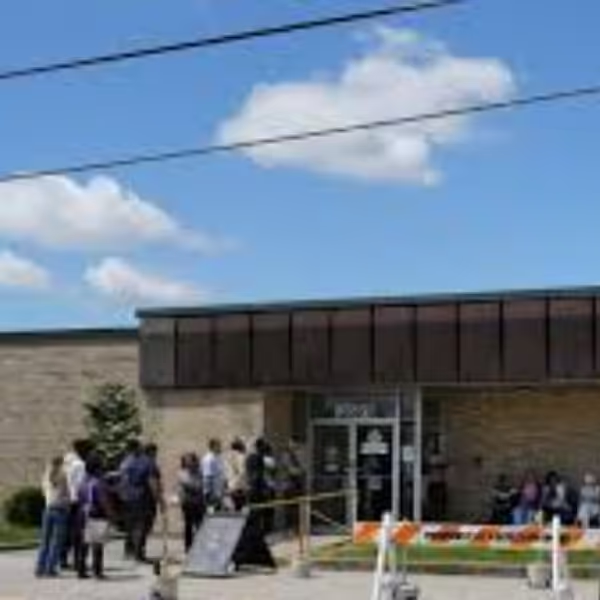
In his first year in office, state Sen. Aaron Reed heard plenty from constituents about problems at Kentucky’s driver licensing regional offices.
The freshman Republican from Shelbyville understood their frustration. As a father of six, he had his own experience to share.
“Two of my kids I had to take to Morehead from Shelbyville to get their driver’s licenses,” Reed said in August at the Kentucky Farm Bureau Ham Breakfast during the state fair. “Something has to give.”
That trip is more than 100 miles each way. Even without traffic on Interstate 64, it still takes more than an hour and a half each direction.
And while the Kentucky Transportation Cabinet says conditions have improved, people seeking licenses earlier this year often faced long lines and extended waits as offices handled a surge of applicants from across the state. The deadline to fly without a Real ID arrived this summer, right as lawmakers lowered the age for a driver’s permit to 15.
It was a “perfect storm,” said state Sen. Jimmy Higdon, chair of the Senate Transportation Committee. Things have eased since the summer rush, he said, but lawmakers still have concerns to address in the next legislative session.
“We basically have two problems to solve,” he said. “In urban areas, we don’t have enough regional offices. In rural Kentucky, people have to drive too far. Kids are missing school for testing.”
The first issue is the easier one, Higdon said. But resolving the challenges facing rural areas may be more complicated.
Regardless, the issue has the attention of the legislature. In his second year, Reed wants to overhaul the system. It’s a top priority, he said in August — “Senate Bill 1 should be bringing the driver’s licenses back to the counties in some form or fashion.”
He’s not alone. State Rep. Savannah Maddox also plans to continue her efforts to undo the current regional model — created by a 2020 law supported by circuit clerks — and restore the ability for officials in all 120 counties to issue driver’s licenses. The Republican from Dry Ridge has filed similar bills before and plans to do so again on the first day of next year’s session.
But the proposal faces resistance. Gov. Andy Beshear has urged caution, and the Kentucky Association of Circuit Court Clerks has raised concerns.
“We will always do what our legislators say,” said Montgomery County Circuit Court Clerk Tanya Terry, the KACCC president. “But I think the cost would be tremendous to our taxpayers.”
How we got here
The Kentucky Transportation Cabinet now operates 35 driver licensing regional offices. Louisville has five, Lexington has two, and the remaining 28 are spread across the state.
It wasn’t always structured this way. Five years ago, each county issued driver’s licenses locally. Shelby County residents didn’t need to drive to Morehead.
The system worked, Maddox argued in an October interview. Circuit clerks handled licensing “successfully for nearly 100 years,” she said, and were easier for residents to access.
What changed? In 2020, lawmakers passed House Bill 453, which removed circuit clerks from the process and gave full responsibility to the Transportation Cabinet.
The shift came after long wait times and technical issues followed a 2017 bill meant to bring Kentucky into compliance with the 2005 Real ID law, created to improve security after 9/11. Amid mounting problems, Real ID and driver’s license responsibilities were transferred in 2019 from circuit clerks to the cabinet after clerks voted in favor of the move.
Terry said clerks “dutifully complied” with the legislative mandate to consolidate licensing under one entity. She added that clerks are willing to work with lawmakers on possible changes.
Beshear, who took office after the 2019 election, has warned against major changes before the current system has enough time to stabilize.
He acknowledged the challenges in an August press conference, including staffing new centers and dealing with an influx of applicants under the new permit-age law. New vision screening requirements also increased wait times, along with the Real ID deadline that took effect this year.
“My commitment is to make it work,” Beshear said. “If we send it back to the clerks, we have to rebuild from scratch, and it might mean another five years of problems.”
Beshear spokesperson Scottie Ellis said in November that conditions have improved significantly. Average walk-in waits have dropped from 49 minutes in the summer to 14 minutes, and appointment waits have fallen from 25 minutes to 11 minutes. More than 21,000 permits have been issued to 15-year-olds, nearly 850,000 vision screenings have taken place, and more than 1.15 million credentials were issued between January and October.
Still, more progress is needed, Beshear said.
“This session maybe we ought to provide more funding,” he added, pointing toward future budget talks. “Let’s find ways to give people a better experience.”
Looking ahead to 2026
Solutions vary depending on who you ask.
For Maddox — who chose to get a passport instead of a Real ID, saying it took less time — the answer is to return licensing to circuit clerks. She filed a similar bill last session with 10 cosponsors, but it stalled in committee.
“Our regional model has failed,” she said. “Kentuckians used to get in and out quickly at their clerk’s office. Now people wait months for an appointment, take off work, drive hours, wait all day, then get their license in the mail weeks later.”
Maddox supported the 2020 bill at the time, saying it was presented as an imperfect but necessary fix. But “hindsight is 20-20,” she said. She believes circuit clerks could manage the system more efficiently with better local access.
Reed said in August he was considering options. It’s complicated, he noted, but the need for change is clear.
“I don’t know if it’s going to be county clerks,” he said. “Circuit clerks don’t want it, not many county clerks do. But the problem is there.”
Any shift would require additional steps, including changes to fee structures. Maddox’s 2025 bill proposed allowing clerks to keep 25% of collected fees.
“It’s not decided yet,” Reed said. “The bill is being drafted. We want to get it right.”
Higdon, who will retire in 2026, has heard extensive testimony on the issue. He expects more once lawmakers return in January.
“I don’t know exactly what the bill will say,” he said. “But we know something needs to be done.”
Still, Higdon doesn’t want to rush. The shift to regional offices started under former Gov. Matt Bevin and continued under Beshear. Reversing it is a major change, he said, one that may be better handled after Beshear leaves office in 2027.
“I think it would be better, if you’re going to do that, to wait for a new administration,” he said. “This system needs work, but overhauling it completely could cause problems.”
He does expect some movement, including potential legislation to allow local offices to handle renewals and expanded permit testing outside regional centers.
The Transportation Cabinet said it will review any licensing-related bills as they move through the legislature. It encourages people scheduling appointments to check online for “skip the line” options.
The cabinet said improvements continue, citing new line management systems, text check-ins, and 125 additional staff members. Wait and processing times have “decreased significantly,” it said.
Terry said clerks will follow whatever lawmakers decide, but warned that shifting responsibilities could create confusion — especially if counties handle renewals but not Real IDs.
“It would take a lot of equipment, money, and staffing,” she said. “It would be a burden on taxpayers.”
For now, Higdon says lawmakers must focus on what’s ahead.
“Before long,” he said, “we’re going to have the next crisis — when all these 15-year-olds turn 16 and need their driver’s test.”
This article has been carefully fact-checked by our editorial team to ensure accuracy and eliminate any misleading information. We are committed to maintaining the highest standards of integrity in our content.







Leave a Reply