

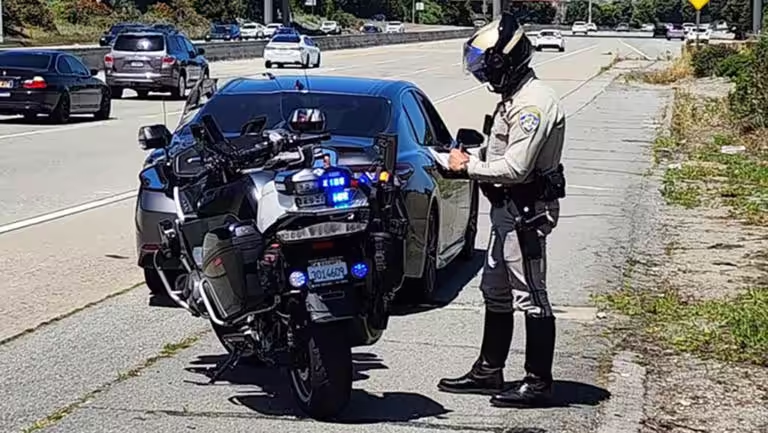
California just sent a strong message to drivers statewide, and many car enthusiasts are probably not going to be happy about it. During a single 24-hour enforcement operation, the California Highway Patrol issued 11,767 speeding tickets, including 200 cases involving drivers allegedly clocked at more than 100 mph. For some of those motorists, the penalties could extend far beyond paying a fine.
Under California’s updated enforcement policies, certain drivers accused of excessive speeding could lose their license before they even step into a courtroom. That is where this story shifts from a routine traffic crackdown into something far more serious.
The enforcement operation lasted from 6 a.m. on April 28 until 5:59 a.m. the following morning. During what the California Highway Patrol described as a Maximum Enforcement Period, officers flooded highways across the state with a major focus on speed violations. By the time the operation ended, CHP officers had carried out 23,087 enforcement actions and issued 19,564 total citations.
The numbers become even more striking when you break them down.
California officers issued an average of about 815 citations per hour throughout the crackdown. That equals more than 13 tickets every minute for 24 straight hours. Speeding violations accounted for most of the citations, with 11,567 tickets handed to drivers traveling under 100 mph but still above the posted speed limit.
That means CHP officers were issuing nearly eight speeding tickets every minute.
Then there were the 200 drivers accused of exceeding 100 mph.
Under California law, those cases now come with far greater consequences than many motorists may realize. The state has expanded the DMV’s authority to revoke licenses in cases involving excessive speed or reckless driving. In some situations, drivers could lose their legal right to drive before ever appearing before a judge.
That changes everything.
For years, traffic citations typically followed a predictable process. Drivers received a ticket, appeared in court if required, paid fines, and later dealt with points or insurance increases. California’s updated approach shifts more authority toward administrative action through the DMV, especially in serious speeding cases.
For drivers, that completely changes the stakes.
A suspended license is far more than a simple inconvenience. It can lead to lost income, massive insurance costs, legal complications, and long-term financial strain. In a state where millions of residents depend heavily on personal vehicles every day, losing driving privileges can quickly become a life-altering problem rather than just another traffic citation.
CHP says the crackdown is centered on safety concerns, particularly the dangers tied to high-speed driving. Higher speeds reduce reaction time, increase stopping distances, and make crashes significantly more severe. Those risks are impossible to ignore.
But the situation becomes more complicated from there.
Speed enforcement remains one of the easiest violations for law enforcement agencies to pursue aggressively because the standard is straightforward. A driver is either above the speed limit or not. Unlike tailgating, unsafe lane changes, or other dangerous driving behaviors that often involve more subjective judgment, speeding is simple to document and process on a large scale.
That helps explain why CHP placed such a heavy emphasis on speed during this operation.
The agency did not highlight other common highway dangers with the same intensity. Reckless driving, slow-moving traffic disruptions, and aggressive tailgating all create serious hazards on California highways. Still, speeding remains the cleanest and most efficient target for enforcement.
And efficiency clearly played a major role here.
The size of this operation signals that California is leaning harder into aggressive traffic enforcement strategies statewide. This was not a small awareness campaign with a handful of extra patrol units parked along highways. Officers saturated roads across the state specifically searching for speed violations, and the final numbers reflect just how aggressive the operation became.
For car enthusiasts, it also deepens the growing conflict between performance-car culture and increasingly strict enforcement policies.
Modern performance vehicles are faster than ever before. Even relatively affordable cars can now hit triple-digit speeds with surprising ease. Many sports sedans, muscle cars, and SUVs can surge past 100 mph within seconds while feeling remarkably stable inside the cabin. That level of performance has become common throughout today’s automotive market.
At the same time, states like California are responding with harsher penalties and expanded enforcement authority.
That is where the debate really begins.
The issue is no longer simply whether speeding is dangerous. Most drivers already recognize the risks that come with excessive speed. The larger question now is how aggressively states should penalize drivers before the judicial process has fully played out.
That distinction matters because administrative license suspensions can affect drivers immediately, often well before a final legal decision is reached. For many motorists, particularly those who have only been accused and not convicted, that raises growing concerns about fairness and due process.
California is clearly wagering that harsher penalties will discourage extreme speeding. Whether those measures actually change driver behavior over the long term remains an entirely different question.
There is also the larger reality that enforcement crackdowns generate substantial revenue through fines, court fees, insurance increases, and related penalties. While public safety messaging stays at the forefront, large-scale ticketing operations inevitably create major financial consequences for drivers statewide.
And drivers are ultimately the ones footing the bill.
For car enthusiasts, another concern lies beneath all of this. Aggressive enforcement campaigns can slowly reshape the entire relationship between drivers and performance vehicles. As penalties become more severe, ownership itself can begin to feel less like a passion and more like a legal liability.
California’s latest enforcement crackdown may have lasted only 24 hours, but the message behind it feels far bigger. The state is moving toward quicker penalties, expanded enforcement authority, and tougher consequences for drivers accused of excessive speeding.
Now the bigger question is how far that strategy eventually goes — and whether drivers will still have much influence once the system begins moving faster than the courtroom itself.










Leave a Reply