

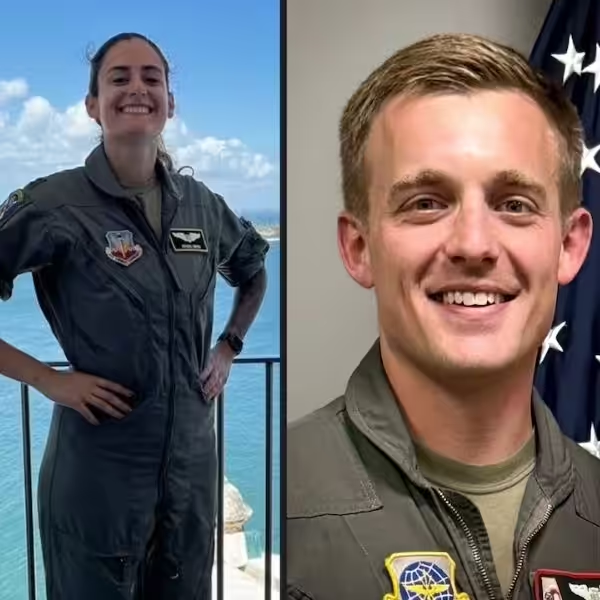
A Kentucky mother of two was among six U.S. service members killed last week when a refueling aircraft supporting operations related to the conflict with Iran crashed in western Iraq.
Tech. Sgt. Ashley B. Pruitt, 34, of Bardstown, Kentucky, was remembered by her husband, Gregory Pruitt, as someone who brought light to every room she entered.
“I’ll give you something brief — in a word, radiant,” he said in a phone interview Sunday while holding back tears. “If there was a light in the room, she was it.”
Pruitt is survived by the couple’s 3-year-old daughter and her stepson.
Dedicated Air Force Career
Pruitt most recently served with the 99th Air Refueling Squadron at Sumpter Smith Joint National Guard Base in Birmingham, Alabama. She worked as an assistant flight chief of operations and also trained others as an instructor for operating the refueling boom on a KC-135 aircraft.
She joined the military nine years ago and had previously deployed overseas three times. During her career, Pruitt logged nearly 900 combat flight hours and earned two associate degrees from the Community College of the Air Force.
Her family said she was deeply proud of her service.
Crash During Operation Support
The U.S. military confirmed Saturday the identities of the six service members who died in the crash. Three were assigned to the 6th Air Refueling Wing at MacDill Air Force Base in Tampa, Florida, and Sumpter Smith in Alabama, while the other three served with the Ohio Air National Guard in Columbus.
The aircraft went down Thursday while flying in “friendly” airspace during a mission supporting operations against Iran, according to U.S. Central Command. Officials said an incident involving another aircraft occurred during the mission, but the other plane landed safely.
The cause of the crash remains under investigation.
Col. Ed Szczepanik, commander of the 6th Air Refueling Wing, said the loss has deeply affected the military community.
“To lose a member of the Air Force family is excruciatingly painful, especially to those who know them as son, daughter, brother, sister, spouse, mom, or dad,” he said in a statement. “To lose them at the same time is unimaginable.”
Other Service Members Remembered
Among those killed was Maj. John A. “Alex” Klinner, 33, who had just been promoted to major in January and deployed less than a week before the crash.
Klinner leaves behind three young children — 7-month-old twins and a 2-year-old son. A graduate of Auburn University, he served eight years in the Air Force and worked as chief of squadron standards and evaluations at the Birmingham base.
Family members described him as a generous person always willing to help others.
“Alex was one of those guys that had this steady command about him,” said his brother-in-law, James Harrill. “He was literally one of the most kindest, giving people.”
Tech. Sgt. Tyler Simmons, 28, of the Ohio Air National Guard’s 166th Air Refueling Squadron, also died in the crash. A boom operator responsible for transferring fuel between aircraft midair, Simmons joined the Air Force in 2017 and deployed three times.
His family said his presence could light up any room.
“Tyler’s smile could light up any room, his strong presence would fill it,” his family said in a statement. “His parents, grandparents, family and friends are grief-stricken for the loss of life.”
Capt. Ariana G. Savino, 31, a pilot with the 99th Air Refueling Squadron, served as chief of current operations and managed the squadron’s flight scheduling and flying programs. She had more than 300 combat flight hours and became a captain in 2021.
Capt. Seth R. Koval, 38, an instructor pilot with the Ohio Air National Guard, had 19 years of service and more than 2,000 flight hours, including 443 combat hours. He deployed five times during his career and trained other pilots in air refueling and operational missions.
Capt. Curtis J. Angst, 30, a KC-135 pilot from the Ohio Air National Guard, had served for about a decade after earning a degree in aerospace engineering from the University of Cincinnati. He accumulated 880 flight hours, including 67 combat hours.
A Lasting Legacy
The KC-135 Stratotanker used in the mission is designed to refuel other aircraft in midair, allowing them to fly longer distances and continue operations without landing. The aircraft can also transport wounded personnel and conduct surveillance missions.
The U.S. Air Force currently operates hundreds of KC-135 aircraft, which have been in service for more than six decades.
For Gregory Pruitt, the loss of his wife is deeply personal — but he hopes others remember the joy and energy she brought to people around her.
“She was radiant,” he said. “If there was a light in the room, she was it.”












Leave a Reply