

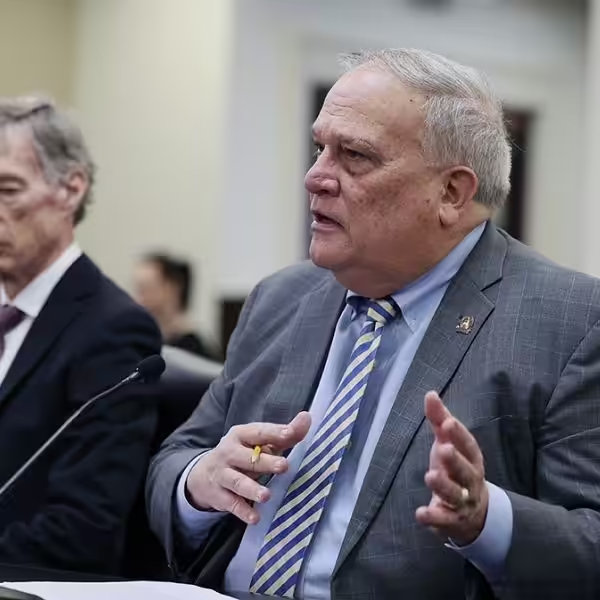
Senate President Robert Stivers’ resolution directs the University of Kentucky, the University of Louisville and Eastern Kentucky University to work together to address Kentucky’s physician shortage. (LRC Public Information)
Republican Senate President Robert Stivers is calling on three Kentucky universities to collaborate on solutions to the state’s growing doctor shortage.
Republicans and one Democrat on the Senate Health Services Committee supported Stivers’ Senate Joint Resolution 116 on Wednesday morning. The resolution directs the University of Kentucky, the University of Louisville and Eastern Kentucky University to “coordinate a search for actionable solutions to the physician shortages and to explore and expand health care opportunities” in partnership with their communities, state agencies, professional associations and others involved in health care across Kentucky.
“We hope that they will engage other entities like UPike (University of Pikeville), which is private, like the Kentucky Hospital Association, the Kentucky Medical Association, the other associations that might be in the realm of health care to come up with solutions since they are basically going to be the largest providers … of the doctors,” Stivers told the committee.
UK and UofL both operate established medical schools. EKU has been working for several years to launch a college of osteopathic medicine and has requested more than $45 million from the legislature to create a reserve fund required for accreditation. UPike already operates an osteopathic medicine college.
An August 2025 report from the Legislative Research Commission found that Kentucky could face a shortage of nearly 3,000 physicians by 2030. Currently, 107 of the state’s 120 counties are designated as health professional shortage areas.
Stivers’ resolution allocates $250,000 from the state’s general fund for the 2026–27 fiscal year to support the study. The universities will examine several issues, including shortages of primary and specialty care physicians in medically underserved areas, limited access to physician care for underserved populations and strategies for retaining doctors in those communities.
The universities are expected to submit their report by Jan. 1, 2027.
Sen. Karen Berg, a Louisville Democrat and physician, praised the proposal and emphasized the importance of training Kentucky’s “best and brightest” doctors within the state so they remain there.
“Where do we train them and how do we keep them?” Berg said. “And that is an issue that I think we need to discuss in this legislature at some point because a lot of my colleagues do not feel that this legislature is friendly to physicians, and they leave because they have a lot of options.”
Another physician on the committee, Nicholasville Republican Sen. Donald Douglas, said he agreed with Berg that the issue requires urgent attention from those in the health care field. He noted that his three children are specialists who chose to live outside Kentucky.
“I really appreciate my colleagues here in the General Assembly and how hard everybody is working to try to change the environment here in the commonwealth so that we can attract more physicians,” Douglas said. “But I’ve been speaking with a lot of my colleagues in the health care space recently a little bit louder, asking my colleagues to come along and be partners and work with us so that we can improve the environment.”
After the committee meeting, Stivers told the Lantern he has “no doubt” the study will lead to future legislation. He said lawmakers may consider policy changes related to scholarships, loan repayment programs and an expedited naturalization process for foreign doctors who agree to work in underserved areas.











Leave a Reply