

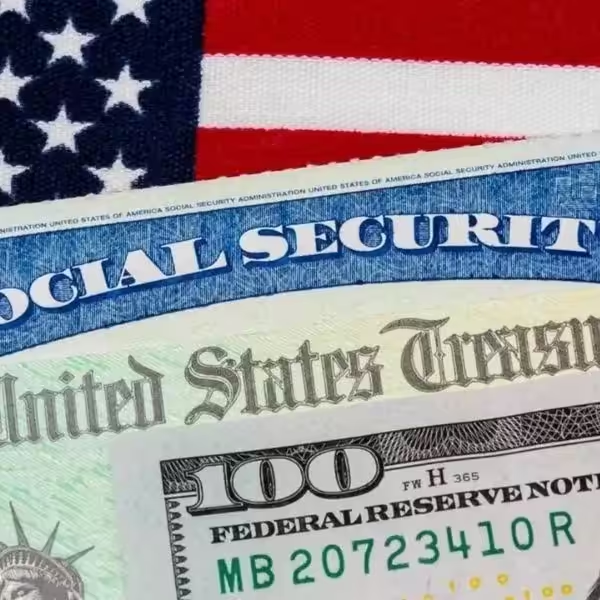
Millions of Social Security recipients are set to receive early payments exceeding $5,000 in the coming weeks.
New legislation is reshaping payouts for some beneficiaries as more than 70 million Americans prepare for their deposits.
Many retirees are expected to feel immediate relief following the rollout of the One Big Beautiful Bill Act (OBBBA), combined with the 2.8 percent Cost of Living Adjustment (COLA) for 2026.
Under the new law, the maximum monthly benefit for a 70-year-old retiree has increased to an estimated $5,181, while the average beneficiary will receive about $2,071 per month.
Most Supplemental Security Income (SSI) recipients already saw an early deposit on Friday, as the first of the month landed on a Sunday.
However, individuals who retired before May 1997, along with those receiving both SSI and Social Security, will receive their payments on Tuesday, February 3.
For everyone else, payments will be issued based on birth dates:
- Those born between the 1st and 10th will be paid on Wednesday the 11th.
- Those born between the 11th and 20th will be paid on Wednesday the 18th.
- Those born between the 21st and 31st will be paid on Wednesday the 25th.
Despite the higher payouts, a 9.7 percent increase in Medicare Part B premiums announced in November is expected to reduce a significant portion of the inflation adjustment.
“The COLA should be a shield against the loss of purchasing power, not an abstract number that disappears into mandatory expenses,” a spokesperson for the American Association of Retired Persons (AARP) said.
As a result, SSI beneficiaries can expect a maximum of $994 for individuals and up to $1,491 for couples.
For an essential person assisting a disabled beneficiary, the monthly cap is set at $498.
The OBBBA legislation also aims to support older taxpayers by introducing an additional $6,000 tax deduction for individuals aged 65 and older, or $12,000 for couples filing jointly.
This provision will be in effect from 2025 through 2028.
The deduction begins to phase out for individuals earning more than $75,000 and for couples with combined incomes above $150,000.
It is fully eliminated for individual incomes exceeding $175,000 and joint incomes above $250,000.
Despite its intended benefits, the new structure has faced criticism across the political spectrum.
Conservative analysts argue, “It’s a short-term fix that will lead to long-term problems.”
“They’re giving away deductions that reduce overall tax revenue, while the clock keeps ticking on the fund’s depletion in 2033,” said Michael Thompson of the Center for Budget Policy.
Critics on the other side say the changes fail to protect the most vulnerable Americans.
“For a retiree who depends solely on Social Security and a small pension, it’s likely they would no longer pay taxes on those benefits. This deduction is irrelevant to them,” said economist Claudia Reynolds of the Coalition for Economic Justice.
“The real issue is that base benefits remain too low compared to rising housing and medication costs.
“Many older taxpayers won’t know whether they qualify or by how much, which could result in unexpected outcomes when filing their tax returns.”
Public policy experts largely agree that the OBBBA serves as a temporary measure that avoids deeper structural reforms.
The law does not alter payroll taxes, adjust the full retirement age, or address long-term sustainability concerns.
Instead, it relies on the tax code to provide temporary and selective income support for retirees without changing the core framework of the Social Security program.












Leave a Reply