

You follow these developments and see how quickly conditions can shift in a region already under strain. The conflict with Iran, which began with major U.S. and Israeli strikes in late February, has now reached a stage where American forces are facing direct aerial losses.
Reports confirm that Iranian defenses shot down at least two U.S. military aircraft in separate incidents on Friday. One was an F-15E Strike Eagle over southwestern Iran. Another aircraft, described in some reports as an A-10 Thunderbolt II, was also hit near the Strait of Hormuz.
Crew members ejected in both cases. One pilot was recovered quickly, while another required a high-risk search inside Iranian territory.
This situation prompted Donald Trump’s national security team to convene urgent meetings at the White House. Discussions focused on search-and-rescue operations, ongoing military actions, and how to manage further escalation.
The human impact is clear—service members operating far from home under dangerous conditions as the conflict enters its fifth week.
Officials described coordinated efforts involving special operations forces, intelligence units, and air support to locate and recover the missing airman, who was eventually rescued after evading capture in difficult terrain.
The Context of the Aircraft Losses
Looking at the timeline, the war began with extensive U.S.-Israeli airstrikes targeting Iranian leadership, nuclear-related sites, missile systems, and naval assets. Initial operations on February 28 reportedly killed Ali Khamenei and other senior figures.
Iran responded with waves of missiles and drones targeting Israel and U.S. interests across the Gulf. For weeks, both sides exchanged strikes, with the U.S. conducting thousands of sorties aimed at weakening Iranian air defenses and infrastructure.
Friday’s incidents marked a turning point. The F-15E was lost during a combat mission, becoming the first confirmed American aircraft downed by enemy fire in this phase of the conflict. Iranian state media claimed responsibility. U.S. forces launched a complex rescue operation involving Delta Force, SEAL Team 6, intelligence coordination, and air cover. One crew member was recovered earlier, while the second—reportedly injured—was later found after signaling for help. Both were safely extracted.
These events highlight that Iranian air defenses remain capable of posing threats despite sustained strikes. Mission planning continues to factor in terrain challenges, remaining missile systems, and real-time combat uncertainties.
What the National Security Meetings Covered
These White House meetings brought together defense, intelligence, and foreign policy leaders. Discussions included assessing the aircraft losses, reviewing operational impacts, and planning next steps. President Trump has emphasized that key objectives—reducing Iran’s missile and drone capabilities, limiting naval threats, and preventing nuclear advancement—remain unchanged.
Officials also reviewed the rescue mission, which involved dozens of aircraft and hundreds of personnel. Reports indicate that two additional U.S. aircraft were destroyed by friendly forces after becoming compromised on the ground during the operation. Despite the risks, no U.S. personnel were lost in the rescue.
Broader strategy discussions likely included the Strait of Hormuz, where disruptions could impact global energy supplies. These incidents show how quickly military setbacks can trigger high-level strategic reassessments.
Iranian Retaliation and Regional Impact
Iran’s response has extended beyond direct confrontation with U.S. and Israeli forces. Missile and drone attacks have targeted Gulf regions hosting American bases, affecting areas in Kuwait and United Arab Emirates. Allied groups have also increased pressure through actions in places like Lebanon.
In the air domain, Iran’s claims of downing U.S. aircraft signal its intent to challenge American air superiority. U.S. officials maintain overall dominance, citing thousands of successful missions, but acknowledge that risks remain.
Civilian impacts continue to grow, with strikes affecting populated areas and causing displacement across multiple countries. Humanitarian concerns are rising as infrastructure and essential services face increasing strain.
The Human and Operational Toll
Behind these developments are individuals facing real danger. U.S. service members continue operations in high-risk conditions, while Iranian forces operate under sustained pressure. Families on all sides deal with uncertainty.
The rescue mission demonstrates the complexity of modern military coordination. Reports describe the missing airman navigating rugged terrain before activating a beacon, allowing special operations teams to execute a precise extraction under cover of air support.
The U.S. reports significant damage to Iranian military capabilities, including naval losses and disrupted missile production. However, officials acknowledge that some targets remain active.
What Comes Next
The situation remains fluid. President Trump has suggested that major objectives could be achieved in the coming weeks, while maintaining pressure in the meantime. Discussions may also include potential paths toward de-escalation, though current messaging emphasizes continued resolve.
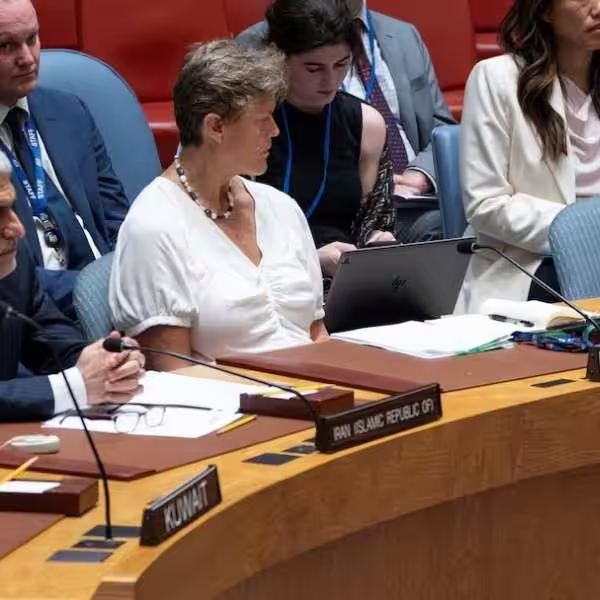
Internationally, the United Nations Security Council has held emergency sessions addressing the broader conflict. Concerns focus on preventing further escalation and protecting global stability, especially around key trade routes.
These aircraft losses and the emergency meetings that followed highlight a key reality: even with technological advantages, setbacks can occur and demand immediate high-level response. The conflict continues to evolve, with new developments shaping both military strategy and global reactions.










Leave a Reply