

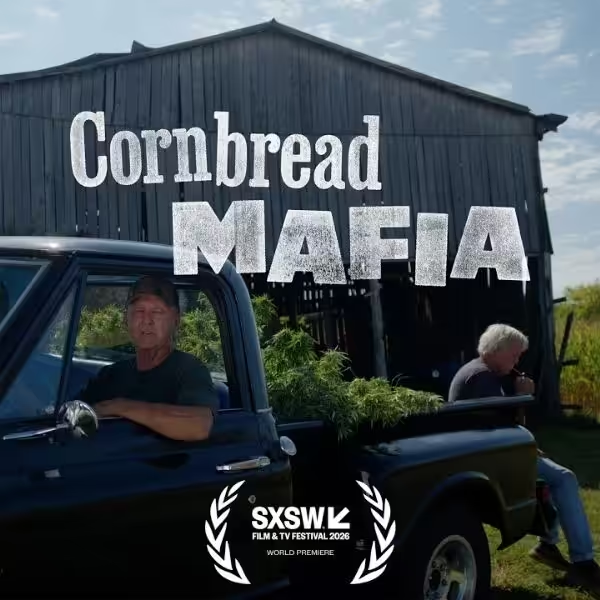
The Cornbread Mafia has been described in many ways over the years—organized crime, outlaw farmers, and a rural empire of marijuana growers. But Joe Keith Bickett says the reality is both simpler and more complicated than the legend.
“We were just a bunch of farm boys trying to make some money,” Bickett says with a shrug that reflects years of experience. “Country guys living on the edge.”
The story has circulated in Kentucky folklore since the late 1970s, when federal investigators began linking marijuana busts across several states to a small rural area in Marion County. As headlines grew bigger, the legend expanded. Meanwhile, the people involved—men like Bickett—became larger-than-life characters in the narrative.
“Every time something comes up, some kind of mystery on the ground, people say, ‘Oh, that was the Cornbread Mafia,’” Bickett laughs. “We get credit for a lot of stuff we did not do.”
For decades, the story has lived on through books, rumors, and court records. Now filmmaker Evan Mascagni is bringing it to the screen with a documentary set to premiere at South by Southwest, using Bickett’s firsthand accounts to explore both the myth and the reality.
“It’s a fun story. It’s a wild ride,” Mascagni says. “But it’s also got a lot of heart. These are real people and these were real lives.”
Mascagni didn’t originally plan to become a filmmaker. The Louisville native once expected to pursue a legal career.
“I thought I was gonna be a lawyer,” he says. “Then I discovered documentary filmmaking in law school and realized I enjoyed making documentaries more.”
That unexpected shift turned into a career. His previous film Building a Bridge—which focuses on Jesuit priest Father James Martin and the Catholic Church’s relationship with the LGBTQ community—premiered at Tribeca and was produced by Martin Scorsese. Even Mascagni finds the path from law school to collaborating with Scorsese surprising.
“A lot of hard work and a lot of luck,” Mascagni says. “But for me it always starts with characters and stories. These are real people. Documentary filmmaking is a collaboration.”
And the Cornbread Mafia story offered no shortage of characters.
The origins trace back to a time when tobacco farming struggled to provide stable income, while marijuana appeared to offer far better profits.
“Tobacco was cheap,” Bickett explains. “We saw marijuana could make a little more money than the local job industry.”
At first, the operation remained small, with scattered patches across central Kentucky farmland.
“We started growing a little pot here and a little pot there,” he says. “Then bigger amounts here and there.”
By the early 1980s, federal authorities began taking notice. Arrests across multiple states started pointing back to the same rural network.
“The feds said, ‘That bunch of country boys out there making too much money,’” Bickett says. “So they bore down on us.”
The consequences were severe. Bickett ultimately spent more than two decades in prison.
“I served over twenty years,” he says. “My friend Bobby Joe Shoemaker served twenty-five. Johnny Boone served about twenty.”
Over time, the situation has taken on an even stranger context.
“Four or five of us guys spent close to a century in prison together,” Bickett says. “Over marijuana. Something that’s legal today.”
Mascagni says that contradiction became a central theme of the film.
“You’ve got these guys serving incredibly harsh sentences for nonviolent drug offenses,” he says. “And now you’ve got people walking into legal dispensaries.”
In one striking example, Mascagni points to the sentencing disparities common during that period.
“The man who murdered their sister got the same sentence as they did,” he says. “Cold-blooded murder, same sentence as growing marijuana. It’s crazy.”
The documentary also explores the historical policies that shaped the era, tracing them back to the War on Drugs.
“We talk about Nixon. We talk about Reagan,” Mascagni says. “All of these federal laws that led to these incredibly harsh sentences.”
While still in prison, Bickett began documenting the experience, filling notebooks with memories of the early years.
“I had a lot of time on my hands,” he says. “So I started writing about what happened in ’77, ’78, ’79.”
Those writings eventually became a trilogy of books chronicling the rise of the Cornbread Mafia, its major figures, and the years spent behind bars.
“I just wanted to tell the firsthand account,” Bickett says. “There was a lot of stuff out there that wasn’t true.”
Mascagni read all three books before starting the documentary.
“I read them and thought, ‘Man, this is quite a ride,’” he says.
Turning that decades-long story into a 90-minute film proved challenging.
“This story spans decades,” Mascagni says. “They were the sons of moonshiners during prohibition. They started in the ’70s. The big bust was ’89. Then prison. Then life after prison.”
“And none of them were running around with video cameras at the time,” he adds with a laugh.
Despite that challenge, the production team gathered archival footage and interviews to piece together the story.
“If it wasn’t a good story,” Mascagni says, “we wouldn’t be premiering it at South by Southwest.”
The documentary also arrives as Mascagni launches a new Louisville-based production company called Slaughterhouse502, a nod to Kurt Vonnegut and the city’s area code.
“I wanted something rooted here,” he says. “Telling Southern stories.”
The Cornbread Mafia documentary provides a fitting starting point.
“It’s a Kentucky story,” Mascagni says. “And it’s an important one.”
Meanwhile, Bickett continues to write. A fourth book—focused on Johnny Boone, known as the “Godfather of Grass”—is already underway.
“I’ve got six grandchildren and three great-grandchildren,” he says. “I work as a paralegal. I’ve got some farms. And in between all that,” he adds, “I keep telling the story.”
This article has been carefully fact-checked by our editorial team to ensure accuracy and eliminate any misleading information. We are committed to maintaining the highest standards of integrity in our content.








Leave a Reply