

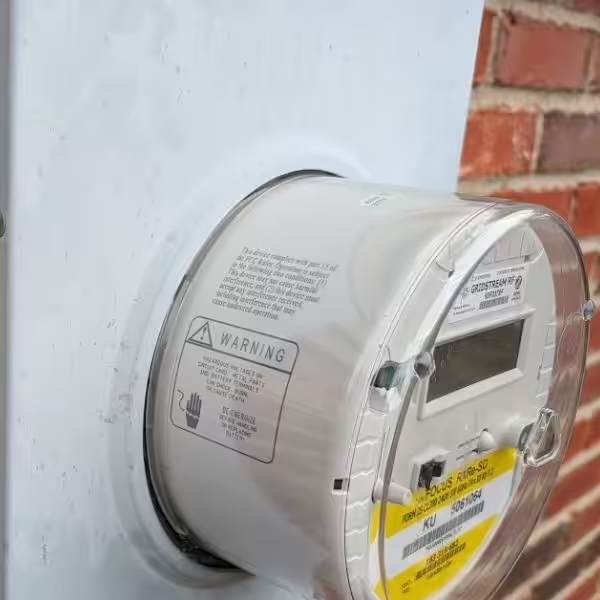
A new report shows 268,000 utility disconnections in a single year as residential electricity rates have climbed 128% since 2001. Hundreds of Kentuckians say this winter brought the highest bills they’ve ever seen.
LEXINGTON, Ky. — When Hali Jane Rossi opened her Kentucky Utilities bill last month, she broke down in tears. The single mother had recently moved to Kentucky for its lower cost of living, but the nearly $600 charge staring back at her — about three times what she expected — left her stunned.
“I called and they suggested I have my appliances looked over,” Rossi said. “My property manager said the homeowners are refusing to pay for that and blamed the weather.”
She isn’t alone. After this newsroom asked Central Kentucky residents on social media whether they had seen unusually high utility bills this winter, responses flooded in. Within days, hundreds shared screenshots and stories filled with shock, frustration and financial strain. Their experiences point to a regional affordability crisis that stretches far beyond one stretch of cold weather.
Hard data now backs up those complaints. A February report from the Appalachian Citizens’ Law Center, the Energy Equity Project at the University of Michigan, and the Energy and Policy Institute found that Kentucky’s electric utilities carried out more than 268,000 service disconnections in the most recent fiscal year — an 87% jump from the year before. Since 2001, residential electricity rates in Kentucky have increased 128%. Meanwhile, the federal safety-net program meant to keep low-income families connected covers less than half of the actual need.
‘My bill was the same as my rent’
Readers’ stories followed a clear pattern: longtime residents in familiar homes, living as they always have, suddenly opening bills two or three times higher than anything they had previously seen.
Hunter Townsend, who has lived in the same two-bedroom duplex for six years, shared his monthly totals. His bill measured $82 in November, rose to $268 in December, climbed to $388 in January and reached $352 in February. “It is the highest that it has ever been in that timeframe,” he wrote. He added that his neighbor in the adjoining unit saw the same spike.
Alan Walters reported a $792 KU bill for his 2,700-square-foot house, even after insulating his crawlspace in the fall. Amanda Todd saw her bill jump from about $200 in November to $557 in January and $888 in February for a 2,000-square-foot home. Nicole Escobar Martinez summed it up: “My electric bill is same as my rent.”
Apartment residents felt the strain, too. Cara Mia Colt received a $480 bill for a 700-square-foot apartment with the thermostat set at 65. Stefani Joi Heller, who lives in a small one-bedroom, said her bill rose from $40 in November to $122 in January while keeping the thermostat at 62. Heather L. Puckett, a four-year tenant in the same apartment, said her bill tripled to $400. “Ridiculous,” she wrote. “I’ve lived in the same apartment 4 years and never had it been this high.”
Several residents said their bills defied explanation. Devyn Kellione reported nearly $600 despite having the meter pulled and using no electricity for eight days in the billing cycle. Therese Dialls received a $300 bill for an apartment she hadn’t occupied for two months. Danielle Jarboe said she kept her home cooler than in past years but still saw her bill double compared to the previous five Januarys.
Some totals would stretch any budget. Char Liese Lewis reported $677. Nathan Hoskins — a public school teacher — received a $755 bill, nearly half his paycheck, he said. Mykala Collins posted a single number: $1,063. Sarah Popkhadze Mohammed, who has lived in her home for 10 years with the heat set at 68, said her bill rose from its usual $140 to $500 last month and $800 this month.
Frustration wasn’t limited to KU customers. Several readers pointed to Columbia Gas of Kentucky, including one who saw a jump from $50 to $330. Another, identifying herself only by her first name, said her Clark Energy bill doubled from December to January and doubled again in February. When she contacted the utility, a representative acknowledged recent fee increases but couldn’t fully explain the spike.
This newsroom also received private emails from residents reluctant to speak publicly. One described a $590 KU bill with just 10% more usage than the same month the previous year, when the bill was $250. Another wrote about a $650 charge for a newly remodeled home whose previous high had been $288. “Being first time homeowners, and being young starting out, we were unsure of what to expect,” the couple wrote. Emma Moore, a Kenwick neighborhood resident, said she contacted four law firms about a potential class-action lawsuit against LG&E and KU, arguing that price gouging during a declared state of emergency is illegal.
What the data shows
The personal accounts align with findings from “Lights Out in Kentucky: Energy Burdens and Electricity Disconnections Across the State,” released this month by the Appalachian Citizens’ Law Center, the Energy Equity Project and the Energy and Policy Institute.
Researchers analyzed disconnection data from 23 electric utilities regulated by the Kentucky Public Service Commission, covering 1.74 million households. Their conclusions were stark. In fiscal year 2025, running from July 2024 through June 2025, utilities disconnected customers 268,885 times — an 87% rise from the previous fiscal year. Louisville Gas and Electric and Kentucky Utilities, which together serve about 1.3 million customers, accounted for 77% of those disconnections.
LG&E’s disconnections alone increased 285% between fiscal years 2024 and 2025 — a surge the authors called “somewhat surprising” because no rate increase occurred during that period, and the spike appeared in every month, not just during extreme weather.
“It was just kind of shocking to see how much of an increase there was, and in particular that LG&E, KU was driving a lot of that,” said Rebecca Shelton, policy director at the Appalachian Citizens’ Law Center and a lead author of the report. “Once you’re disconnected, that’s where the hardship starts.”
Kentucky’s weighted average energy burden — the share of household income spent on electricity and home fuels — stands at 5.8%, just below the 6% affordability benchmark researchers use. But that average conceals wide disparities. Nearly half of the state’s census tracts exceed the 6% mark. More than one in five housing units face unaffordable energy bills. For households earning below 150% of the federal poverty level, energy burdens range from 13.6% to 21.8%, depending on the utility.
The heaviest burdens cluster in two seemingly different regions: the Louisville metropolitan area and Eastern Kentucky. Five of the 10 most burdened census tracts lie in Jefferson County; the other five sit in Appalachian counties including Pike, Perry, Knox and Bell.
“When it comes to utility affordability, one of the most urban areas of the state and one of the most rural areas of the state have a lot in common,” Shelton said.
Who gets disconnected — and who doesn’t
The report highlights that high energy burdens don’t always lead to high disconnection rates. Utility policies make a significant difference.
Kentucky Power Company, which serves much of Eastern Kentucky and has the state’s highest average energy burden at 9.6%, recorded the lowest disconnection rate studied: just 0.23% of customers per month. That rate declined over three years, even after a January 2024 rate increase and an unusually cold winter in early 2025.
Researchers pointed to Kentucky Power’s protective measures: limiting disconnections to weekday business hours, banning them when temperatures are forecast at 32 degrees or below, giving customers 21 days to pay instead of 15, and running its own assistance program funded by customer charges matched two-to-one by shareholders.
By contrast, LG&E, which has the lowest average energy burden at 4.7%, posted the highest disconnection rate. The report cited a sharp drop in federal LIHEAP assistance for LG&E customers in fiscal year 2025 and the rollout of smart meters that allow remote disconnection without sending a worker.
“I’m not saying that that is why there are more disconnections, but it is certainly easier to disconnect and reconnect people when you don’t have to drive out to their house,” Shelton said. “There haven’t been any studies on that, but I think it’s definitely something to explore.”
Drew Gardner, a spokesperson for LG&E and KU, said disconnection totals vary by year and noted that smart meters can shorten outages because workers don’t need to travel for reconnections. He added that the utility eliminated its remote reconnection fee.
The report also found utilities sometimes disconnect customers over small debts. Most utilities had cut off service for balances under $100, and Nolin RECC had disconnected customers who owed less than $25. Shelton described it as “shocking” how little debt could trigger a shutoff.
Reconnection fees add to the burden. Most utilities charge them, ranging from $30 to nearly $400. South Kentucky RECC charges $387 for after-hours reconnection compared to $47.76 during business hours.
A safety net with holes
The federal Low-Income Home Energy Assistance Program, or LIHEAP, serves as the main safety net for struggling families. In Kentucky, 23 Community Action Agencies administer the program, providing eligible households — those at or below 150% of the federal poverty level — with a one-time credit of up to $250 for a seasonal subsidy or up to $400 in a crisis.
Researchers concluded those amounts fall far short. In fiscal year 2025, LIHEAP distributed $33.3 million to customers of the 23 studied utilities, while disconnected customers owed $68.6 million in total debt. Preventing all disconnections would have required more than $100 million, the report estimated.
Measured against full affordability, LIHEAP covers only 1% to 9% of the gap between what eligible households pay and what an affordable bill would be.
The program’s future remains uncertain. Federal funding for Kentucky dropped from $89 million in fiscal year 2023 to $59.5 million in fiscal year 2025. The Trump administration’s proposed 2026 budget called for eliminating LIHEAP entirely, and in April 2025, the administration dismissed the program’s entire staff, delaying fund distribution to states.
Who bears the heaviest burden
Low-income households carry energy burdens five times higher than higher-income households. Renters face burdens 1.5 times greater than homeowners, regardless of a home’s age. Residents of manufactured housing spend 9.6% of their income on energy. In four out of five utility territories with majority people-of-color census tracts, those tracts carry higher average energy burdens than majority-white tracts served by the same utility.
Social media responses reflected that strain. Halima Williams wrote that she paid $1,600 to KU over the past year and another $1,000 across December and January alone — for a two-bedroom house where both adults work during the day. Bobby Curtis asked, “Mine is 452 what is people to do foreal.” Mary Rest, facing a $600 bill, asked, “How do they expect someone to pay that?”
Some respondents criticized corporate profits. Nathan Hoskins noted that PPL Corporation, KU’s parent company, reported $915 million in net profit during the first nine months of 2025, up nearly $200 million from the previous year. “Public Utilities should NEVER BE FOR PROFIT,” one commenter wrote. “THIS IS UNACCEPTABLE.”
Rita DaVega questioned the role of the Public Service Commission, which approves rates. “For once, I’d like to see them DENY a rate increase,” she wrote. “Who are these people that control the ‘show’?”
Calls for action
Report authors proposed several policy changes, including creating a state-funded assistance program of at least $75 million annually to supplement shrinking federal LIHEAP funds. They urged banning disconnections during extreme temperatures and weekends, setting a $100 minimum debt before shutoff, expanding weatherization efforts and giving the Public Service Commission authority to approve low-income rate designs.
Current Kentucky law has led the PSC to reject income-based rate classifications, citing statutes interpreted as prohibiting different rates based on income. The report argues lawmakers must grant explicit authority for equitable rate structures and debt management programs.
Some proposals are already moving. Gov. Andy Beshear proposed a $75 million utility bill assistance fund. A joint resolution from Sen. Scott Madon, R-Pineville, would direct the PSC to examine ways to improve affordability for low-income and fixed-income residents. In 2025, a House bill that would have banned disconnections during extreme temperatures and limited them to weekday business hours failed to pass.
“I think this is such a huge problem, and I think people are really eager for some solutions,” Shelton said. “But there is a lot to consider in terms of understanding what can we get that’s actually going to be effective.”
Meanwhile, the bills keep coming
For many Kentuckians who responded, policy debates feel distant as immediate bills demand payment.
Sarah Wilson reported a $348 bill in January and $436 in February and worried about March. Brittany Walters, who usually pays $200 to $300 in winter, received a $913 bill; she said KU blamed the cold and suggested inspecting her water heater. Makenzie Brooks reported a bill over $500 and said a representative called her usage “excessive” and offered a meter check for $90.
Becks Sky, who has lived alone in a 1,000-square-foot Wilmore home for 10 years and runs appliances once a week, said her bill had never exceeded $163 until it reached $249 this month. “We’ve had winter storms like this before, plenty of times,” she wrote.
Danielle Dishman, who lives in an apartment, saw her bill rise from $130 to $230 and regretted plugging in her Christmas tree. “The sudden jump from my regular bill has doubled,” she wrote. “I’m like howwww!! This is so disappointing because the money has to be taken from somewhere else.”
Somewhere else. That choice defines the reality for an estimated one in three Kentucky adults, according to census data: deciding which necessity — medicine, food or heat — to sacrifice to keep the lights on.











Leave a Reply