

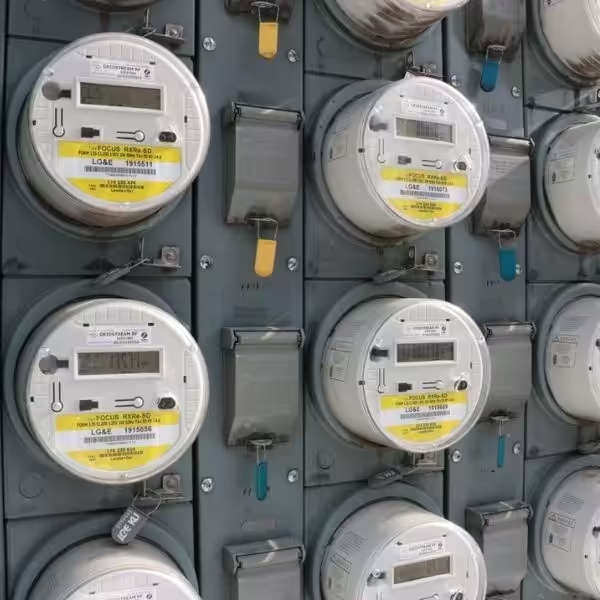
A matrix of electric utility meters for Louisville Gas and Electric. (Kentucky Lantern photo by Liam Niemeyer)
Kentucky electric utilities carried out more than 268,000 service disconnections over a recent 12-month period as federal funding meant to prevent shutoffs fell far below what Kentuckians needed, according to a recent review of state and federal data.
The February report reviewed disconnection data that 23 electric utilities submitted to the Kentucky Public Service Commission across three fiscal years. It also analyzed each utility’s policies and fees outlining when and how disconnections and reconnections can occur.
The report found an 87% jump in disconnections across all utilities in fiscal year 2025 (July 2024–June 2025) compared with the prior fiscal year. A sharp rise in shutoffs by Louisville Gas and Electric and Kentucky Utilities, known as LG&E and KU, largely drove the increase. These investor-owned utilities serve the largest share of electric customers in the state, providing gas and electric service to about 1.3 million customers.
“It was just kind of shocking to see how much of an increase there was, and in particular that LG&E, KU was driving a lot of that,” said Rebecca Shelton, policy director at the Appalachian Citizens’ Law Center and one of the report’s authors. “Once you’re disconnected, that’s where the hardship starts.”
The report, co-published by the Energy Equity Project at the University of Michigan and the watchdog nonprofit Energy Policy Institute, also examined rising residential electricity costs in the state — up 128% between 2001 and 2024 — and the financial strain low-income Kentuckians face in paying their power bills.
The findings identified census tracts across both urban and rural Kentucky where residents carry the highest “energy burden,” meaning a larger share of their income goes toward energy costs.
“When it comes to utility affordability, one of the most urban areas of the state and one of the most rural areas of the state have a lot in common: Eastern Kentucky and Louisville metro,” Shelton said.
Drew Gardner, a spokesperson for LG&E and KU, addressed questions — including why their disconnections rose — in an emailed statement. He said the number of shutoffs changes year to year “for several reasons, including our weather-related suspensions.”
“Our current year-round policy factors in Kentucky’s variable weather, which can bring stretches of unseasonably warm or cold days throughout the year where we suspend service disconnections,” Gardner said. “Additionally, long-term moratoriums make it possible for customers to build up significant debt that may be more difficult to resolve. Large, accumulated balances can create greater financial hardship for customers and may reduce the amount of assistance available from limited community resources.”
Gardner added that the utility urges customers struggling to pay to reach out quickly to arrange payment plans or connect with community resources that can help cover bills.
What the report data shows
The authors found that utilities serving a high percentage of customers with heavier energy burdens did not automatically disconnect customers at higher rates.
Big Sandy RECC, an electric cooperative serving parts of Eastern Kentucky where many residents face higher energy burdens, recorded seven months during the roughly three-year period without disconnecting any customers. That included winter months leading into 2025. Jeff Prater, the cooperative’s president and CEO, did not respond to emails seeking comment about its disconnection policies.
In contrast, the authors reported that Louisville Gas and Electric, which serves Louisville and nearby counties, posted a “surprisingly high” disconnection rate even though its customers, on average, carry the lowest energy burden among the utilities studied.
Between fiscal year 2025 (July 2024–June 2025) and fiscal year 2024 (July 2023–June 2024), disconnections by Louisville Gas and Electric climbed 285%.
“This enormous increase in disconnections is also somewhat surprising because there was not a rate increase during this time period and an increase in disconnections occurred across all months,” the authors wrote.
The report also determined that a long-running federal safety net for low-income households does not come close to covering the outstanding debt of Kentuckians who lose service. The Low-Income Home Energy Assistance Program, or LIHEAP, gives eligible households a one-time credit toward summer or winter electricity bills, including emergency cases when someone faces disconnection.
From July 2024 to June 2025, LIHEAP distributed $33,253,076 to customers tied to the 23 utilities reviewed. During that same period, customers whose electricity was disconnected owed a combined $68,560,819. When combined, the authors estimated that more than $100 million would have been needed to prevent shutoffs during that timeframe.
Shelton called LIHEAP “really important” but said “the scale of the need has just outpaced that program.”
The authors suggested that reduced LIHEAP funding for Louisville Gas and Electric customers in fiscal year 2025 may have contributed to the spike in disconnections. They also noted the company’s installation of smart meters, which allow remote disconnections and reconnections.
“I’m not saying that that is why there are more disconnections, but it is certainly easier to disconnect and reconnect people when you don’t have to drive out to their house,” Shelton said. “There haven’t been any studies on that, but I think it’s definitely something to explore.”
Gardner said LG&E and KU’s smart meters “can reduce the duration customers are without service” because employees do not need to travel to restore power. He added that the utility eliminated its reconnection fee when customers are reconnected remotely.
“This technology ultimately helps us restore service more quickly and reduce costs for customers,” Gardner said.
The authors reported that nearly all of the utilities studied charge disconnection and reconnection fees that can add to the burden for customers already struggling. Those fees range from $30 to several hundred dollars.
Shelton told the Lantern that the after-hours reconnection fee charged by South Kentucky RECC stood out.
South Kentucky RECC charges $387 for after-hours reconnection, compared with $47.76 during regular business hours. The Lantern did not receive a response to emails requesting comment about the fee.
The report also reviewed how much debt customers owed before utilities disconnected them. Most utilities had carried out disconnections when customers owed less than $100.
One utility, Nolin RECC, had made more than one disconnection when a customer owed under $25. A spokesperson did not respond to requests for comment.
Shelton said she was “shocking” to see how little debt could trigger a shutoff.
“To put someone through that level of hardship for that small of a debt seems unreasonable to me,” Shelton said.
Joe Arnold, a spokesperson for Kentucky Electric Cooperatives, said in a statement that nonprofit electric cooperatives are led by local members who “always come first, not activist groups or outside agendas.”
“There are no out-of-town shareholders or profit motives,” Arnold said. “For any co-op members having trouble paying their bill, co-ops work directly with them to help them avoid falling into arrears and to address payment challenges before balances become unmanageable which can lead to permanent disconnection. No one wants that.”
Arnold said cooperatives have policies “to address extreme weather, medical needs, and hardship situations” and encourage members to discuss payment plans.
He added that cooperative members should contact their local co-op to explore “payment arrangements, levelized billing and other tools to avoid disruption in service.”
What the report recommends
The authors outlined several steps they believe could reduce utility disconnections in Kentucky.
Their recommendations include:
Establishing a $75 million annual state fund for utility bill assistance to prevent disconnections.
Setting a $100 minimum debt threshold before a disconnection can occur.
Banning disconnections during extreme heat or cold and over weekends.
Ensuring the Kentucky Public Service Commission has authority to address high energy burdens through “equitable” rates, utility debt management programs, and other measures.
Expanding weatherization programs for households with high energy burdens.
Shelton spoke earlier this month at a press conference supporting a bipartisan House bill that would set extreme temperature standards in state law to prohibit certain disconnections.
She said Democratic Gov. Andy Beshear’s proposal to create a $75 million utility assistance fund is “certainly helpful.” She also highlighted a joint resolution primarily sponsored by Sen. Scott Madon, R-Pineville, directing the Public Service Commission to examine ways to improve affordability for low- and fixed-income residents.
“I think this is such a huge problem, and I think people are really eager for some solutions,” Shelton said. “But there is a lot to consider in terms of understanding what can we get that’s actually going to be effective.”
Referring to Madon’s resolution, she said having the commission “study this issue is a good first step.”










Leave a Reply