

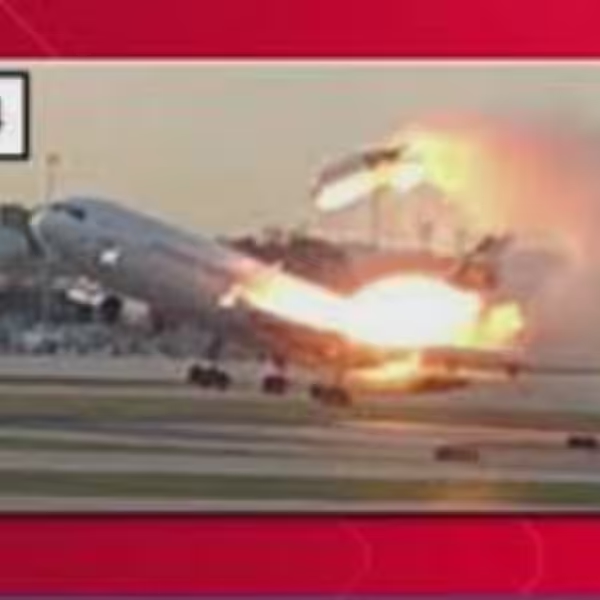
LOUISVILLE, Ky. — An aviation expert says newly released data from the National Transportation Safety Board (NTSB) helps explain why UPS Flight 2967 was unable to gain altitude after losing its first engine on Nov. 4, 2025.
Last week, the NTSB released an update as it continues investigating the deadly cargo jet crash that killed all three crew members and 12 people on the ground. The agency said Boeing had known since 2011 that a component connecting the wing to the engine, known as the spherical bearing race, could split into two pieces. Boeing said at the time that the issue “would not result in a safety of flight condition.”
The NTSB update also included a graph containing data from the aircraft’s flight data recorder.
Ladd Sanger, an aviation attorney who frequently represents families of crash victims, reviewed the graph for WHAS11.
Credit: NTSB
Data from the recorder shows engine 1 stopped transmitting data around 5:13 p.m. and 11 seconds. Seconds later, engine 2 began showing thrust fluctuations.
The graph indicates that engine one, mounted on the left wing, stopped emitting data at about 5:13:11 p.m. The vertical dotted line marks the moment the engine separated from the aircraft.
Engine two then began fluctuating roughly one to four seconds later. According to Sanger, the blue line represents the front, or fan section, of the engine, while the red line below it shows the rear, or “hot,” section.
Sanger said the data aligns with compressor stalling or foreign object debris entering the engine.
“If we look at the parameters from the recorder, you see these drop-downs here, so both the compressor side and the hot side suffered decreases in performance for engine two,” Sanger said.
He added that this finding is unlikely to significantly alter the NTSB’s investigation, which is focused primarily on why the coupling system between the wing and the engine failed before engine one was lost. However, he said the data supports long-held suspicions about why the aircraft could not climb.
“That engine, engine two, wasn’t producing thrust. So this airplane couldn’t fly heavy the way it was with just one engine, engine three. If it had both engines, engines two and three, it could fly,” Sanger said.
The NTSB stopped short of confirming that conclusion in its update.
“FDR and other engineering data will be incorporated into the NTSB airplane performance study to understand why the airplane’s altitude did not substantially increase after separation of the left pylon and engine,” the report stated.












Leave a Reply