

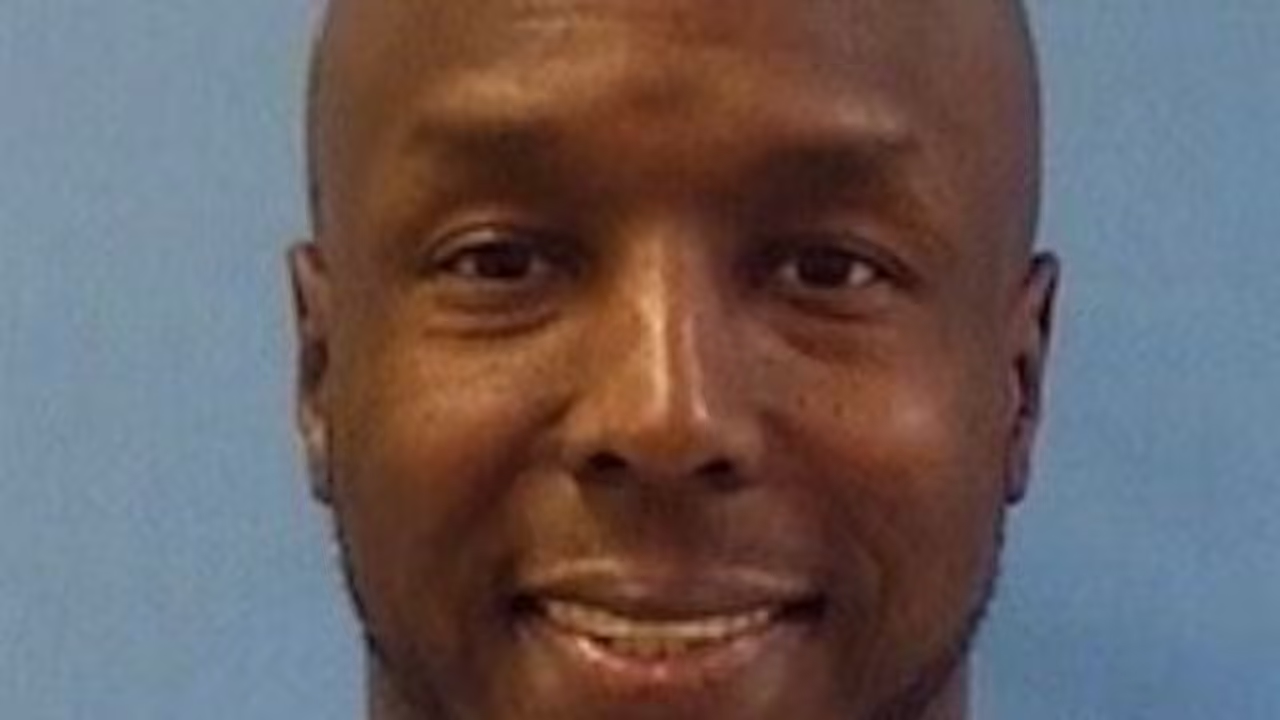
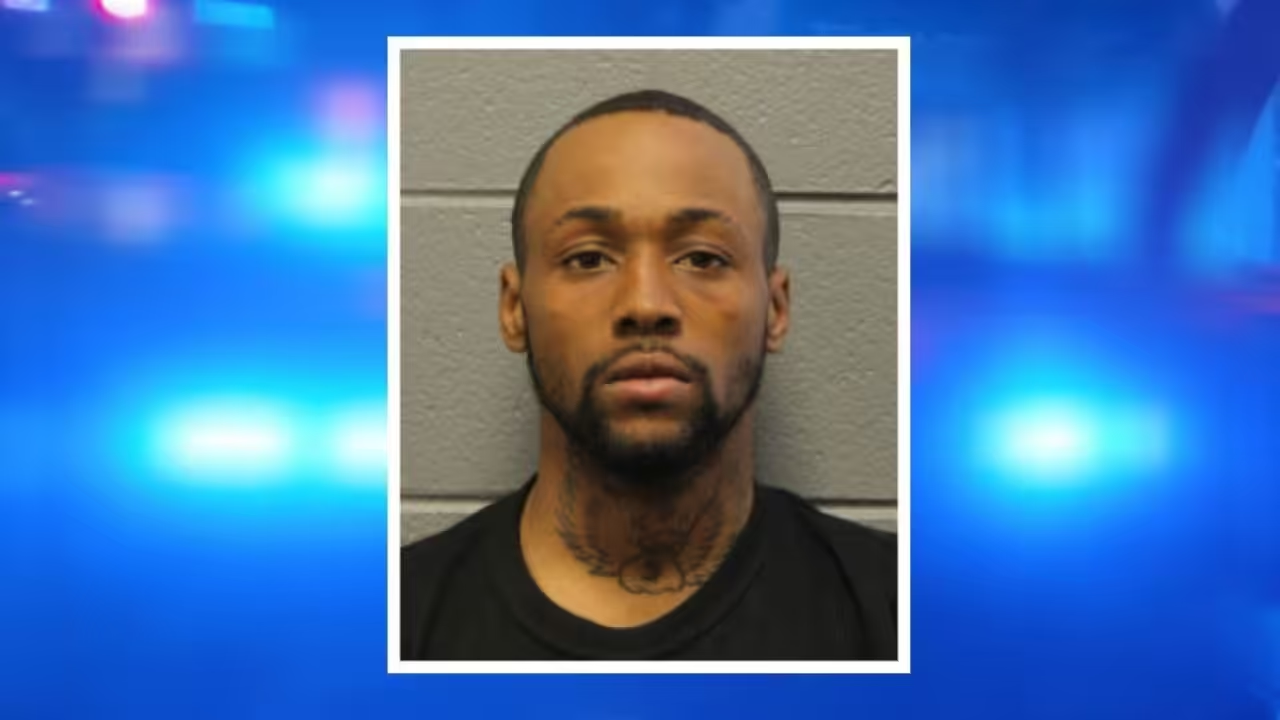
A man who served 26 years in prison for a crime he did not commit just earned a $13 million settlement accepted by the Chicago City Council.
Arnold Day was found guilty of first-degree murder and robbery on June 23, 1994. He was found guilty of murdering Jerrod Irving, 16, who was shot twice in the head on Chicago’s South Side in 1991. Day was sentenced to sixty years in jail.
Day was one of the victims who were wrongfully convicted in Chicago due to misconduct by Chicago police officers assigned to the Area 1 homicide division. These investigators included Kenneth Boudreau, James Halloran, William Foley, Michael Kill, and others.
They worked under infamous Detective Jon Burge, who was convicted of perjury in federal court in 2010 for disputing charges of torture that included obtaining false confessions from at least 118 Black men. Officers under Burge’s command used a variety of ways to torture individuals, including electric shocks, putting weapons in their mouths, staging fake executions, and tying a suspect to a radiator.
Day was only 18 years old when he was jailed in 1994 for two murders that he did not commit. He was acquitted of the murder of Rafael Garcia, 48, who was fatally shot during an attempted robbery near where Irving was wounded. During his trial, Day was able to demonstrate his innocence by providing alibi proof.
In that case, Day was charged with murder with Anthony Jakes, who was 15 years old at the time. He was convicted by a separate jury and sentenced to 40 years in jail.
In court, Jakes said that Detective Kill knocked him to the ground and kicked him in the chest until he confessed to the crime. During the trial, Jakes’ counsel provided images of injuries on Jakes’ body from his initial appearance.
While Day was acquitted in Garcia’s murder, he was convicted of murdering Irving almost completely on the basis of his fake confession. During the trial, no eyewitnesses testified against Day, and no forensic evidence linked him to the crime.
Day stated in court that during his arrest for Irving’s murder, Evans stomped on him, and Foley choked him and threatened to throw him out the window to get him to confess. Day made a false confession and relied on details provided to him by officers while shackled to the interrogation room wall.
During the trial, Day’s counsel attempted to submit evidence indicating that about a month after the incident, police retrieved a gun from a guy that was linked to the shot shells found near Irving’s body through ballistics testing. The individual was not charged with Irving’s murder. The judge refused to allow the evidence, despite the fact that the gun linked to the murder was a Smith & Wesson semi-automatic pistol. It was not a TEC-9, as Day claimed in his confession to have used when shooting Irving.
After being convicted of murdering Irving, Day attempted an appeal, which was dismissed by the Illinois Appellate Court in 1996. In 1997, Day requested a new trial but was denied.
However, in 2017, the abuse Commission determined that Day’s allegations of abuse during interrogation were credible.
“Although Detectives Boudreau and Foley have denied that the incidents Day described ever occurred… there is pattern and practice evidence suggesting that both officers may have engaged in abusive conduct during police interrogations,” the Commission found. ” Moreover, given that a jury acquitted Day of the murder of Raphael Garcia, despite a signed confession to that crime, it is reasonable to conclude that the jury did not credit testimony by the officers contradicting Day’s alleged mistreatment.”
Day’s conviction was overturned after attorney Steven Greenberg filed a post-conviction petition citing nearly 50 cases, primarily murders and other violent crimes, in which Boudreau, Foley, Kill, Halloran, and other detectives they worked with were accused of beating and torturing defendants during interrogations, as well as physically abusing witnesses to falsely implicate them.
The petition included a sworn affidavit from Krona Taylor, who resided in the building where Irving was slain. Taylor claimed police, including Boudreau, interviewed her for 16 hours after she reported seeing two people approach the building and then hearing gunshots. Taylor’s description of the murderer did not match the description of Day.
Jakes filed an appeal in 1996 with the Illinois Appellate Court. He later updated the petition to include allegations of physical torture and coerced confessions in 13 cases involving Kill and 16 cases involving Boudreau.
In 2016, records revealed that Kill had been accused of assaulting suspects in 19 distinct cases, including the use of electric shocks.
In 2018, special prosecutor Robert Milan persuaded a judge to overturn Day’s conviction. Jakes, who had spent nearly 19 years in prison, also had his conviction overturned that year. Jakes paid $11.6 million to settle his federal case against the city of Chicago in October 2024.
Renee Spence, Day’s attorney, said in a statement, “Nothing can make up for the years that these policemen purposefully robbed from him. But he is pleased that this 35-year experience is now over and that he can now begin to rebuild his life in peace.
Overall, twenty-four Black males have been exonerated after being convicted on evidence gathered by the same detectives who falsified the case against Day.



Leave a Reply