

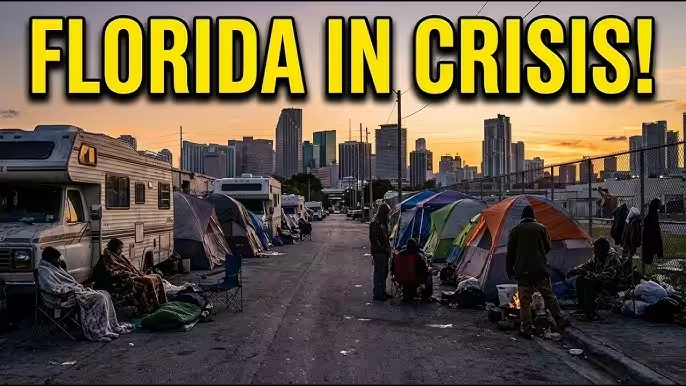
Florida News Network: South Florida — Imagine spending forty years working, paying taxes, and doing everything right — only to retire and discover that a Florida apartment now costs more than your Social Security check. For thousands of older and lower-income Floridians, a motor home or RV parked on their own property is not a lifestyle choice. It is the last barrier standing between them and homelessness. And right now, city after city across the state is moving to strip that away.
From Hialeah to Miramar to Opa-locka, South Florida municipalities have passed — or are rushing to pass — local ordinances that prohibit people from living in recreational vehicles, even on land they legally own. The fines are steep. The deadlines are tight. And for people already pushed to the edge by Florida’s punishing housing market, the message coming out of city hall could not be more direct: you are not welcome here.
What Cities Are Actually Doing:
The push is spreading fast. Miramar commissioners recently approved an amendment prohibiting the use of RVs as living quarters, joining a growing list of South Florida cities that have moved to restrict vehicle dwelling in residential areas. City officials in Miramar pointed to roughly 80 complaints received the previous year about RVs being used as rentals, with some hooked up to water, sewer, and electricity connections. “They are parked on sidewalks, and it’s not only illegal, but it’s also a safety issue,” Commissioner Yvette Colbourne said in defense of the ordinance.
Hialeah led the charge earlier, passing rules that limit residents to one recreational vehicle, no longer than 33 feet, parked only in a driveway. Multiple RVs on a single property are now banned outright. Opa-locka followed suit, advancing a proposed ban carrying a $500 fine for violations and a tight 30-day window to comply. The city’s commissioner, who sponsored the ordinance, said she did not want Opa-locka to become a “trailer park” — a statement that did not sit well with affordable housing advocates.
Statewide, the picture grows even more complicated. A county-by-county breakdown of Florida’s RV rules reveals that nearly every county either explicitly prohibits full-time RV living on private land, caps it at 14 days or fewer per year, or allows it only during active home construction. Hamilton County, which had previously issued RV living permits on private land, placed a moratorium on all new permits as of December 2024. Only landowners holding existing permits may continue.
The Real Reason People Are Living in RVs:
To understand why this is happening, you have to look at what Florida’s housing market has done to ordinary people over the last five years. In that time, the median price of a single-family home in Florida climbed by roughly $150,000 — a 60 percent jump. As of mid-2024, the median sale price sat at $409,700, according to Redfin data. Rents have followed the same upward trajectory, and insurance costs have added yet another layer of financial pressure squeezing homeowners and renters alike.
For seniors, the numbers are especially grim. A recent analysis from the Nonprofit Center of Northeast Florida found that more than half of older adult renters in Duval County now spend at least 30 percent of their income on housing, while one in four spends more than half. In that same county, the number of renter households headed by someone 65 or older jumped 71 percent between 2014 and 2024. “They’re calling about rent, rent increases,” said one nonprofit worker quoted in the report. “A lot of times, their rent is increasing, and so they are at risk of being evicted and displaced.”
These are not people gaming the system. These are retirees, low-wage workers, and families displaced by hurricanes and rising costs who turned to an RV as a survival strategy when every other door closed. Fining them for staying and telling them to leave is what critics are calling it plainly: punishing poverty.
The Pushback Is Getting Louder in the Free State:
Floridians are not taking this sitting down, and the fight is unfolding on two fronts at once. The first is in Tallahassee. In 2023, the Florida Legislature passed a significant property rights protection tucked inside House Bill 437, creating Florida Statute 720.3045. The law bars homeowners’ associations from restricting residents from storing items — including RVs and boats — on their own property, as long as those items are not visible from the street or from a neighboring parcel. That means HOAs can no longer issue blanket bans on RVs in backyards that are properly screened from view. For many homeowners, this was a meaningful win, and it lit a path forward for future battles.
The second front plays out in local courthouses and city commission meetings, where residents and advocates are challenging ordinances they argue reach far beyond what cities have any right to regulate. The core argument is straightforward: if you own land in Florida, you should have the right to decide how you live on it, within reasonable safety limits. Using an RV as your home on property you own and pay taxes on is not the same as illegally subletting a vehicle in someone else’s driveway. That distinction matters, and courts are beginning to hear it. Legal challenges to the most aggressive local ordinances are working their way through the system, and the outcome could set the rules for hundreds of thousands of Floridians who are one rent hike away from needing those same options.
Safety vs. Survival: The Real Debate Nobody Wants to Have:
City officials are not entirely wrong when they raise concerns. Illegally run RV rentals that overload neighborhood sewer lines, block sidewalks, and create fire hazards through improvised utility hookups are real problems that deserve real solutions. No one disputes that. But there is an enormous difference between targeting bad actors running unlicensed rental operations out of multiple RVs and punishing a 72-year-old widow who parks her motor home on her own property because she cannot afford the apartment down the street.
Right now, many of these ordinances draw no such distinction. They sweep everyone into the same net, and the people who fall through it are almost always the most vulnerable. Meanwhile, the state’s affordable housing programs are themselves under strain. A December 2025 report from the Florida Office of Program Policy Analysis and Government Accountability warned that thousands of affordable housing units set aside for low-income households, elderly residents, and people with special needs are set to expire before 2030. The safety net already has holes in it — and cities keep pulling out more threads.
Florida Forward:
The clash between city zoning authority and the basic human need for shelter is only going to grow sharper. As long as Florida’s housing costs remain out of reach for average workers and elderly retirees, more residents will turn to motor homes as a practical housing solution. Cities will likely face mounting legal challenges over property rights and privacy violations if they continue relying on unannounced code inspections to enforce their bans.
Moving forward, local governments may have no choice but to look beyond fines and code enforcement. Finding ways to create legal, safe, and regulated spaces for alternative living arrangements is not optional — it is urgent. Because once the backyard safety net disappears entirely, there will be nothing left to catch the people who fall.








Leave a Reply