

KANSAS CITY, Mo. (WDAF) – A picture of the Last Supper hangs in the Niemanns’ dining room. Just beyond it is the kitchen, where Greg and Jennifer usually prepare meals together. Around this time each day, dinner holds special meaning for the couple and their young son.
Greg told Nexstar’s WDAF that five years ago, their meals often included “pork chops, hamburgers, spaghetti, a lot of beef, meat, and potatoes.”
Now, dinner looks different. Tonight, they’re having burgers—emu burgers—because Greg can no longer eat red meat.
“The hardest part is shopping [and] looking at every label,” Jennifer said.
Greg cannot eat beef, pork, lamb, bison, or any mammal-derived products.
That restriction also means no milk. He once relied on cereal and milk for breakfast. He also had to give up favorite snacks like Cheez-It crackers and M&M’s.
“I really miss M&M’s,” Greg said. His limitations go beyond food, as certain medications and dental products are also off-limits.
What happens if he consumes something from a mammal?
“I’ll have a gastrointestinal problem, or I may go into full anaphylaxis shock,” he said.
Now, his diet mainly includes “turkey, chicken, chicken, chicken, chicken”—along with emu burgers, which more closely resemble red meat in taste and texture.
Greg is living with AGS, also known as alpha-gal syndrome, a condition that can be life-threatening.
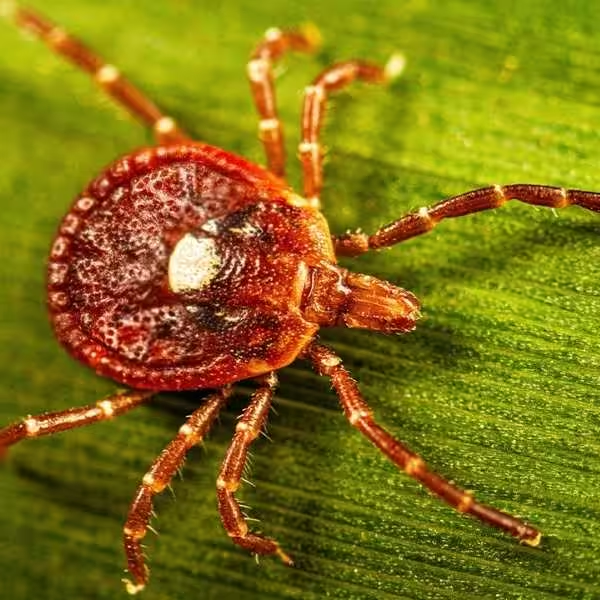
The condition begins with a bite from a Lone Star tick, which triggers the body to produce antibodies against a molecule called galactose-alpha 1,3-galactose, or alpha-gal. These antibodies then cause allergic reactions.
Greg nearly died from the condition after breaking out in hives and requiring ICU care.
The Centers for Disease Control and Prevention (CDC) reports that Missouri and Kansas are hotspots for AGS. Lawmakers in Missouri are considering a bill that would make reporting alpha-gal cases mandatory. A study published last fall found that AGS has seen an “explosive rise” across the U.S., with the Lone Star tick continuing to expand northward.
Federal lawmakers are also considering requiring manufacturers to list alpha-gal as an allergen, similar to labeling for eggs, milk, and soy.
Researchers at the University of Missouri School of Medicine are working to better understand the condition and find solutions for affected families.
“As a physician, we like to have definitive answers for people. Alpha gal is the exception,” said Dr. Benjamin Casterline, who recently received a grant aimed at finding a cure.
By analyzing blood samples and conducting experiments, Casterline’s team hopes to identify biomarkers that explain how the condition behaves in the body. This research could help doctors provide better guidance, as current advice largely focuses on avoiding certain foods indefinitely.
The study is using samples from patients already being treated at Casterline’s clinic. While new participants are not being added at this stage, he hopes to expand the research in the future.
“We’re trying to gather the data together and connect the pieces of the puzzle,” Casterline said.
For now, the Niemann family continues adjusting to life without red meat.
“I don’t look at it as something I want to consume anymore,” Greg said.












Leave a Reply