

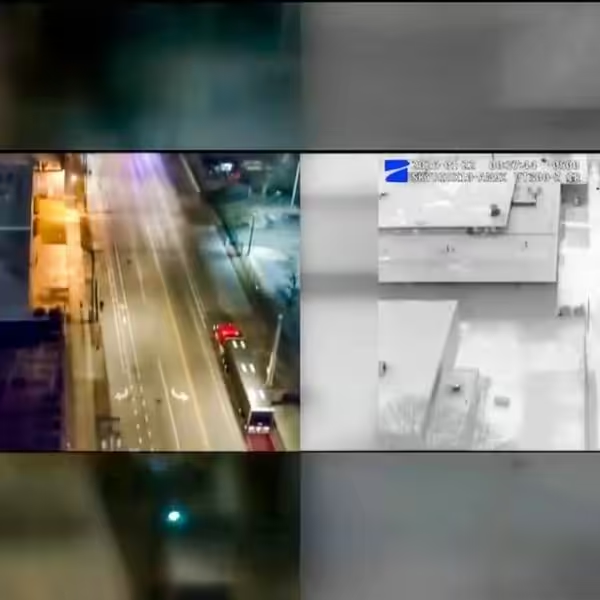
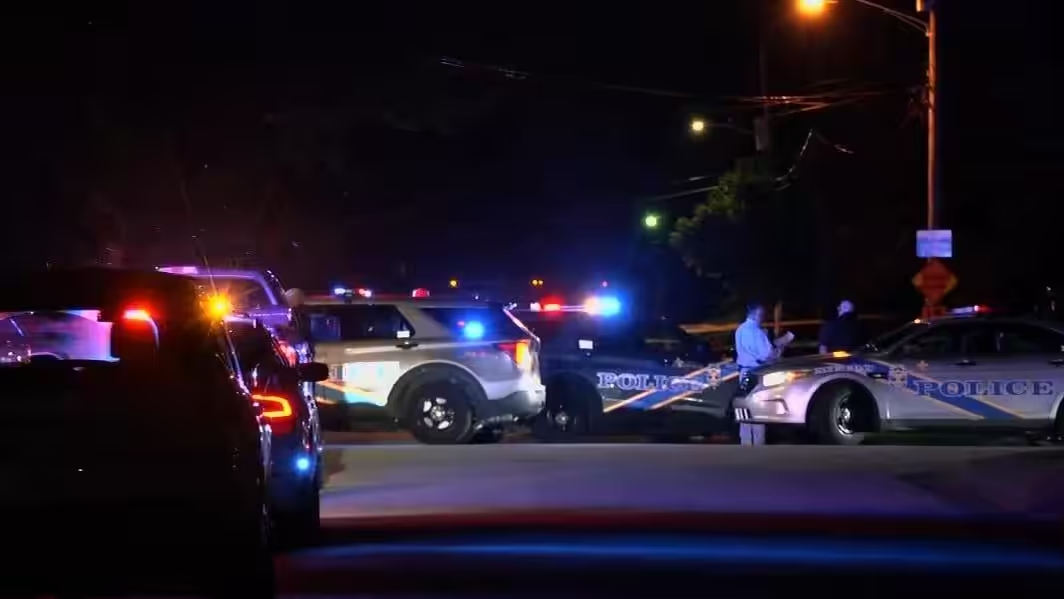
Late Saturday night in Louisville, a burglary suspect ran from Doss High School, likely counting on darkness, distance, and winter conditions to evade police. That attempt ended quickly when an officer launched a drone, which immediately revealed the suspect’s location from above.
Within moments, the drone tracked the suspect, recorded the arrest, and helped officers locate evidence hidden in the snow. The technology removed guesswork and eliminated the need for a prolonged ground search.
For Louisville Metro Police Department Chief Paul Humphrey, the incident highlighted how drones have moved beyond experimentation and become a core policing tool.
From emerging technology to everyday policing
“This is just absolutely taking off for us,” Humphrey said while speaking with local media, describing drones as standard equipment rather than optional technology.
LMPD currently operates 14 drones, including the Skydio X10, shared among several dozen officers trained to deploy them directly from the scene. These drones are not limited to specialty units and can be launched immediately when needed.
Humphrey said one of the most effective features of the Skydio X10 is its thermal camera. While autonomous flight and obstacle avoidance are useful, thermal imaging has consistently delivered results in real-world situations.
Thermal imaging allows officers to detect heat signatures through darkness and light cover, exposing hiding spots that would otherwise remain unseen. In the Doss High School case, it shortened the search and reduced uncertainty.
LMPD wants to double its drone fleet
Humphrey wants to expand the department’s fleet to about 28 drones, with the goal of providing round-the-clock drone coverage across all LMPD divisions. That expansion would shift drones from an occasional resource to a constant operational presence.
“These are tools for us,” Humphrey said. “These are tools for us to take bad people off the street and do it in a safer way.”
Thermal technology reshapes nighttime policing
The safety benefits were also evident during a Jan. 22 incident involving MetroSafe’s Drone as First Responder program. In that case, a thermal-equipped drone located a shooting suspect hiding behind a bush at night, a tactic that has long worked against officers relying only on flashlights.
Thermal imaging removed that advantage.
The drone guided officers and a police dog toward the suspect using continuous visual data, reducing uncertainty and risk. Humphrey said this clarity helps officers approach situations with better communication and fewer surprises.
He also emphasized that drones can improve safety for suspects. Knowing a suspect’s precise location reduces the likelihood of rushed searches or high-stress encounters driven by uncertainty.
“These things have happened forever,” Humphrey said. “But to have that added layer of technology that gives us those odds is a very important tool that makes it safer not only for the officers, but it makes it safer for the suspects as well.”
A growing trend nationwide
Louisville’s experience reflects a broader national pattern. Departments often begin with small drone programs, see clear operational benefits, and then expand coverage. Thermal-equipped drones work at night, in poor weather, and in areas where helicopters are impractical, while reaching scenes faster than patrol units.
Questions about privacy and oversight remain, but police leadership increasingly views aerial thermal technology as a way to reduce risk rather than increase it.
As departments expand their drone programs, darkness and concealment are becoming less reliable tools for suspects attempting to evade law enforcement.



Leave a Reply