

Whistleblower claims maintenance workers were instructed to make unsafe electrical fixes to mislead future inspectors
The inspection uncovered faulty outlets that were improperly wired or not working. A whistleblower says he was directed to carry out unsafe repairs intended to deceive inspectors.
NEW ALBANY, Ind. — The New Albany Housing Authority failed a federal inspection in 2024 after inspectors identified more than 100 deficiencies across 30 apartments, with many issues requiring immediate repairs.
A whistleblower now alleges that some of those repairs were performed solely to mislead future inspections.
Faulty outlets found throughout complex
One of the most common problems identified during the 2024 inspection involved outlets that were either wired incorrectly or not functioning. A whistleblower claims supervisors ordered unsafe fixes designed to pass inspections rather than correct the underlying problems.
Melanie Malone has lived at the Parkview Terrace complex for four years and relies on affordable housing due to health issues that prevent her from working.
“It’s all right, but they got little mice and then the electricity in the kitchen, it just doesn’t work. And then I can’t even use my fireplace because it caught fire in the wall,” Malone said.
She said the outlet for her electric fireplace caused burn marks. When she contacted maintenance, she was told not to use the fireplace anymore.
“It was a three-prong, and they changed it to a two,” Malone said.
Housing authority failed federal inspection
Malone’s apartment was among 24 units reviewed by Housing and Urban Development inspectors in August 2024. The complex failed the inspection.
The report repeatedly cited missing or improperly wired ground fault circuit interrupter outlets, which were classified as severe deficiencies.
Pat Payne, who recently retired after seven years as a maintenance worker for New Albany Housing, said he performed drywall, electrical, flooring, and framing work during his tenure.
He said he became concerned about how he was instructed to repair the outlets.
“It was about a year and a half ago, maybe two, at this point that we were told to change out the GFIs, ground fault outlets,” Payne said.
Maintenance worker says he was told to bypass safety features
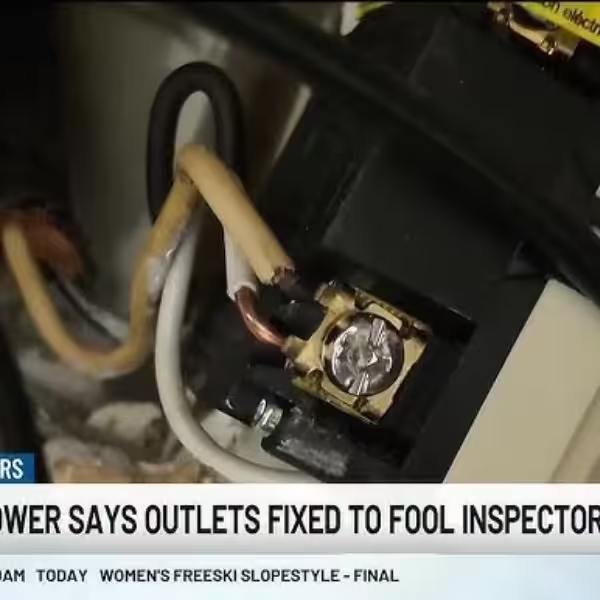
Payne said the outlets only had two wires, while GFCI outlets require a third wire. He said Property Service Director John Noble instructed him to fix the issue by connecting the outlet’s ground screw to its neutral terminal.
“And so I, not being a trained electrician, I questioned how I was going to do it. So I went to my boss, John Noble, and talked to him about it. And he said to bypass that,” Payne said.
“So basically all I was doing is putting a GFI in the wall that was no different than the outlet that was already there,” Payne added.
Payne said the repair did not seem right and that a licensed electrician later confirmed it was unsafe. When he raised concerns again, Payne said Noble told him it didn’t matter as long as the outlet passed inspection.
According to Payne, he made similar repairs in 30 to 40 apartments and said all maintenance workers were given the same instructions.
Work orders show repairs completed after failed inspection
WAVE obtained work orders completed during the week of Aug. 26, four days after the failed inspection. The records show maintenance workers documented outlet repairs in each affected apartment.
WAVE visited 26 apartments and asked tenants for permission to inspect their outlets. Five tenants agreed, including Malone.
When reporters used the same type of outlet tester employed by inspectors, the outlets appeared to be wired correctly. However, after removing the outlets from the wall, reporters found bypass wiring consistent with Payne’s claims.
Expert says wiring violates electrical code
Kyle Krueger, who leads the codes and standards division at the National Electrical Contractors Association, said the wiring method violates electrical code.
“It creates an opportunity for unwanted current to end up on other parts of the system and potentially create a shock hazard, or even a fire hazard,” Krueger said.
“That is one way that you could potentially trick one of those devices,” he said, referring to plug-in testers used during inspections.
City records show none of the maintenance staff, including Noble, are licensed electrical contractors.
Property maintenance official declines to comment
When asked for comment, Noble said he could not speak on the matter and referred questions to his supervisor, the executive director.
WAVE scheduled an interview with the executive director after outlining its findings in an email. Although the Housing Authority initially agreed, the interview was canceled four hours beforehand due to the executive director taking an unexpected trip out of town.
Malone said the situation makes her feel unsafe.
“Yeah, because a fire can happen anytime,” she said.
She said she has no other housing options and waited nearly a year to secure her apartment.
Payne said he reported his concerns to the city’s building and fire departments, as well as HUD. Messages left for the fire marshal and building inspector were not returned.
The housing authority board is scheduled to meet Feb. 18. WAVE plans to ask how quickly the disputed repairs will be redone.
The Housing Authority provided the following statement:
“The New Albany Housing Authority has been made aware of inquiries regarding electrical maintenance practices involving Ground Fault Circuit Interrupter outlets in certain older NAHA properties.
Many NAHA buildings were constructed decades ago, before modern electrical grounding standards were adopted. As a result, some buildings contain legacy two-wire electrical systems that do not include a separate grounding wire. This type of wiring was common at the time of construction and has historically remained in service under long-standing grandfathering protocols.
Over time, NAHA upgraded outlets in these buildings to three-prong GFCI outlets so residents could use more modern appliances. A GFCI outlet does not require a grounding wire to function and improves safety by shutting off power if it detects an unsafe electrical imbalance.
As a public housing authority, NAHA is overseen by the U.S. Department of Housing and Urban Development and governed by HUD’s federal inspection program. In 2024, HUD implemented a new inspection system known as NSPIRE, which introduced new outlet testing methods and requires prompt corrective action, often within 24 hours.
NAHA has undergone one NSPIRE inspection. During that inspection, outlets were tested using a handheld device to determine compliance. Where outlets did not pass, NAHA addressed the issues within the required timeframe and was not found in violation of HUD standards.
NAHA acted promptly and in good faith to meet HUD requirements and has since consulted with its licensed electrical engineer and NSPIRE training resources to review inspection outcomes and discuss long-term modernization options for older buildings. Those discussions are ongoing.
Resident health and safety remain NAHA’s top priority, and NAHA will continue making repairs and upgrades as feasible while responsibly managing limited public resources.”










Leave a Reply