

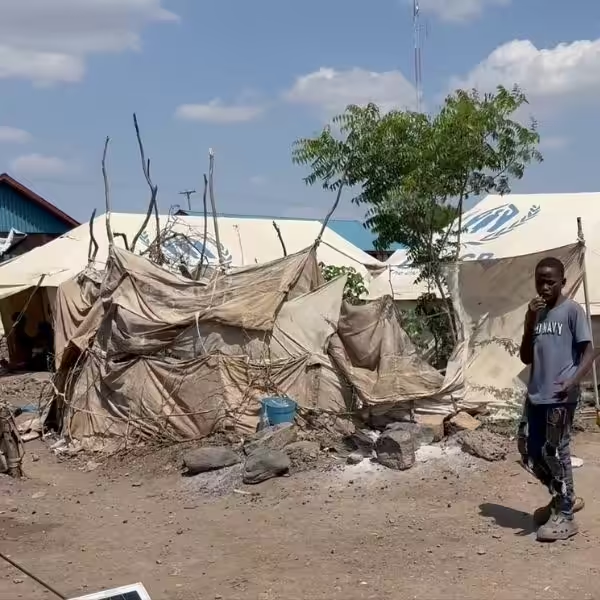
A young man walks through a refugee camp filled with damaged tents and rubble, where more than 320,000 refugees await entry into the United States. The tents display the logo of the United Nations Refugee Agency.
Nonprofit organizations serving refugee communities across Kentucky are preparing for significant changes to refugee resettlement, employment opportunities, and food assistance.
Refugees who have already been approved to enter the United States and have settled in the country are beginning to feel the effects of President Donald Trump’s One Big Beautiful Bill, which he signed into law on July 4.
Refugees and asylum seekers who have not yet entered the U.S. now face uncertainty following an indefinite nationwide pause on the resettlement program and the announcement of the lowest refugee admissions cap ever set. Under the new policy, white South Africans, also known as Afrikaners, will receive priority for admission.
President Trump has implemented new restrictions on refugee employment opportunities and food assistance while prioritizing entry application approvals for white South Africans.
Employment
U.S. Citizenship and Immigration Services approved and implemented major restrictions affecting how refugees gain employment in their U.S. communities. Employment Authorization Documents allow refugees to work legally in the country and require regular renewal. Until recently, individuals who filed renewal applications on time received automatic extensions.
Under the Interim Final Rule published on October 30, automatic EAD extensions will end. More recently, on December 5, USCIS introduced new measures that reduced EAD validity from five years to just 18 months for many refugee categories. These changes increase processing times, add administrative burdens, and raise the risk of employment gaps for refugee communities.
The One Big Beautiful Bill Act also increases EAD application fees and eliminates waiver programs for at-risk populations. Refugee Cash Assistance, a government benefit for newly arrived refugees, has been reduced to four months from 12.
Albert Mbanfu, executive director of the International Center of Kentucky in Bowling Green, said restricting employment authorization while cutting food benefits places refugees in an impossible position.
“You take away their benefits, but give them the opportunity to work. But now, you’re revoking employment authorizations, meaning they don’t have the benefits, they don’t have the right to work, so what? What do you want them to do?” he said.
Food assistance
A new eligibility rule removing food assistance for resettled refugees is expected to affect about 7,000 refugees in Kentucky and roughly 90,000 nationwide. That number is expected to grow as employment lapses increase, particularly for refugees arriving in the U.S. with limited resources during their first months in the country.
The restriction remains in place until refugees receive their green cards. However, green card applications and asylum interviews have been placed on indefinite hold. The change took effect on November 1 and impacts both current SNAP recipients and new applicants. The One Big Beautiful Bill Act also revokes Medicaid access for refugees, with that change scheduled to take effect in October 2026.
Cuts to refugee admissions
In addition to scaling back social safety net programs, the Trump administration has sharply reduced refugee admissions and limited countries of origin. In a presidential determination, Trump announced that only 7,500 refugees would be admitted to the U.S. in fiscal year 2026, the lowest number since 1980. Of those, 7,000 will be white South Africans, or Afrikaners.
President Trump has repeatedly claimed the policy addresses a “white genocide” in South Africa, a claim Mbanfu and other resettlement leaders dispute.
“There is no genocide in South Africa. None has been established, even if our government does not recognize it. Crime, yes, exists in South Africa. That crime affects the blacks more than the whites. The blacks are killed in greater numbers than the whites, so if the issue is crime then maybe you would bring in even more black South Africans than white South Africans, but that is not the case,” Mbanfu said.
He added that the policies represent a dramatic shift in how refugee agencies must operate.
“It’s totally different. In the past years, we’ve brought in people from different nationalities, Afghanistan, Sudan, Syria, Congo, Burma, all over. But this time, we’re like, ‘Okay. You have to resettle white South Africans,’ which is unfortunate, because if you look at the definition of a refugee as stated by the United Nations, all of the Afrikaners do not qualify.”
The Bowling Green center has approval to resettle 100 refugees in fiscal year 2026, all Afrikaners. That figure marks a steep drop from fiscal year 2025, when the center welcomed 597 refugees. Despite the decline, and with centers in Louisville resettling nearly 3,000 refugees last year, Mbanfu expects Bowling Green to host the highest number of refugees in Kentucky. He said that is largely because many resettlement agencies have declined to operate under the requirement to accept only Afrikaners.
This article has been carefully fact-checked by our editorial team to ensure accuracy and eliminate any misleading information. We are committed to maintaining the highest standards of integrity in our content.










Leave a Reply