

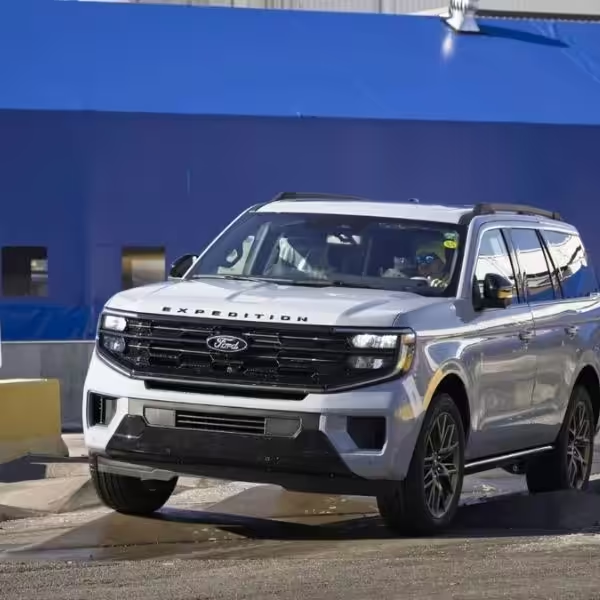
The automaker invested $500 million in the factory last year to prepare for the launch of the 2026 Expedition, which began rolling off the assembly line earlier this year.
A Ford Expedition is being driven in front of the Ford Kentucky Truck Plant. Another Expedition moves along a test track outside the plant, where inspectors use a 166-point checklist to conduct both static and dynamic audits to ensure quality.
LOUISVILLE, Ky. — Ford Motor Co.’s Kentucky Truck Plant operates like a symphony of noise and motion. The assembly line stretches across multiple levels, where robots and workers team up to assemble large components.
Every vehicle built at the plant uses traditional body-on-frame construction, where the body sits on a separate, durable ladder frame. This method streamlines production and makes it easier for Ford to build different body styles on the same chassis. As a result, an Expedition SUV might move down the line right behind a Lincoln Navigator, followed by an F-250 or F-550 Super Duty pickup.
The noise in the Kentucky facility reflects its scale: Ford is one of the state’s biggest manufacturers and employers, with more than 9,000 workers, including 8,200 hourly employees, depending on the plant for their livelihood.
Last year, Ford invested $500 million to prepare the plant for the new 2026 Expedition, which started production earlier this year.
Ford CEO Jim Farley was on-site for Job One. In his remarks, he repeatedly emphasized Ford’s commitment to quality. For the new Expedition, the company added more inspections, technology tests and AI-powered tools than it used during the previous model’s launch.
“The process and many of the tools are entirely new,” said Brittaney Heine, team leader at the Kentucky Truck Plant, during a recent media tour. She spoke near the split tailgate assembly station, which is a new feature on the Expedition and the Lincoln Navigator.
Ford also integrated two new SUV trim lines into the plant’s 25 miles of conveyor track to accommodate the split gate assembly. The feature undergoes up to five tests before reaching customers. Inspectors review sensor performance, smoothness and alignment. Other updates to the Expedition’s quality checklist include lift gate lights and seatback USB-C ports.
The split gate design can hold up to 500 pounds and converts the cargo space into a bench with a backrest, a tiered packing shelf or a serving table. Power outlets in the cargo area sit within easy reach. According to Ford, every part of the design reflects customer needs. Research showed that families use the Expedition extensively for camping, tailgating and kids’ sports.
Despite these quality upgrades, Ford has faced multiple recalls this year, including several affecting Kentucky-built models. Some 2025 Ford Expedition and Lincoln Navigator SUVs were recalled in June because of incorrectly manufactured passenger-side air bags from a supplier. Dealers are replacing the faulty components at no charge under warranty.
With the 2026 Expedition, Ford implemented 1,200 additional inspections, 203 more inspectors, 72 new technology tests and six times the number of AI-powered inspection tools compared to the previous year’s model launch.
Another major quality improvement is Ford’s Mobile Artificial Intelligence Vision System, which uses AI, machine learning and computer vision to help workers detect issues in real time. Developed by Ford, the technology is deployed at 27 plants worldwide, including Kentucky.
“Team leaders can stop the assembly line and have operators fix any issue immediately,” said Warren McWilliams, a process engineer who spoke during the tour about AI and 3D printing. “The technology is highly adaptable and can be moved anywhere in the plant.”
Ford is also using 3D printing to create tools that enhance the accuracy and efficiency of quality checks, such as custom light fixtures and visual aids that help operators examine connections more clearly.
All vehicles assembled at the Kentucky Truck Plant undergo the Ford Customer Product Audit, where inspectors perform both static and dynamic evaluations using a 166-point checklist to verify Expedition quality.
A final quality check takes place outside on the “squeak and rattle test.” One of 20 trained drivers takes each vehicle onto a test track that simulates different road surfaces. The driver listens for unwanted noises and records them so engineers can pull the vehicle for further inspection.
This road test is crucial because Ford refined the driving experience of the 2025 Expedition using feedback from nearly 500,000 customer test drives.
The goal is to deliver a smooth ride on rough surfaces without sacrificing the highway comfort customers value — a balance that gives drivers the best of both worlds.
It reflects the uncompromising level of quality customers expect.
This article has been carefully fact-checked by our editorial team to ensure accuracy and eliminate any misleading information. We are committed to maintaining the highest standards of integrity in our content.












Leave a Reply