

It’s been more than three years since California last faced a drought. Reservoir levels remain above average, and a strong El Niño is developing in the Pacific that could deliver heavy storms this winter.
But across the state, grass has become a new endangered species. A broad water conservation law will soon roll out in phases, prohibiting the watering of “ornamental turf” with drinking water at corporate, industrial, government and homeowners association properties throughout California.
Gov. Gavin Newsom signed the state law in 2023, as California emerged from a punishing three-year drought. Beginning Jan. 1, local and regional government agencies statewide — including schools, cities, counties, courthouses, fire stations and libraries — will no longer be allowed to irrigate decorative grass with potable water, regardless of whether California is experiencing a drought.
Officials expect enforcement to remain light initially. However, violators could eventually face fines of up to $1,000 per day. The ban will expand on Jan. 1, 2028, to include commercial properties such as office parks, car dealerships, supermarkets, strip malls and corporate campuses, as well as colleges and universities. On Jan. 1, 2029, homeowners associations will also fall under the restrictions.
The rules do not affect lawns at residential homes, apartment buildings or cemeteries, nor do they apply to “functional turf” used for recreation. Sports fields, golf courses, playgrounds, pet exercise areas, picnic grounds and spaces regularly used for community gatherings are all exempt.
Supporters say the law, AB 1572, will save millions of gallons of water currently wasted each year on grass along road medians, parking lot edges and areas between buildings — landscapes that people neither use nor eat.
“Despite a few wet winters and the anticipation of another, water is a precious resource for Californians,” said Victoria Rome, state government affairs director at the Natural Resources Defense Council, an environmental group in San Francisco that co-sponsored the law. “Local cities, towns and school districts should be evaluating their water usage now to ensure that every drop of potable water is used only on the most necessary of landscapes, like parks and ball fields.”
Since 2007, California has endured three severe droughts. Supporters of the law say climate warming will make future droughts inevitable. They argue that water sources such as the Colorado River and Sierra snowpack are becoming increasingly unreliable, making it essential to secure drinking water savings now for the dry years ahead.
“These are long-term investments to ensure we have sustainable supplies,” said Tracy Quinn, CEO of Heal the Bay, an environmental group based in Santa Monica that co-sponsored the bill. “This is not taking turf out of play yards or baseball fields. It’s where the grass is purely ornamental. It’s low-hanging fruit.”
Opponents, however, say the measure goes too far.
They argue that many local governments are unprepared for the new requirements and have not set aside money to replace grass with water-efficient landscaping.
“This was enacted three years ago under different circumstances than we have now,” said Jon Coupal, president of the Howard Jarvis Taxpayers Association, a taxpayer rights group in Sacramento. “It’s an example of knee-jerk legislation, an immediate reaction to a problem. Legislation passed under those circumstances is not often well-thought through. I would hope that if this proves to be unworkable, they can go back and tweak it or repeal part of it.”
Coupal said California would be better served by building more reservoirs and offering voluntary incentives for water conservation, including additional rebates for property owners who choose to replace grass with low-water landscaping.
“The law is an example of legislating scarcity when there are ways you can legislate abundance and meet the needs people have,” he said.
How widely local government leaders know about the law remains unclear.
A survey of landscape and property companies conducted at the Central Coast Water Summit in June in Santa Cruz found that 80% said their clients “are still waiting for direction or avoiding the subject.”
When asked what motivates property owners to replace their landscaping, half pointed to lower water bills. Almost none cited environmental sustainability.
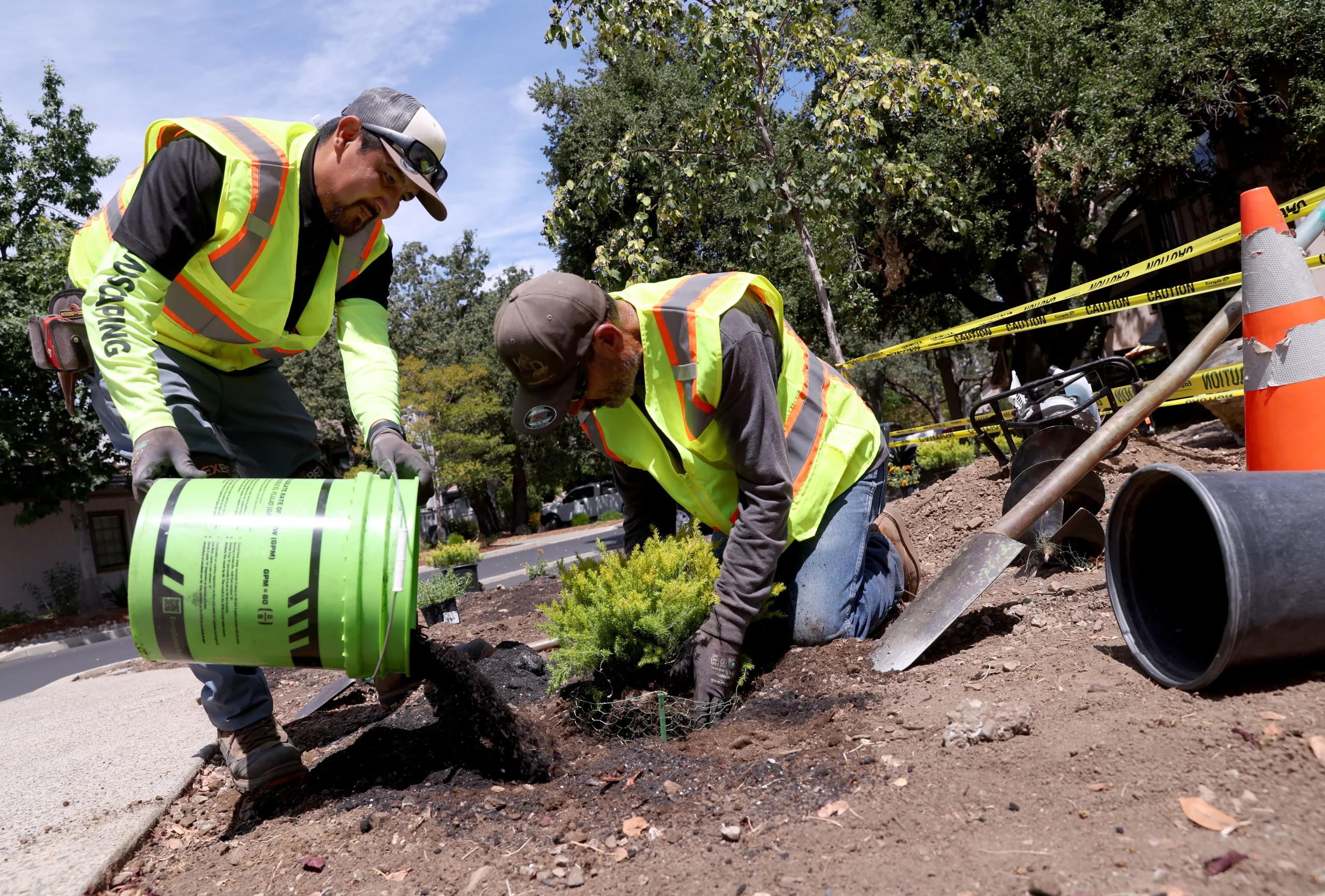
In recent months, Daniel Nemire, a manager for K&D Landscaping in Watsonville, which hosted the event, said more homeowners associations and commercial property owners have started learning about the law and reaching out with questions.
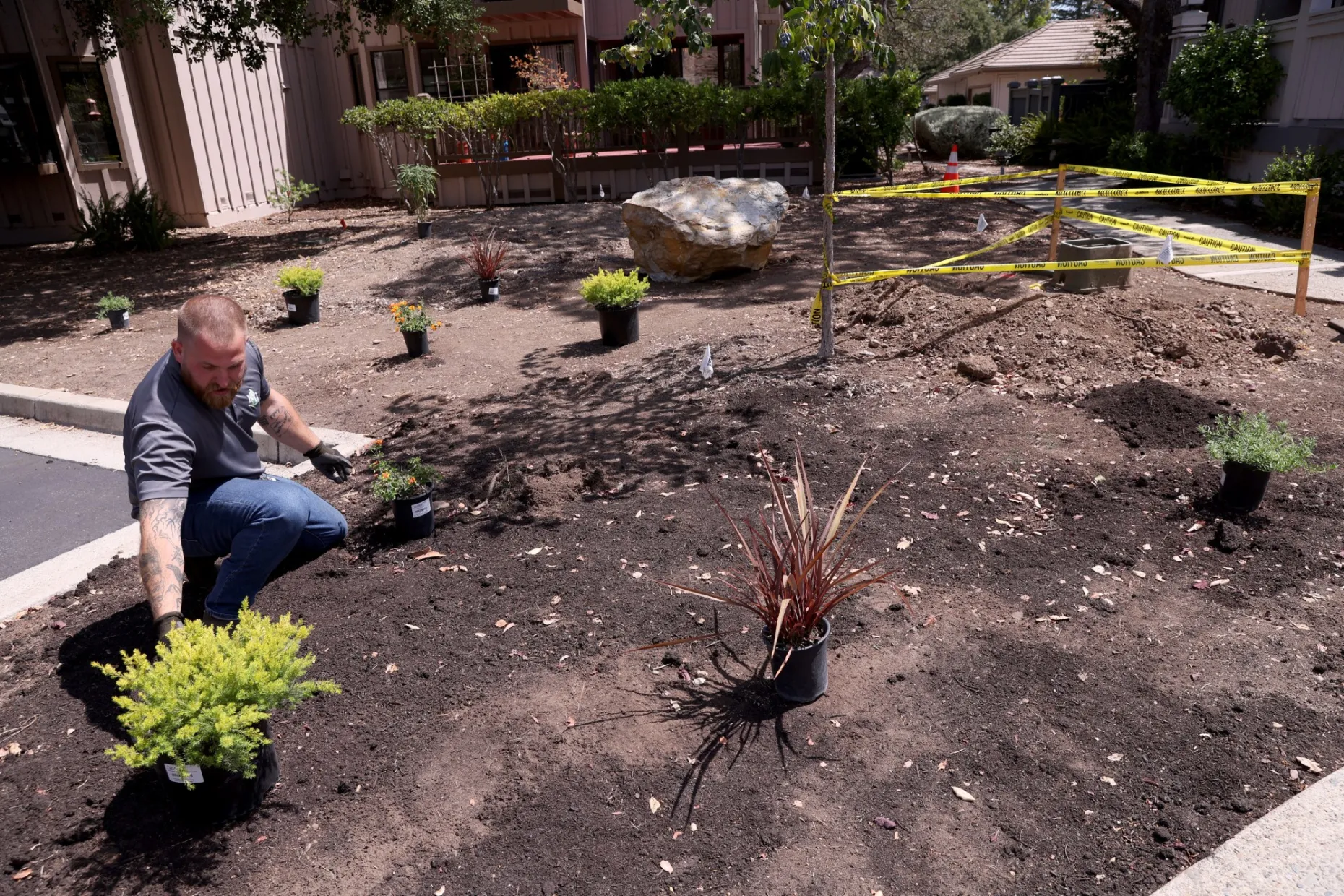
K & D Landscaping manager Daniel Nemire checks on a native plant installation at the Villas of Almaden in San Jose, Calif., on Thursday, August 20, 2026
“Our message is you don’t want to be stuck,” Nemire said. “If they do start enforcing and you have thousands of feet of turf, it’s a big thing for your budget. You want to spread it out. Do yourself a favor and break it up. There are dozens of plant types you can use. It doesn’t look like the desert. It can look really beautiful.”
He said upgrades to landscape and irrigation equipment can reduce water use by up to half.
Some cities have already moved ahead of the new rules.
Last year, Morgan Hill held a public contest to redesign the landscaping around its city hall and reduce water use. Crews removed more than 4,400 square feet of grass, added mulch and park benches, and planted 173 native plant species, including deer grass, ceanothus, sticky monkey flower, red buckwheat and manzanita. They also planted three new trees and relocated five others from a parking lot where solar panels had been installed. The project cost about $32,000, but an $8,000 rebate from the Santa Clara Valley Water District brought the total down to $24,000.
“We’re trying to be proactive. We want to lead by example,” said Shannon Rossow, an environmental programs coordinator with the Morgan Hill Environmental Services Division. “Then other property owners can see it’s possible.”
The law could also face controversy. It was modeled after legislation passed by the Nevada state legislature in 2021 that banned the use of Colorado River water on ornamental grass at commercial, government and homeowners association properties in areas such as Las Vegas.
This year, homeowners associations representing more than 10,000 property owners filed a class action lawsuit against the Southern Nevada Water Authority in an effort to block the measure. They argue that it could kill trees, unfairly burden property owners and worsen the urban “heat island” effect.
In California, retail water providers — including government water districts, private water companies and city water departments — will enforce the law, according to the State Water Resources Control Board, which also holds enforcement authority.
“Slowly, the news is getting spread among property owners about this,” said James Nachbaur, director of research, planning, and performance at the state water board. “Generally our approach is trying to get people into compliance with education as opposed to jumping immediately to enforcement.”
Local water agencies shared that approach.
The East Bay Municipal Utility District in Oakland has been reminding large property owners about available rebates for landscape projects, including free consultations with landscape architects. Geneva Gondak, a water conservation supervisor for the district, said it likely will not fine violators unless the state enters another drought.
“We don’t want to see all of these green areas turn into dead patches, and we don’t want the trees to die,” she said. “We are helping people convert these landscapes to more sustainable areas.”
In San Jose, one homeowners association is already preparing for the law. The Villas of Almaden is spending $100,000 to replace turf around 180 homes with water-efficient landscaping while upgrading an irrigation system that dates to the 1980s with a high-tech system equipped with weather sensors. After receiving a rebate from the Santa Clara Valley Water District, the project will cost $80,000, said Fadi Cotran, president of the homeowners association board. He said the changes should reduce water use by about 35% and pay for themselves within five to 10 years.
“We have huge water bills. We are trying to find ways to conserve,” he said, adding that the board is trying to be proactive by also replacing aging roofs and improving fire protection. “And we wanted to get the rebates before the money runs out. The early bird gets the worm.”









Leave a Reply