


Six Ohio Medicaid providers are facing criminal charges after state investigators allege they stole $558,382 from the taxpayer-funded health program, with one Pickerington woman alone accused of embezzling more than $400,000 by inflating claims for services to foster children and summer camps. The suspects, described by the state attorney general’s office as being from central Ohio, include home-health aides accused of billing for shifts they never worked and a behavioral-health program operator accused of instructing employees to pad records for kids who never received the claimed services.
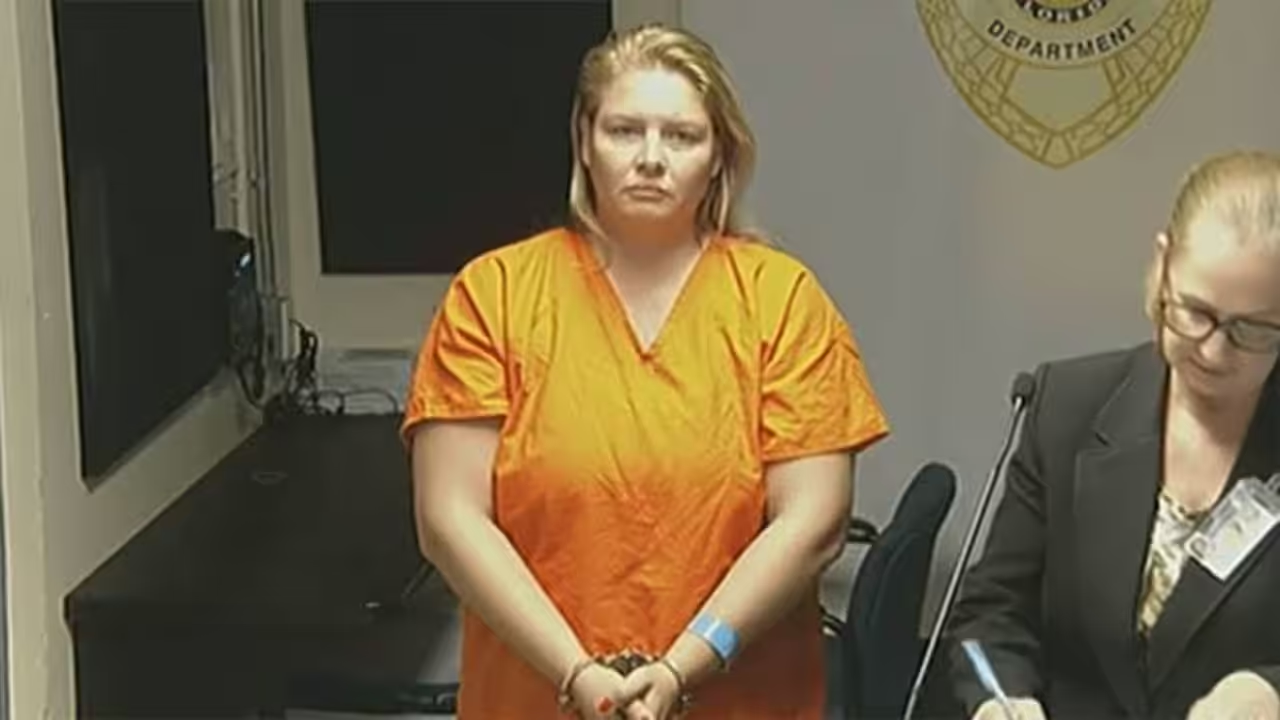
According to NBC4 WCMH-TV, the largest case concerns Rasheedah Biles, the owner and operator of Reset Tomorrow, a Columbus behavioral-health program for children. State investigators allege that Biles encouraged staff to exaggerate claims for services provided to children in after-school programs and summer camps, as well as inhabitants of a foster-children group home, from November 2023 to October 2025. Biles’ claims allegedly included upcoding and charging for treatments that were never given, resulting in a $404,810 Medicaid loss. Biles’ inquiry began in May 2025, when a referral reported high billing, and she has now been accused of Medicaid fraud and theft.
Aside from the Reset Tomorrow claims, three additional defendants — Carol Dawes-Willis, Yvette Johnson-Woodall, and Sasi Kaza — were accused of scamming Medicaid for approximately $142,000, according to the same NBC4 article. Dawes-Willis, of Hillsboro, is accused of charging for homemaker and personal care services on days when state investigators say she never actually visited the client, resulting in $4,510 in Medicaid losses. Johnson-Woodall, of Youngstown, is accused of invoicing for therapeutic behavioral services for four homeless or hospitalized clients between April 2021 and February 2026, with some of the hours allegedly overlapping her shifts as a school bus aide.
Kaza, the owner of Moonlight Home Health Care in Austintown, is facing charges related to $53,405 in alleged Medicaid losses. According to state inspectors, she habitually billed for the maximum allowable hours regardless of whether services were really provided, even on occasions when customers were hospitalized or had died. The case highlights a systemic weakness that authorities have already identified: home-health billing that continues even after a patient dies.
Two further cases involve individual home health aides who are suspected of billing for time they did not work. Binetou Ndao of Columbus is accused of charging for complete shifts as a home health aide while consistently arriving late and leaving early between January 2025 and January 2026. Electronic visit-verification data apparently showed her clocking in and out of locations other than the client’s house, and the suspected fraud involving Ndao resulted in a $5,140 Medicaid loss.
Dorika Carter, also of Columbus, is accused of fabricating timesheets while providing home health care to a hospitalized client and reportedly overbilling Medicaid while working full-time and on medical leave. The Ohio Medicaid Fraud Control Unit was looking into Carter’s actions, which state officials said resulted in a $6,661 Medicaid loss.
The indictments were issued by newly appointed Ohio Attorney General Andy Wilson, who entered office in June after former Attorney General Dave Yost resigned to enter the private sector. Wilson’s office currently manages a Medicaid Fraud Control Unit, which collaborated with the Ohio Department of Medicaid to secure 444 indictments, 481 convictions, and $78.4 million in recovered taxpayer dollars between January 2023 and May 2026. According to the HHS Office of Inspector General, state investigators have increasingly relied on an automated data-mining system created by the attorney general’s office in early 2026 to identify improper billing patterns among home health and behavioral providers for manual review.
This current investigation follows a similar crackdown in May, when Ohio grand juries arrested eight people, including five Medicaid providers accused of stealing $542,176, for charging in-home services while working other jobs or traveling worldwide. The pattern reflects two distinct modes of fraud identified by state officials: individual aides who double-dip or fudge hours while working second jobs or while patients are in the hospital, and larger program operators who direct staff to systematically inflate claims for youth programs and group homes.
The $558,382 at stake in this sweep pales in comparison to Ohio’s Medicaid program, which serves more than 3 million citizens and accounts for around $43.2 billion in state spending in fiscal year 2025. Nonetheless, the lawsuit comes amid a larger examination of the program’s finances, with the State of Ohio Single Audit for Fiscal Year 2025 warning that questioned Medicaid expenditures might total up to $4 billion across the program due to paperwork and eligibility difficulties.
The Reset Tomorrow allegations against Biles also contrast with a much larger case arising from Franklin County’s $9.3 million phantom-care case, in which a former Powell couple operating One Community Mental Health was indicted in July for allegedly siphoning $9.3 million from Ohio Medicaid through phantom billing claims for entire households. Together, the cases demonstrate the vast variety of scale in Medicaid fraud schemes being prosecuted in Ohio courts, from six-figure timesheet padding to multi-million-dollar structured billing operations.
All six individuals implicated in the August sweep are facing official charges, although none have been convicted, and the claims against them remain untested in court.



Leave a Reply