

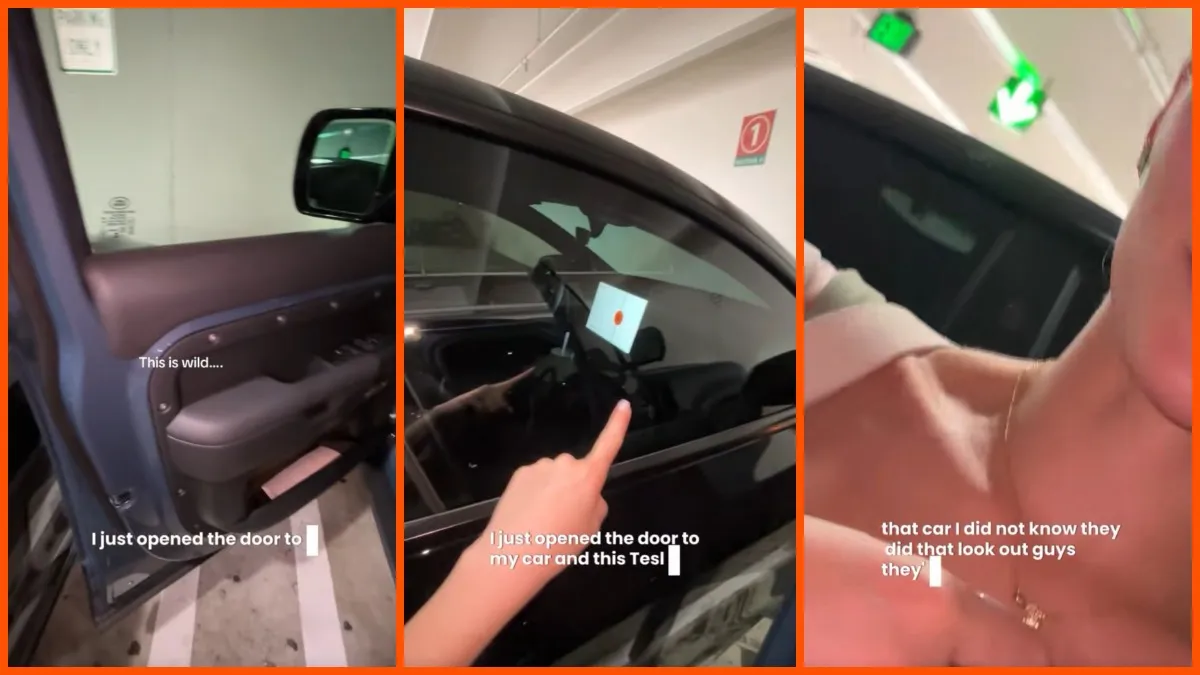
While out in New York one day, Christine Dawn noticed that a parked Tesla beside her was actively recording her as she stepped out of her own car. Caught off guard, she took to TikTok to share the experience in a video that has since racked up 1.2 million views. She captioned the post, “And then I record it, recording me 🤣 Careful guys, Tesla is always watching….”
The clip shows the TikToker pointing her camera at her car door before panning over to reveal the ‘recording’ symbol on the Tesla’s dashboard. “I just opened the door to my car and this Tesla next to me is recording me to make sure that I don’t hit that car. I did not know they did that. Look out guys, they’re always watching,” she tells viewers.
Reactions from the audience varied depending on their familiarity and comfort with the technology. A user named Jess pointed out, “It records anytime you’re near it,” while Kaisa responded, “Wtf that so creepy.” Ado called it “the only good thing about Tesla,” and Calvin Here chimed in with, “I love it! best feature.” The comments even took a humorous turn, with Bedilia joking, “I’ma start farting loud AF next to them.”
From Dashcams to Sentry Mode
The feature Christine encountered is called Sentry Mode. According to Capital One, it is a vehicle-monitoring system built to give Tesla owners an added layer of protection. When the car is parked or powered off, it keeps its built-in cameras and proximity sensors running to detect potential theft, vandalism, or break-ins. If the system picks up a minor interaction, it enters an Alert status and displays a warning on the infotainment screen.
For more serious threats, Capital One noted that the system triggers an alarm protocol that flashes the headlights and sounds an alarm. Owners can even pull up live feeds directly through the Tesla mobile app. The level of surveillance the feature provides, however, has sparked privacy concerns worldwide, with some countries already moving to restrict or ban its use altogether.
For drivers who don’t own a Tesla, the traditional dashcam remains the go-to solution for vehicle security. According to U.S. News, dashcams function like webcams, saving footage locally to a MicroSD card. While people most commonly install them to establish fault in traffic accidents, many models can be hardwired to record motion even when the car is off.
This makes them a useful tool for catching hit-and-run drivers, though it does take some effort to manage the wiring and prevent battery drain. Their real-world impact has also proven significant — dashcam footage exposed a repair scam at a Virginia Chevy dealership and, in New Jersey, helped identify a potential murder suspect and gave investigators key clues about a possible motive.
Unlike factory-integrated systems, U.S. News points out that dashcams come as an out-of-pocket expense, typically ranging from $100 to $500. They won’t bring down insurance premiums, but they can save drivers considerable money by supplying solid evidence during insurance claims.
The conversation on Christine Dawn’s post kept going as users debated the legality and necessity of constant recording. User missyblue_eyes2020 came across as a fan of the feature, writing, “It’s called Sentry mode and it’s a wonderful feature!” while others made their discomfort with the surveillance clear.
User Mariachi questioned, “this is legal? Like recording u the whole time?” while 🖤🎱🕷️🎳🐃 stepped in to clarify, “It records anytime there’s anything close to the vehicle person or not.”
Addressing the concerns, user Shanice pointed out, “Most dashcams start recording as soon as there’s movement nearby, not just Tesla’s.” Still, some users remained skeptical and found the technology intrusive altogether. User spiralshapeketchup shared, “I have seen this too many times. It’s so creepy. If I even walk near one this happens sometimes. 🤦♀️”
According to U.S. News, road safety is becoming an increasingly pressing concern, with AAA reporting a rise in road deaths between 2020 and 2022. Given that trend, dependence on camera evidence looks set to grow.







Leave a Reply