

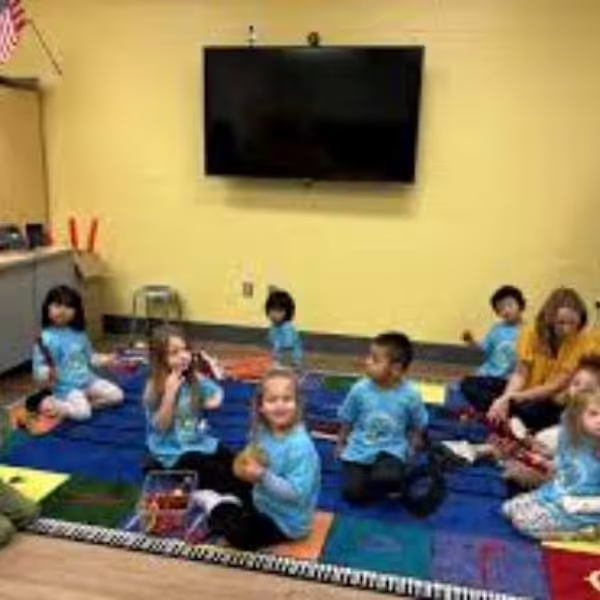
Preschool students at Warren County Public Schools’ Early Learning Academy take part in a music class. (Lisa Autry)
Kentucky Gov. Andy Beshear is likely to leave office without achieving one of his key goals. During the final budget session of his second term, lawmakers declined to fund universal pre-K. While the Republican-led legislature cited cost concerns, Beshear, a Democrat, blamed politics.
At Warren County Public Schools’ Early Learning Academy, three- and four-year-olds shake tambourines, play maracas, and explore xylophones during music class. The district opened its first standalone preschool last fall.
“It’s been great. It gives them a lot of opportunities and they really like coming in here,” said teacher Tracy Phelps. “They come in to class not knowing how to interact with others and by the time they leave, they’ve got friends they talk to every day. They can socialize a whole lot better.”
Some families pay tuition, but low-income students and those with disabilities attend for free through state funding. The program can serve up to 650 students. Phelps said her students leave with stronger social skills, emotional control, and improved reading and math abilities.
However, not all children in Kentucky have access to similar programs.
During this year’s legislative session, lawmakers rejected Beshear’s proposal for publicly funded preschool for all four-year-olds, even though fewer than half are considered kindergarten-ready.
“They show up with fewer words. Some don’t know their colors,” Beshear said. “I talked to one kindergarten teacher who had five students in her class that weren’t potty-trained.”
Beshear also promoted universal pre-K as a way to help more parents enter the workforce amid a shortage of affordable childcare.
Students at the Early Learning Academy also benefit from specialized labs introducing them to STEM, medical, and culinary fields. (Lisa Autry)
Republican lawmakers opposed the plan, including Senate Majority Leader Mike Wilson of Bowling Green, who spoke at the academy’s ribbon-cutting.
“Preschool for all doesn’t necessarily go year round. It’s like the school system. What you need for the workforce is child care, which is year round,” Wilson said. “And we just don’t have the infrastructure. We don’t have the teachers, and the funding for that will be enormous.”
With limited chances of passing universal pre-K under a Republican supermajority, Democrats proposed alternative measures to expand access.
Rep. Tina Bojanowski of Louisville introduced House Bill 572, which would have raised eligibility for free preschool to 250% of the federal poverty level—about $80,000 annually for a family of four. Currently, the cutoff is 160%, or about $38,000.
Bojanowski, a former special education teacher, said early education leads to better academic outcomes and higher graduation rates.
“By investing now, we save later,” she said. “Studies show that every dollar invested in early learning returns savings through reduced need for remedial and special education. Pre-K graduates are also less likely to enter the criminal justice system and tend to earn higher lifetime incomes.”
A companion Senate bill (SB 166) proposed the same eligibility expansion, while other legislation outlined a phased rollout of universal pre-K by the 2034–2035 school year.
Beshear suggested funding the initiative with revenue from sports wagering, but some Republicans raised concerns about impacts on pension funding. Others warned expansion could strain resources, requiring more facilities and staff, and potentially affecting private childcare providers.
Beshear argued the opposition was political.
“Four-year-olds can’t vote, so if any of these folks are pushing back against this because they think it gives me a win, what they’re really doing is handing another group of four-year-olds a loss,” he said.
Lawmakers did pass House Bill 6, which became law without the governor’s signature. The bill offers a $2,000 incentive to parents and childcare providers when a child is deemed kindergarten-ready. The University of Kentucky will oversee the pilot program, funded through the Tobacco Master Settlement Agreement.
The measure also creates “microcenters,” smaller childcare facilities designed for rural or low-income families or those with nontraditional work hours. Additionally, it seeks to revamp Kentucky All STARS, the state’s childcare rating system.
Several groups, including the Kentucky Association of School Superintendents, the Prichard Committee for Academic Excellence, more than 40 chambers of commerce, 60 county judge-executives, and 30 mayors, supported universal pre-K.
Despite backing expanded preschool, KASS Executive Director Jim Flynn said a full rollout may have been premature.
“Each community is unique in terms of the kind of assets it has relative to early childhood education programming,” Flynn said. “Space, workforce availability, operational funding, and long-term sustainability all vary.”
Flynn said he would have preferred a phased approach but considers House Bill 6 a step forward.
“Your floor determines your ceiling, so the more kids we have prepared for kindergarten, the better outcomes we’ll see,” he said.
Prichard Committee President and CEO Brigitte Blom emphasized the need for a balanced approach.
“What we’d like to see is a comprehensive system that integrates child care and preschool,” she said. “As the state grows and attracts workers, we need to get this right for families and employers.”
Students at the Early Learning Academy have access to STEM labs, music, arts, and culinary programs. (Lisa Autry)
Meanwhile, a new report highlights Kentucky’s lagging progress in early education.
The state dropped from 26th to 28th nationally in preschool access, according to the National Institute for Early Education Research.
During the 2024–25 school year, Kentucky served just 26% of its four-year-olds in preschool, compared to the national average of 37%.
“When states invest in quality preschool programs, they invest in a better future for children and taxpayers,” said W. Steven Barnett, NIEER’s senior director and founder.
With relatively low enrollment rates, advocates for universal pre-K face significant challenges as they continue pushing for expanded access.









Leave a Reply