

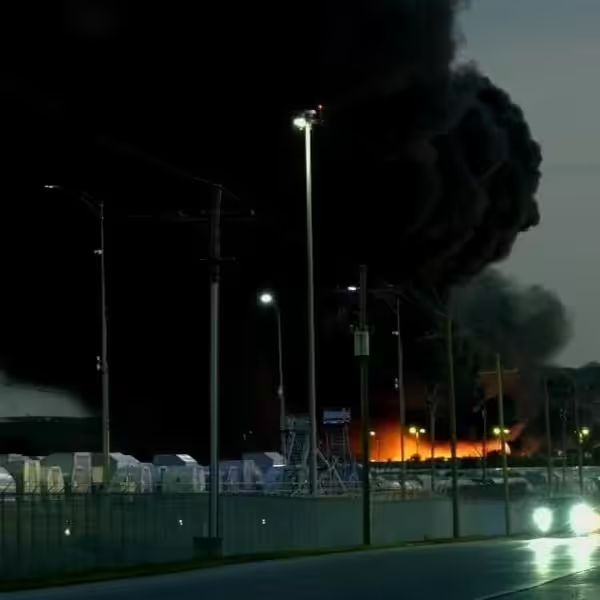
Airport firefighters train daily to respond within minutes to jet fuel fires and other high-stakes emergencies.
LOUISVILLE, Ky. (WDRB) — Weeks after a UPS plane crashed near Louisville Muhammad Ali International Airport, airport firefighters provided a rare look inside the highly specialized emergency response that unfolded in the minutes after the aircraft went down.
Chief Joshua Grimes, a 20-year veteran of the Louisville Airport Authority, said the crash was unlike anything he had ever experienced.
“This is definitely the worst incident I’ve ever responded to in my 30 years,” Grimes said.
The crash occurred earlier this month when Flight 2976 caught fire on the runway, sending thick black smoke into the sky and triggering a full response from airport firefighters, the Kentucky Air National Guard and the Louisville Fire Department. Drone video from WDRB later showed charred wreckage and burned debris scattered across the area.
Inside the airport firehouse Monday, Chief Grimes walked WDRB through the specialized trucks and tactics airport crews used that day. Each green “ARFF” truck — short for Aircraft Rescue and Firefighting — carries thousands of gallons of water, firefighting foam and dry chemical agents.
Unlike city fire engines, which must stop before using their hoses, these rigs can “pump and roll,” giving firefighters the ability to attack flames while the vehicle is still moving.
“City fire trucks have to park and fight a fire,” Grimes said. “These trucks are designed to drive and pump at the same time.”
The airport’s ARFF trucks carry 3,000 gallons of water, more than 400 gallons of firefighting foam and dry chemical powder designed to smother jet-fuel fires — the same flames crews encountered the morning of the crash.
Grimes said flames, burning oil, explosive debris and downed power lines created dangerous obstacles as firefighters moved toward the wreckage. At one point, crews had to disconnect hoses and reposition equipment to avoid becoming trapped in burning pools of fuel.
Airport fire crews train year-round and practice daily. Just two weeks before the crash, they participated in a full-scale exercise with the Air National Guard. That training, Grimes said, directly supported the massive multi-agency response.
“All three of our agencies arrived at the same time and operated on scene until the next morning,” he said.
Assistant Chief Kyle Miller of the Kentucky Air National Guard said his team responded immediately when the “Alert 3” call sounded — the code for an aircraft accident.
“Once they called out Alert 3, we know that’s a plane crash,” Miller said. “As soon as we exited the apparatus bay, you could see the plume of smoke.”
Miller said his job was to supply water to the massive crash trucks battling heavy smoke and flames that shot 100 to 200 feet into the air. He described the scene as chaotic, fueled by large amounts of jet fuel and burning oil.
“Training just really kicked in,” he said. “You have a job, and whatever you’re told to do, you do it.”
Grimes said the immediate firefighting operation has ended, and the focus has shifted to environmental cleanup and investigation. But the crash — and the risks his firefighters faced — remains deeply felt within the airport’s rescue command.
“We’re the subject matter experts in aircraft emergencies,” Grimes said. “We train for this every single day to make sure we’re prepared for anything.”
This article has been carefully fact-checked by our editorial team to ensure accuracy and eliminate any misleading information. We are committed to maintaining the highest standards of integrity in our content.






Leave a Reply