

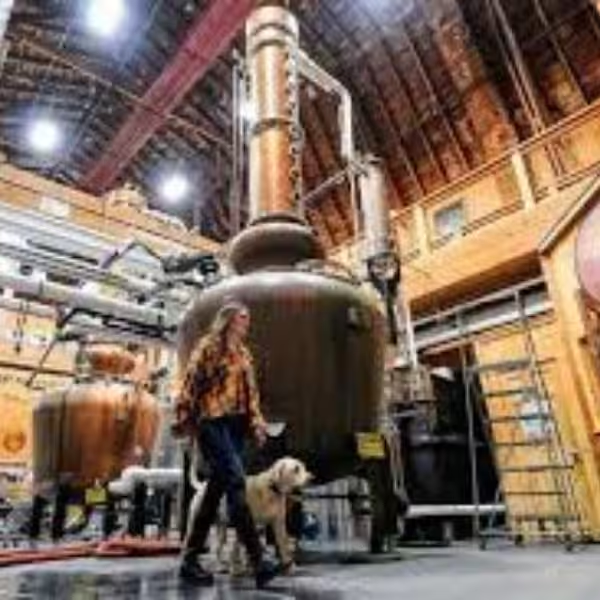
SHOREHAM, Vt. — Meghan Ireland always had a passion for chemistry, but as a freshman studying chemical engineering, she didn’t realize she could apply it to crafting whiskey.
That changed when she came across a story about a female chemical engineer who became a master distiller. While many of her classmates pursued careers in plastics or pharmaceuticals, Ireland chose whiskey.
“It was kind of like a connection of, ‘hey, I can see someone who looks like me, who has the same exact kind of education and background doing this job,’ and kind of opened it up as an option,” said Ireland, now the chief blender at Vermont-based WhistlePig.
Ireland is part of a growing wave of women stepping into leadership roles in an industry long dominated by men. More women are launching their own brands and driving innovation at a time when female whiskey consumption is also increasing.
Women in whiskey
Women in the industry often face lingering skepticism, including questions about whether they even enjoy whiskey.
Becky Paskin, a U.K.-based journalist and founder of the OurWhiskey Foundation, said she has encountered that doubt firsthand, even while judging tasting events.
“It is a drink that comes with certain expectations around which gender drinks it and which gender makes it,” Paskin said, adding: “Barely any other drink or food falls under such scrutiny.”
Paskin also highlighted the lack of accurate representation, noting that images of women drinking whiskey have often been stereotypical or inappropriate.
A long history of women in whiskey
Despite modern perceptions, women have played key roles in whiskey-making for centuries.
The first distilling instrument is credited to Maria Hebraea, an alchemist from around the second century. Historically, distilling was often considered women’s work, tied to home brewing and medicine-making.
In the 1800s, women managed distilleries in Kentucky. Catherine Carpenter documented the earliest known sour mash recipe, now the most common style of American whiskey. During Prohibition, some historians believe there may have been more female bootleggers than men.
Industry expert Susan Reigler noted that while women have always contributed to bourbon, many worked behind the scenes.
Three women also co-founded the Kentucky Bourbon Trail, including Peggy Noe Stevens, the first female Master Bourbon Taster, along with Donna Nally and Doris Calhoun.
“There have always been women in bourbon,” Reigler said. “But a lot of them have been behind the scenes.”
Driving innovation and change
Today, women are helping redefine the industry through creativity and leadership.
Ireland, who has overseen consistency at WhistlePig since 2018, also leads experimental projects. Her work on the Boss Hog VII, finished in Spanish oak and Brazilian teakwood barrels, earned widespread recognition.
She believes the growing presence of women is reshaping perceptions of whiskey.
“It can be enjoyed by everyone and it’s being made by females too,” she said.
Judy Hollis Jones, CEO of Buzzard’s Roost in Kentucky, entered the whiskey business after a long career in the food industry. She said the transition felt familiar, as she was often the only woman in executive settings.
Jones noted that while the whiskey business can be challenging, more women are attending tastings and tours, reflecting a broader shift in the industry.
“I’ve had people say to me, ‘Oh, well, you don’t wear jeans, boots and a cowboy hat,'” she said. “And I said: ‘No, I don’t. And every bourbon drinker female does not. We are very wide range of people that love bourbon.'”






Leave a Reply