

Republican Kentucky state Sen. Lindsey Tichenor of Smithfield speaks on the Senate floor in January 2026.
A bill cleared a Kentucky Senate committee Wednesday that would further restrict secondary identification forms voters can use to cast a ballot in Kentucky elections — even though state records show only a very small share of voters rely on them.
The Kentucky General Assembly passed a 2020 law requiring voters to present valid photo identification to vote, while also permitting secondary forms of ID if voters signed an affidavit confirming their identity.
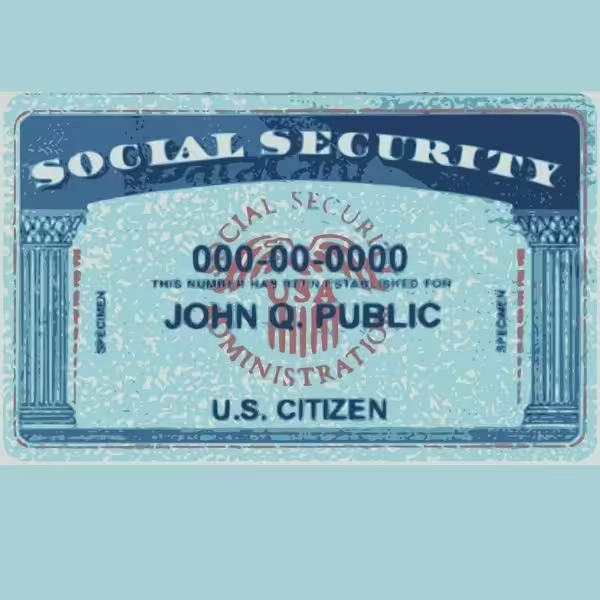
Last year, lawmakers excluded credit cards with a voter’s name from qualifying as valid secondary identification. Senate Bill 154, which advanced Wednesday, would also remove Social Security and food assistance cards from the list of acceptable secondary IDs under the 2020 law.
Republican Sen. Lindsey Tichenor of Smithfield told committee members her bill would strengthen Kentucky’s voter ID law, since these secondary forms do not include a voter’s photo.
Tichenor noted that 10 other states require a photo ID to vote and said SB 154 “would get us in line with some other states, and really in line with a stronger system to have identification for our voters.”
However, records from the State Board of Elections obtained by Kentucky Public Radio show that very few Kentucky voters use Social Security or food assistance cards — also known as food stamps, EBT or supplemental nutrition assistance cards — as identification when voting.
State data shows that of nearly two million people who voted in person in Kentucky’s 2024 general election, 99.3% presented a driver’s license as primary ID, while another 0.5% used another valid photo ID, such as a passport, military ID or college ID.
Only 981 voters in 2024 used a Social Security card as secondary ID — less than half of a tenth of a percent of all voters — and just 67 used an EBT or food assistance card.
Democratic Sen. Cassie Chambers Armstrong of Louisville cited those same 2024 figures, asking whether there is any evidence that people are using fraudulent Social Security or EBT cards to vote.
Tichenor said Kentucky has no active cases of voter ID fraud involving Social Security or food assistance cards. Still, she said EBT cards are frequently transferred illegally and that identity fraud involving Social Security across the country is “rampant.”
“The potential for fraud exists,” Tichenor said. “So this would eliminate that potential for fraud.”
Chambers Armstrong voted against the bill, arguing that it makes little sense to remove a legal voting option used by more than 1,000 Kentuckians in the last election cycle without evidence of fraud.
“It’s really essential to democracy that everybody have the ability to vote,” Chambers Armstrong said. “And it concerns me that every year we’re seeing laws pass through this body that make it more difficult to vote, despite not having any evidence that there’s a problem that we’re trying to solve.”
The law passed last year barred credit cards with a voter’s name from serving as valid secondary ID. That form was also rarely used in 2024 — only 470 of the two million voters relied on it.
Democratic Gov. Andy Beshear vetoed the 2025 bill, saying it would make voting harder for Kentuckians, but the Republican-controlled legislature overrode his veto.
Nick Storm, spokesperson for Republican Secretary of State Michael Adams, said the state’s top election official remains neutral on the bill because it would have minimal impact on voters or election security.
“Secretary Adams believes the bill, if enacted, would not make much difference because hardly any voters use social security cards or public benefit cards under his Photo ID to Vote law,” Storm said. “Typically 98% of voters use a driver’s license as qualifying Photo ID. He is neutral on the bill because it would not appreciably protect election security or harm voters.”
Adams opposed a 2024 bill that would have barred student photo IDs as a valid primary voter ID, arguing that it could increase the likelihood of courts striking down the entire voter ID law.
State election records also show that although secondary IDs are rarely used overall, they appear more often on a per capita basis in rural Appalachian counties.
In Martin County, just over 1% of voters — 35 people — used a Social Security card as their ID in the 2024 election, while 0.4% of voters did so in Breathitt and Lee counties.
Menifee County voters were most likely to use EBT or credit cards as identification in that election, at 0.07% and 0.2%, respectively.
This article has been carefully fact-checked by our editorial team to ensure accuracy and eliminate any misleading information. We are committed to maintaining the highest standards of integrity in our content.











Leave a Reply