

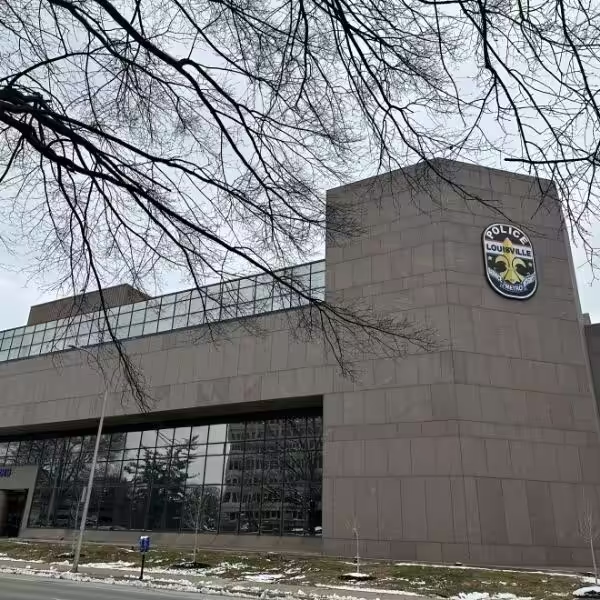
LMPD headquarters on West Chestnut Street in downtown Louisville.
After the Louisville Metro Police Department declined to release records showing where license plate readers are placed across the city, the Kentucky Center for Investigative Reporting appealed to the attorney general, arguing that LMPD violated the state’s open records law.
The attorney general serves as the arbiter in public records disputes and determines whether a government agency broke the law by withholding documents. Parties can appeal those decisions in court.
In an opinion issued this month, Kentucky Attorney General Russell Coleman sided with LMPD. He concluded that Louisville Metro officials were legally justified in withholding records that would reveal where the city installed nearly 200 cameras that capture details of passing vehicles, including license plate numbers, and store them in a database LMPD shares with law enforcement agencies nationwide.
Two experts on Kentucky’s Open Records Act — attorney Michael Abate and former assistant attorney general Amye Bensenhaver — criticized Coleman’s ruling, saying it stretches an exemption in the law beyond its intended use.
In this case, LMPD denied KyCIR’s request for the locations of its Flock cameras, citing an exemption that allows agencies to reject records requests deemed unreasonably burdensome.
City officials did not argue that gathering and producing the records would be burdensome. Instead, they contended that once the locations became public, the city would face the burden of relocating all the cameras.
LMPD has said that disclosing the locations could enable individuals committing crimes to avoid detection. KyCIR reported that while some Kentucky law enforcement agencies, including LMPD, keep their license plate reader locations confidential, others — such as the Lexington Police Department — disclose them.
In an opinion written by Assistant Attorney General Zachary Zimmerer, Coleman’s office stated that previous attorney general rulings found the burden exemption applies if an agency demonstrates that fulfilling a request “would compromise a significant governmental interest” or require it “to overhaul an existing system” whenever related documents are released.
Coleman’s office determined the city met both standards.
The attorney general accepted LMPD’s argument that revealing camera locations would weaken the effectiveness of Flock cameras as a crime-fighting tool and hinder law enforcement efforts.
He also said the city detailed the costs and logistics involved in relocating the cameras. Louisville Metro estimated that moving a single Flock camera costs between $500 and $1,000 and can take months to secure the necessary permits.
“Thus, if the locations of the cameras were disclosed, Metro’s cost to relocate all of the 189 cameras it has already installed would be between $94,500 and $189,000, coupled with the loss of efficiency and deterrence resulting from the disclosure of existing camera locations,” Coleman’s opinion said.
Abate and Bensenhaver dispute Coleman’s conclusion.
Abate, who represents Louisville Public Media and KyCIR in open records and press freedom matters, said the opinion “premised on this notion that we live in a police state where the government can have cameras all over the place to record everybody’s comings and goings … and that there’s a compelling need to maintain this secret camera network.”
“The attorney general cites absolutely nothing to support that legal proposition, other than LMPD’s say-so,” Abate said.
Both Abate and Bensenhaver said Coleman, a Republican and former FBI agent, has issued multiple open records opinions that they view as overly deferential to law enforcement agencies.
“An attorney general who so clearly associates himself with law and order as Russell Coleman is going to take the narrow view of the right to public access,” Bensenhaver said.
Kevin Grout, a spokesperson for Coleman’s office, told KyCIR in an email: “We’ll let the open records decisions speak for themselves.”
Aaron Ellis, a spokesperson for LMPD, said in an email: “We respect the attorney general’s review process and appreciate the clarification provided in this matter.”
‘The right to have secret cameras’
Abate and Bensenhaver said the “unreasonable burden” exemption in state law typically applies to requests that are overly broad or voluminous, meaning it would require excessive time and expense for an agency to gather and redact the records.
“I genuinely believe the law was enacted to deal with requests that would literally paralyze an agency because of their scope,” Bensenhaver said.
However, she acknowledged that agencies have also used the exemption to prevent potentially harmful uses of public records, such as accessing a government credit card number or exposing jail security measures.
She argued that the exemption does not apply in this case, despite Louisville Metro’s claim that releasing the locations would undermine its crime-fighting efforts.
“We are seeing agencies expand it beyond its intended scope to protect things that other agencies have absolutely no problem releasing. So it doesn’t make sense to invoke it in this situation,” she said. “I mean, there’s no reason to think it’s unreasonably burdensome as to one [agency] if it’s not unreasonably burdensome as to all.”
Abate noted that the Kentucky General Assembly has not created a specific exemption in the open records law shielding the locations of police surveillance cameras from disclosure.
“They’re not able to cite anything where the General Assembly has said, you know, that this kind of information can be kept secret and off limits,” he said. “So they’re relying on a procedural argument … But that just assumes they have the right to have secret cameras all over the place.”
He warned that this reasoning invites agencies to rely on “slippery slope” arguments, such as anticipating future steps they might take to shield their actions from public scrutiny.
“Well geez, here’s all the stuff we’re going to have to do in the future to hide our actions from the public. And that is exactly the opposite of what the open records law is intended to do, right? … It turns it on its head.”
The backstory
LMPD’s use of license plate reader cameras has faced increased scrutiny in recent months.
The department purchases its cameras from Flock Safety, a company that has drawn criticism over how law enforcement agencies use the technology to support President Donald Trump’s push for expanded immigration enforcement.
KyCIR recently reported that outside law enforcement officers, including a Drug Enforcement Administration agent who used an LMPD officer’s password, searched Louisville’s Flock database to assist federal immigration enforcement efforts.
KyCIR also reviewed LMPD’s 2025 criminal citations that referenced license plate readers and found that half of those charged were Black.
Local civil liberties advocates have raised concerns that LMPD may have installed a disproportionate number of cameras in predominantly Black neighborhoods. That concern cannot be confirmed or disproven if the city keeps the camera locations confidential.
Although Louisville Metro declines to disclose all camera locations, others have attempted to gather the information through alternative means.
The anonymously operated website NosyNelly.com and local news outlet The Courier-Journal have each published some Louisville license plate reader locations, citing information from city permit records.
Crowdsourcing has also emerged as a strategy. The website deflock.me posts locations submitted by individuals in the United States and other countries who report spotting Flock cameras in their communities.









Leave a Reply