

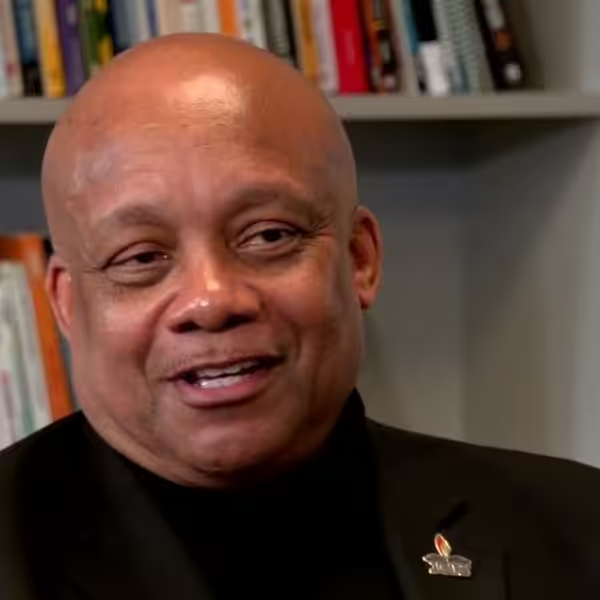
On Friday, WDRB interviewed Superintendent Brian Yearwood for the first time since Jefferson County Public Schools announced a budget crisis and sweeping cuts.
LOUISVILLE, Ky. (WDRB) — As Jefferson County Public Schools moves ahead with a draft budget that includes $142 million in proposed cuts, Superintendent Brian Yearwood said he did not fully understand the scope of the district’s financial crisis until September, several months after he took office. He said the priority now is accurately identifying the deficit rather than focusing on how it developed.
During Friday’s interview, Yearwood discussed the crisis following the announcement of budget reductions. Earlier this week, the Jefferson County Board of Education voted to accept the 2026–27 draft budget, which is intended to address a projected $188 million shortfall. The vote came during Tuesday night’s meeting and marked the first public debate over the proposal, less than a week after Yearwood presented the initial plan.
That plan was revised Friday after principals raised concerns, shifting proposed cuts from instructional coaches to mental health practitioners. After protests at the start of Tuesday’s meeting, Vice Chairman James Craig filed a motion to restore funding for mental health practitioners and return to the original proposal cutting district funding for instructional coach positions, leaving principals to decide whether to fund those roles at the school level. The board approved the motion in a 5–2 vote, reversing the superintendent’s revised plan.
In total, the accepted draft budget outlines about $142 million in cuts.
When the deficit became clear
Yearwood pushed back on the idea that he and former Superintendent Marty Pollio used different calculations to determine the size of the deficit.
“I didn’t have different math to Dr. Pollio because I don’t know what his math was,” Yearwood said. “To be honest, I did not know what the math was. Sept. 16 was the day that we all realized what the math truly is.”
He said the seriousness of the situation became clear during a presentation to district leaders, when officials warned that the district could struggle to meet payroll without selling assets.
“I had heard bits and pieces before then,” he said.
When asked whether it was concerning that the magnitude of the crisis appeared to be discussed publicly before he was fully briefed, Yearwood said he supported notifying the board once the information was brought to his attention.
“I didn’t find out at the board meeting,” he said. “I want to clarify that. Prior to the board meeting, when it was brought to me, I was actually one that encouraged that we talked to our board about this and informed them about what was happening.”
Yearwood said the financial information he received during his first months in office was inconsistent.
“I was hearing various numbers, and nothing was clear,” he said.
Classroom impact and staffing concerns
Yearwood has said he does not expect the proposed cuts to harm classrooms, even as principals warn of staffing reductions. He defined classroom impact as protecting core instruction.
“Ensuring that all classroom systems remain in place is high integrity,” Yearwood said. “As we look at teachers who teach our core classes — reading, math, the things that schools are built around — maintaining that.”
Several middle school principals said they expect to lose between one and seven teachers under the proposed cuts.
“Schools have budgets and they have allocations,” Yearwood said. “But we really have to look at what we can truly afford.”
When asked whether fewer adults in school buildings could affect students, Yearwood acknowledged the concern but described the changes as a realignment.
“To say that they’re negatively impacting, I would say we are realigning to strengthen what we’re doing while also taking a sustainable approach,” he said.
Safety administrators and school closures
The draft budget includes $41 million in reductions from school budget funds JCPS said are not directly tied to instruction, including the elimination of many safety administrator positions. Asked whether he was concerned about schools operating without dedicated security staff at all times, Yearwood pointed to existing safety measures.
“The protocols and processes that are in place — weapons detection systems and the overall structure of school safety — will continue,” he said, adding that other staff members would still be involved in safety operations.
The plan also formally closes King and Zachary Taylor elementary schools, a decision that drew strong opposition from parents and staff during public comment.
Asked about the timing of closing Martin Luther King Jr. Elementary the day after Martin Luther King Jr. Day, Yearwood said the decision was difficult but necessary.
“Losing any school is heartbreaking,” he said. “That’s one of my toughest decisions, but we have a responsibility to our taxpayers.”
JCPS said families at both schools will receive priority status during the school choice process. Magnet applications will also be prioritized based on capacity, and transition committees made up of principals, teachers, staff, parents, and community members will help families through the process.
Families can begin submitting transfer or magnet applications immediately.
Students from King Elementary may apply to magnet programs at Brandeis, Brown, Coleridge-Taylor, Hawthorne, Lincoln, and the Traditional Magnet. Nearby schools include Kennedy and Maupin, with additional address-based options in the Doss, Fairdale, Iroquois, PRP, and Valley zones.
Zachary Taylor families may apply to the same magnet programs and are zoned for Ballard-area elementary schools, including Chancey, Dunn, Norton Commons, Norton, Portland, and Wilder.
The $90 million gap
Yearwood was asked about the roughly $90 million difference between earlier projections discussed under Pollio and the $132 million figure now cited.
“I’m not sure what Dr. Pollio said about the 90,” Yearwood said. “All I know is that we had $132 million.”
He said the current figure was determined by the same financial team that served under Pollio.
“For me, I wanted to make sure that we are 100% accurate,” Yearwood said.
When asked whether the $90 million difference has been fully accounted for, Yearwood said he could not explain how the increase occurred but said he understood why the district is in deficit.
“I can tell you where the money was spent — on some great initiatives like weapons detection,” he said.
Asked whether reviewing how the deficit grew was important to prevent future issues, Yearwood said his focus is on clearly defining the total shortfall.
“What’s most important is understanding exactly what your deficit is,” he said.
A retrospective audit of the district’s finances is currently underway.
Central office and pay cuts
The draft budget includes $44 million in central office cuts, eliminating about 300 positions through department reorganizations.
Yearwood said deeper reductions were considered but limited by time.
“The runway was a lot shorter for me,” he said. “We wanted to make sure the cuts didn’t destroy divisions I need to support schools.”
He confirmed that salary cuts for top district officials, including himself, were considered but ultimately ruled out.
“Yes, we did consider that,” Yearwood said. “That was taken off the table because of the impact it would have had on certain employee groups.”
Yearwood said he spoke briefly with Pollio after taking office but has not had contact since.
“Since taking office, yes, at the beginning we spoke,” he said. “After that, no.”
Breakdown of proposed cuts
The $142 million in proposed reductions include:
- $44 million from central office, including the elimination of about 300 positions
$41 million from school budget funds not directly tied to instruction, including many safety administrator roles
$30 million tied to ongoing union negotiations, including teachers’ cost-of-living allowances
$13 million from operations and transportation
$9 million from contracts and subscriptions
$5 million from facilities and underutilized assets
JCPS estimates roughly 80% of the cuts will come from central office positions, supplemental programs, and changes related to union contracts.









Leave a Reply