

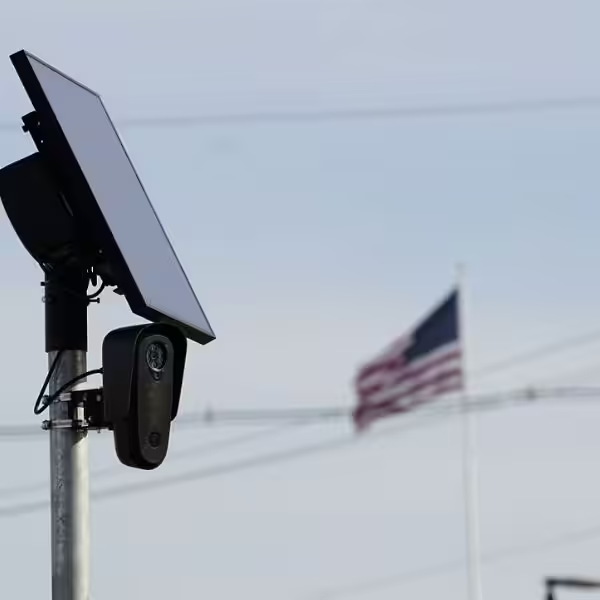
LOUISVILLE, Ky. — A Kentucky House Republican is again pushing for statewide regulations governing the use of automated license plate reader cameras by police.
What You Need To Know
House Bill 58 would regulate police use of automated license plate reader cameras, including a 90-day data retention limit and regular audits.
The bill passed the Kentucky House 90-1 last year but did not move forward in the state Senate.
Louisville and Lexington are among more than 5,000 agencies nationwide using Flock cameras.
As of Jan. 12, HB 58 has not been assigned to a committee, and the 2026 session runs through mid-April.
Last week, state Rep. John Hodgson, R-Fisherville, filed House Bill 58. If approved, the bill would put into law what he considers best practices for police use of automated license plate readers.
“It says, let’s keep the law enforcement benefit of the cameras, but let’s make sure that they can’t keep the data on your whereabouts for more than 90 days,” Hodgson said. “They’ve got to destroy it unless there’s an active criminal investigation, let’s make sure that it’s illegal to sell it.”
In recent years, ALPRs have become a widely used tool for police departments across the country. More than 5,000 agencies use Flock cameras, including departments in Louisville and Lexington.
Data collected by ALPRs can be searched by law enforcement agencies nationwide, yet Kentucky currently has few statewide rules governing their use.
“It’s something we need to get our hands around before there are big databases out there that can track the location of your license plate anywhere in America, and piece that together,” Hodgson said.
Hodgson’s push to establish regulations has drawn bipartisan support. A similar bill he filed last year passed the Kentucky House by a 90-1 vote, but it stalled in the state Senate during the short 2025 session.
“Yeah, I have talked to the Senate chairman of transportation committee,” Hodgson said. “I think he’s amenable to hearing it this year.”
He said the bill seeks to strike a balance between addressing concerns about government surveillance and helping law enforcement pursue criminals.
“Nobody likes to be spied on, right? And nobody likes improper use of law enforcement data,” he said.
The proposal would also require police departments to conduct audits every 90 days to ensure license plate data is being used appropriately.
Use of Flock cameras for immigration-related purposes has drawn attention in recent months. Spectrum News reported that a Louisville Metro police officer shared his Flock login credentials with a DEA agent, who conducted immigration-related searches using the officer’s account in early 2025.
Hodgson told Spectrum News he supports using Flock and other ALPR systems for immigration enforcement.
“Well, I’m 100% in favor of immigration enforcement. I want to see every illegal in America deported, either voluntarily or involuntarily. If this is a tool for law enforcement to use to assist with that, I’m fine with that,” Hodgson said. “But American citizens who are just going about their daily lives need to have their personal privacy protected. We need to enforce the law, but we also need to be concerned about a government that may get past its boundaries and start to, you know, hunt down legal citizens doing legal things.”
Cities across the United States, including Syracuse, New York, are considering ending their relationships with Flock amid concerns over data sharing.
As of Jan. 12, House Bill 58 had not yet been assigned to a committee. The 2026 legislative session runs through mid-April.









Leave a Reply