

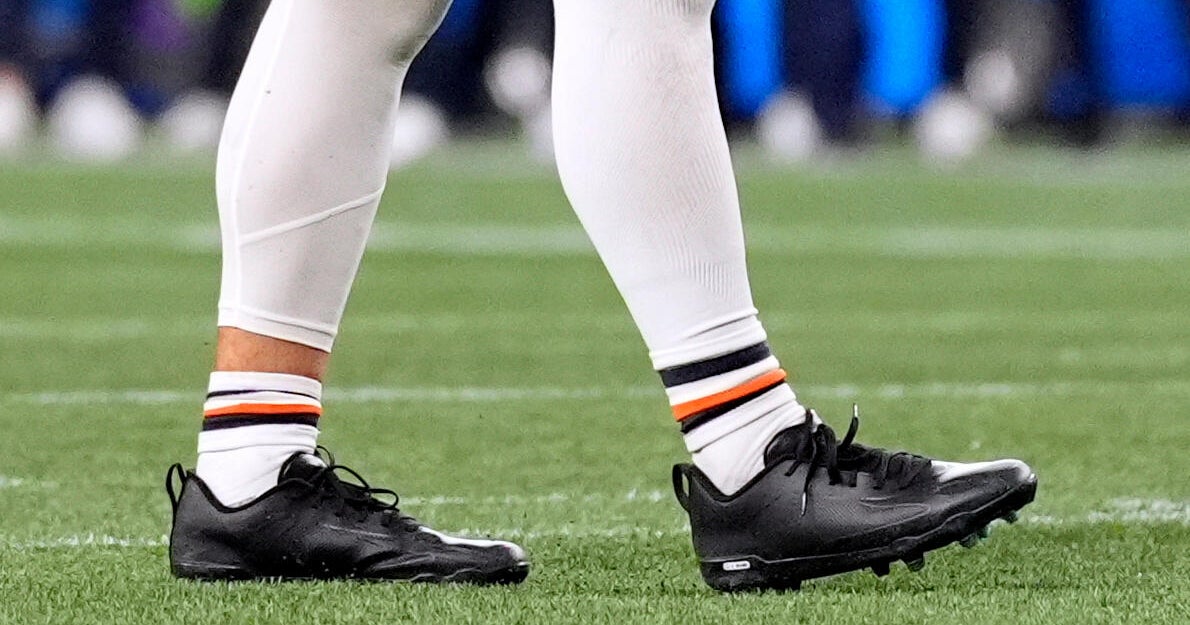
Everything started with a single phone call. Dr. Tom Gormely contacted Caddix the previous year, informing the startup that he represented a quarterback who was interested in trying their cleats.
“We said, ‘Who?'” Caddix CEO Jack Rasmussen recalled. “And he said, ‘I’ll tell you later.’ And I was like, ‘Oh, this is a fun conversation.'”
As it turned out, that was only the beginning of something far more significant.
Gormely’s client was none other than Chicago Bears star Caleb Williams, and that conversation proved to be a defining moment for Caddix , even if its full implications were not immediately apparent. Williams began wearing the cleats during the current season, which led to an $11,941 fine from the NFL for displaying an unauthorized logo in Week 6 against Atlanta, followed by a $23,882 penalty for the same violation in Week 7 against New England.
For Baltimore-based Caddix , a company with just four employees and annual revenue of just under $2 million , the attention was nothing short of extraordinary.
“To be able to turn around with this press from Caleb Williams and to get what would be tens of millions of dollars in free advertising and conversation, that is a cash cow for a small company,” said Peter Stolpe, a professor in the Warsaw Sports Business Center at the University of Oregon. “That is fantastic news. And it’s even more fantastic news that the player of record is saying, I feel better in these cleats.”
NFL regulations prohibit players from wearing footwear that displays unapproved logos or branding. The league’s three officially authorized footwear suppliers are Adidas, Nike, and Under Armour. Should a player choose to wear footwear from any other manufacturer, all visible third-party names, logos, brands, or commercial identifiers must be concealed or removed entirely.
Although Caddix does not hold a formal sponsorship agreement with Williams , the first overall pick in the 2024 NFL Draft , Rasmussen has voluntarily offered to cover the fines Williams incurred. Additionally, Caddix supplied a logo-free pair of cleats that Williams wore during Monday night’s 34-17 victory over the Seattle Seahawks, effectively avoiding any further disciplinary action from the league.
“Just to calm things down, man,” Williams said.
Caddix cleats are engineered with flexible studs specifically designed to minimize stress on the knees and ankles. Williams played an active role in developing his custom model alongside Gormely and Rasmussen, who traveled to Florida in June to observe the quarterback during throwing sessions and finalize the product’s design.
“The cleats, they’ve been great, they’ve been super comfy and they’ve worked,” Williams said. “They are a science type of cleat. … They call them smart studs, and they move when you move in these hard plants so they take tension off of your tendons and your joints.”
According to Rasmussen, more than 80 NFL players are currently wearing Caddix cleats. Notable names on that list include Seattle Seahawks wide receiver Cooper Kupp, Pittsburgh Steelers cornerback Jalen Ramsey, and Buffalo Bills tight end Dalton Kincaid.
Kayla Sharples, a defender for the NWSL’s Kansas City Current, holds an investment stake in Caddix, and the brand has also gained considerable traction within the women’s lacrosse community.
San Francisco 49ers fullback Kyle Juszczyk noted that he has been wearing the cleats for two years and covers the logo to remain compliant with league rules.
“I’ve genuinely never slipped since I’ve worn these,” he said.
Carolina Panthers cornerback Will Lee shared that he began using the cleats after observing his teammate Jaycee Horn wearing them during the offseason.
“They got the rotational studs in the bottom of them, so they help a lot with cuts, breaks on grass fields and turf fields,” he said.
The story of Caddix finds its origins in a pivotal moment from October 2015, when former Kansas City Chiefs running back Jamaal Charles suffered a torn ACL in his right knee. Rasmussen and his father, Jeff, were watching the game and believed the injury represented a problem that could be addressed through better footwear design.
At the time, Jack Rasmussen was just 19 years old , a college dropout working as a housekeeper. Despite his circumstances, he immersed himself in the study of biomechanics and physics, eventually filing a patent alongside his father as the two developed their concept for a new kind of cleat.
He later returned to academia and went on to play college football as a punter for Missouri Western State and Western New Mexico.
“Honestly, I didn’t play football till I was 23 years old, so I didn’t know much about it,” Rasmussen said. “I didn’t play in high school or anything. … So being on the football field and watching my teammates complain about their cleats, it was so informational because the best part about cleats is taking them off, you know. So I had testers at my disposal all the time.”
Veteran quarterback Joe Flacco was among approximately 25 NFL players who began wearing the cleats in 2024, a year in which the product also received official league approval for on-field use. Flacco, along with former Baltimore Ravens tight ends Todd Heap and Dennis Pitta, are all investors in the company.
It was Pitta who introduced the cleats to Kincaid, who had been hampered by knee injuries over the previous two seasons. The 27-year-old Kincaid began incorporating them into his offseason training regimen.
“I love them. I’m going to continue to wear them,” Kincaid said. “I actually just texted Dennis, I was like, I need a new pair. They’ve been great to me.”
Rasmussen noted that Caddix has been selling cleats for 19 months and is currently in the process of securing additional capital through a funding round. The company is also exploring the possibility of expanding into recovery or lifestyle footwear in the future.
“It’s pretty rare air that we’re breathing, but it’s exciting,” Rasmussen said. “It’s really tough to quantify. … It’s an exciting ride.”







Leave a Reply