

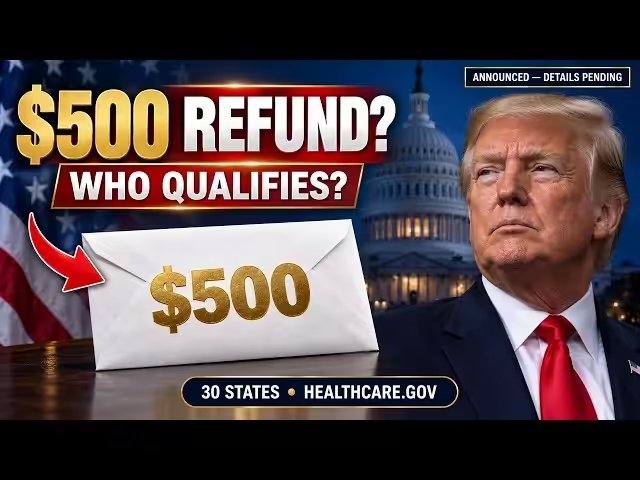
A surprise $500 check from the federal government is already on its way to hundreds of thousands of Americans. According to CNBC, the Treasury Department began mailing payments on Sept. 30 to more than 950,000 people. For households trying to get ahead financially, an unexpected $500 could certainly help.
But this isn’t a new stimulus payment open to everyone. The checks are tied specifically to Affordable Care Act (ACA) Marketplace coverage, and the eligibility rules rule out the vast majority of Americans. The key is knowing exactly which coverage and payment history count.
Here’s what you need to know.
You need qualifying HealthCare.gov coverage
The White House says the $500 payments are going to people who bought Marketplace insurance without receiving premium assistance. In other words, they paid the full premium instead of having a premium tax credit lower the cost. Each eligible person gets $500, not each household, so a family with several qualifying enrollees could receive more than one check.
Most recipients are expected to have incomes above 400% of the federal poverty level, which is roughly $63,000 for one person or $129,000 for a family of four. These people lost federal premium assistance when the enhanced ACA subsidies expired. Some people with incomes between 100% and 400% of the poverty level may also qualify. The Trump administration says the payments come from surplus Marketplace user-fee revenue, which it argues was ultimately passed on to consumers through higher premiums.
You don’t need to submit a separate application. Officials have already identified eligible recipients from Marketplace records.
Shopping for cheaper auto insurance? Enter your zip code here to get started.
Only people in these 30 states are included
The program covers people whose 2026 Marketplace coverage went through the federal HealthCare.gov platform.
CMS lists the 30 states as Alabama, Alaska, Arizona, Arkansas, Delaware, Florida, Hawaii, Indiana, Iowa, Kansas, Louisiana, Michigan, Mississippi, Missouri, Montana, Nebraska, New Hampshire, North Carolina, North Dakota, Ohio, Oklahoma, Oregon, South Carolina, South Dakota, Tennessee, Texas, Utah, West Virginia, Wisconsin, and Wyoming.
The reason for the checks is disputed
The Trump administration describes the payments as refunds of excessive Marketplace “user fees.” The White House says insurers passed those fees on to consumers in their premiums, while the federal government collected more than it needed to run HealthCare.gov and built up an unused surplus.
Others read the situation differently. CMS’s 2026 payment rule, finalized in January 2025, set the federal Marketplace user fee at 2.5% of monthly premiums, specifically to fund exchange operations based partly on expected enrollment. The Associated Press reported that a KFF analysis found some $1 billion in unspent funds may trace back to user fees collected during Trump’s first administration. That complicates the claim that the entire surplus came from Biden-era overcharges.
You don’t need to apply or pay anyone
If you qualify, you won’t fill out a form or pay a processing fee. The government is mailing the payments automatically, and reports on the program say recipients don’t need to take any further action to receive them.
That makes the program an obvious target for scammers. The Federal Trade Commission warns that legitimate government agencies never require you to pay money or hand over financial-account information to receive a refund. Be especially wary of texts, emails, or calls that ask for your banking information to “unlock” a $500 payment.
This isn’t a Medicare or tariff-dividend check
For people approaching retirement, the distinction matters. This $500 payment connects to ACA Marketplace insurance, which many people use before they become eligible for Medicare at 65. Medicare isn’t part of the ACA Marketplace, and people who already have Medicare likely don’t use Marketplace coverage.
The payment is also separate from proposals for a much larger tariff-funded “dividend.” Officials have discussed those proposals publicly, but they are not the same program as these ACA refunds. Likewise, the $500 Marketplace payment isn’t a general IRS stimulus or direct-deposit program that you receive just because you filed a tax return.
Bottom line
Did you enroll through HealthCare.gov in 2026, pay your Marketplace premium without a tax credit, and live in one of the 30 participating states? If so, you may be among the more than 950,000 people receiving a $500 Treasury check automatically. If you received premium assistance, used a separate state Marketplace, or already had Medicare coverage, this particular refund generally isn’t aimed at you.
If you’re unsure, check your Marketplace history through your HealthCare.gov account or call the official Marketplace Call Center at 1-800-318-2596. Don’t respond to an unsolicited message. A legitimate $500 payment won’t fix every affordability problem, but putting unexpected money toward essentials, debt, or savings could help you handle rising bills without putting your personal information at risk.







Leave a Reply