

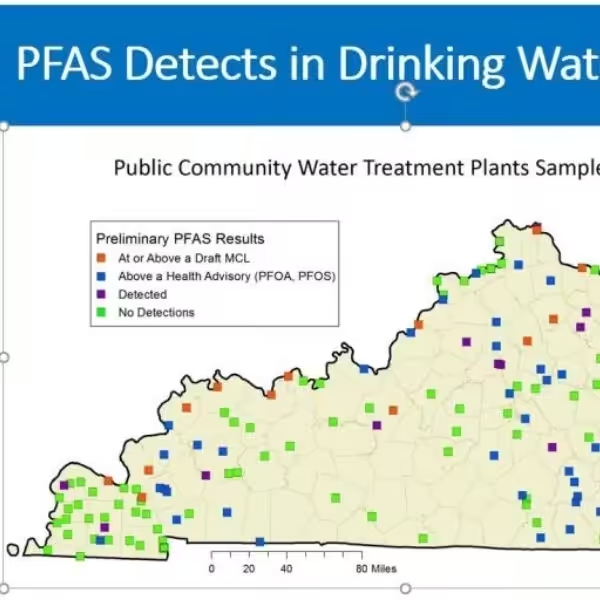
Are you wondering about the quality of your drinking water? On Feb. 24, USA TODAY released a map of public drinking water systems that recently submitted test results for “forever chemicals” to the U.S. Environmental Protection Agency.
Officials found that some locations across the commonwealth exceeded federally permitted levels. Here’s what we know.
What are ‘forever chemicals’?
The EPA defines PFAS, commonly called “forever chemicals,” as long-lasting chemicals whose components break down very slowly over time.
Because industries widely use these chemicals, they appear in water, air, soil, fish and even human blood at varying levels. Scientific studies show that exposure to certain PFAS may link to harmful health effects in humans and animals.
In response, the EPA set legally enforceable limits in 2024 for six PFAS in public drinking water. Public water systems must monitor these chemicals and act to reduce their levels if they exceed EPA standards. They must also notify the public about any violations.
Can PFAS be filtered out of water?
Not every filter removes PFAS from water. The EPA advises consumers to choose filters specifically certified to reduce these chemicals.
The agency recommends the following types of water filters:
Charcoal (Granular Activated Carbon or GAC): These filters use carbon to trap chemicals as water flows through them.
Reverse Osmosis (RO) Systems: This process forces water through an extremely thin barrier that separates chemicals from the water.
Ion Exchange Resins: These tiny resin beads act like powerful magnets, attracting and holding contaminated materials so they do not pass through the water system.
Kentucky areas with PFAS over EPA limit
The following public water systems in Kentucky reported “forever chemical” levels above the EPA limit:
Georgetown: 1.5x the limit.
Cynthiana: Up to 3.8x the limit.
Corbin: Slightly above the limit.
Williamsburg: 1.1x the limit.
Chemicals detected in Louisville’s water
Officials detected PFAS in Louisville’s water, but not at levels that require action. USA TODAY’s map shows that testing identified four chemicals at one location, and the highest single measurement reached 1.9x over the limit.
This article has been carefully fact-checked by our editorial team to ensure accuracy and eliminate any misleading information. We are committed to maintaining the highest standards of integrity in our content.









Leave a Reply