

Have you ever wondered which cities feel the most unsafe to walk through? Today, we’re counting down the most dangerous cities in the world and looking at what makes them so risky. These urban areas top the charts for all the wrong reasons, from sky-high murder rates to worrying levels of home break-ins and car thefts. Let’s dive in and see what danger looks like around the globe.
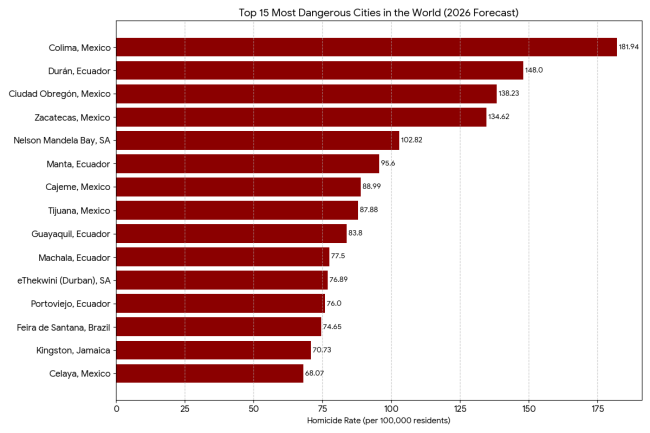
The latest statistics (2024–2025) from Statista reveal a significant shift in the world’s most dangerous cities. Mexico still dominates the top of the list, but escalating drug wars have driven a tragic surge in violence in Ecuador, and South Africa’s major metro areas continue to report high homicide rates.
1. Colima, Mexico
Homicide Rate: 181.94 per 100,000
Colima remains the most dangerous city in the world for the third consecutive year. Powerful cartels fight turf wars here, and the violence is so pervasive that Numbeo’s crime index (72.32) paints a picture of a city where 66% of residents fear their homes will be broken into daily.
2. Durán, Ecuador
Homicide Rate: 148.00 per 100,000
Durán makes a new and shocking entry at #2 and has become the epicenter of Ecuador’s security crisis. It was once a quiet suburb of Guayaquil. Now Colombian and Mexican-linked gangs fight over it, and its murder rate has tripled in less than two years.
3. Ciudad Obregón, Mexico
Homicide Rate: 138.23 per 100,000
Obregón, located in the state of Sonora, continues to struggle with high-intensity violence. Residents report a crime level of 92.50, and nearly 74% of the population constantly worries about property theft and armed robbery.
4. Zacatecas, Mexico
Homicide Rate: 134.62 per 100,000
Zacatecas remains a critical transit point for drug trafficking, and its murder rate keeps it firmly in the top five. With a staggering Numbeo crime index of 81.25, over 75% of locals live in fear of home invasions.
5. Nelson Mandela Bay (Gqeberha), South Africa
Homicide Rate: 102.82 per 100,000
Violence has climbed significantly in South Africa’s most dangerous city. It ranks highest outside Latin America, and deep-seated systemic issues, along with gang violence and civil unrest, have pushed its homicide rate into triple digits.
6. Manta, Ecuador
Homicide Rate: 95.60 per 100,000
Drug trafficking groups have sought alternative exit points for cocaine, and this has driven a massive surge of violence in Ecuador’s coastal city. Manta is a new and tragic addition to the global top ten.
7. Cajeme, Mexico
Homicide Rate: 88.99 per 100,000
People often group Cajeme with Ciudad Obregón, but the broader Cajeme municipality maintains its own distinct and high level of danger. It has ranked in the top 10 for the last five years, largely because of its role in regional cartel logistics.
8. Tijuana, Mexico
Homicide Rate: 87.88 per 100,000
Tijuana remains one of the world’s most violent border cities. Its rate has dipped slightly from its all-time highs, but property crime remains rampant, and over 80% of residents report serious concerns about theft and carjackings.
9. Guayaquil, Ecuador
Homicide Rate: 83.80 per 100,000
Guayaquil is Ecuador’s main port, and it has become a global hub for cocaine shipments, which has set off an explosion of violence. The city’s crime index has spiked to 87.41, reflecting the rapid deterioration of safety in the region.
10. Machala, Ecuador
Homicide Rate: 77.50 per 100,000
Another Ecuadorian city rounds out the top ten. Machala serves as a key coastal point for the “Southern Route” of drug trafficking. Its entry into the top 10 underscores how quickly the security situation in Ecuador has shifted compared with historical rankings.
11. eThekwini (Durban), South Africa
Homicide Rate: 76.89 per 100,000
Durban faces a lethal combination of organized crime, taxi industry violence, and political assassinations, and it maintains its status as a high-risk metro.
12. Portoviejo, Ecuador
Homicide Rate: 76.00 per 100,000
Portoviejo illustrates the “spillover” effect in Ecuador, where violence has moved from the coastal ports into the provincial interiors as gang territories expand.
13. Feira de Santana, Brazil
Homicide Rate: 74.65 per 100,000
Feira de Santana is currently Brazil’s most violent city. It sits at a critical highway junction that connects the drug-producing regions to the export hubs in the north.
14. Kingston, Jamaica
Homicide Rate: 70.73 per 100,000
Jamaica continues to face high levels of interpersonal and gang violence, particularly in the impoverished areas surrounding the capital, though conditions have improved slightly from previous highs.
15. Celaya, Mexico
Homicide Rate: 68.07 per 100,000
Celaya once ranked higher and has seen a modest decrease in 2025, yet it remains one of the most dangerous cities globally because of ongoing fuel-theft (huachicol) conflicts and extortion.
How to Determine the Most Dangerous Cities in the World
Researchers and organizations such as Statista, the Igarapé Institute, and the CCSPJP (Citizen Council for Public Safety and Criminal Justice) rely on a standardized set of criteria to build the list of the world’s most dangerous cities. This approach lets them compare a city in Mexico fairly with one in South Africa.
Metric: Homicide Rate per Capita
Global rankings measure “danger” primarily through the homicide rate. “Crime” covers everything from pickpocketing to fraud, but homicides are the most reliable “hard” data, since governments almost always report and document them.
The formula they use is:

Population Threshold
Most international rankings include only cities with a population of 300,000 or more. This keeps tiny villages with a single high-profile incident from skewing the data.
Data Source
Researchers gather data from several authoritative “layers” to ensure accuracy:
- Official Government Reports: National health ministries and justice departments publish them, such as Mexico’s SESNSP or the South African Police Service.
- International Bodies: The UNODC (United Nations Office on Drugs and Crime) provides verified annual stats.
- Civil Society & Think Tanks: Organizations like the Igarapé Institute and CCSPJP track cartel-related violence in real time, so they deliver the most current updates before official annual reports are finalized.
What Makes These Cities the Most Dangerous in the World
No single factor defines the world’s most dangerous cities. According to Worldatlas, multiple deep-rooted issues combine to drive high crime rates. In these high-risk urban areas, persistent socioeconomic challenges, weak institutions, and systemic violence create environments where crime thrives.
- Poverty and Inequality: Widespread poverty and a lack of economic opportunity breed desperation and social tension, which correlate with higher rates of violent and property crime. Struggling communities often have limited access to education, stable jobs, and support services, and this fuels cycles of crime and insecurity.
- Gang and Organized Crime: Gangs, cartels, and organized criminal networks have a strong presence in many of the world’s most dangerous cities. These groups wage turf wars and run drug trafficking, extortion, and other illicit activities, which leads to regular violent confrontations and elevated homicide rates.
- Weak Law Enforcement: Underfunded or corrupt police forces struggle to deter crime, investigate incidents, and build public trust. Without effective policing, criminals often act with impunity, neighborhoods feel unsafe, and fewer people report crimes.
- Political and Social Instability: Political unrest, government instability, or ongoing conflict often cause spikes in violence in affected cities. When institutions become unstable, law enforcement and public services weaken, and criminal activity and disorder spread easily.
Together, these structural conditions (economic hardship, organized criminal influence, insufficient policing, and unstable governance) explain why some cities consistently rank among the most dangerous in the world.







Leave a Reply