

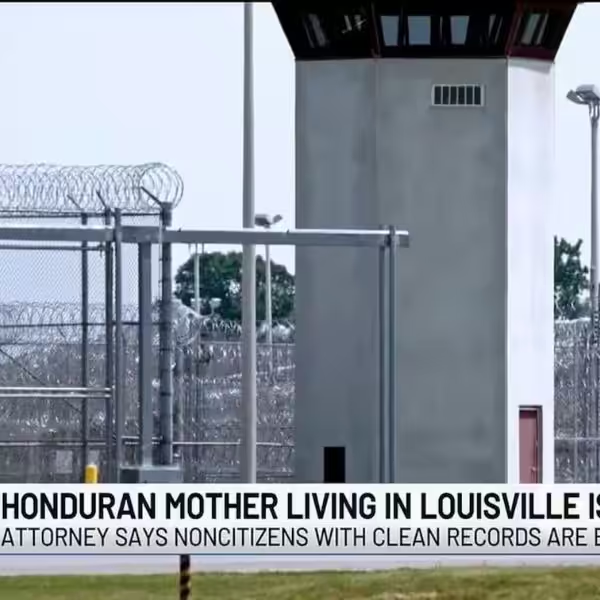
Ciceli Martinez’s attorney says cases like hers are becoming increasingly common in the Louisville Metro area.
LOUISVILLE, Ky. (WAVE) – A Honduran woman who lived in Louisville for more than 12 years has been deported to Honduras, leaving behind four children, including three under the age of 12.
Ciceli Martinez was not a U.S. citizen, but she also had no criminal record. Her attorney says situations like hers are becoming more frequent in the Louisville area.
How the detention began
Martinez crossed the U.S.-Mexico border with her oldest son, Deivys, nearly 13 years ago and received an expedited removal order, which allows ICE to remove non-citizens due to a lack of documentation. Previous administrations had allowed people with those orders to remain in the country.
She came to the United States to escape violence in Honduras. While living in the country, she had three more children, all U.S. citizens, and maintained steady employment.
“All my life I tried to do things the best I could,” Martinez said in Spanish during a FaceTime call with WAVE News. “Since I got there (Louisville), I didn’t miss one appointment with ICE because I wanted to be at peace. I knew that if I missed an appointment with ICE, I was going to lose even more.”
On Sept. 10, 2025, Martinez was detained during a scheduled check-in with ICE’s Alternatives to Detention program. After being detained, she was transferred from Louisville to Indiana, then to an ICE facility in Louisiana, and later back to Indiana, where she remained until her deportation.
Martinez said the four months she spent in custody were extremely difficult. She reported having bruises from handcuffs and said she was assaulted by two inmates held on criminal charges while reading her Bible. In detention facilities, non-citizens are sometimes held alongside individuals jailed for criminal offenses.
“I went through many trials,” she said. “I take them as trials that God put on me and, aside from that, as a spiritual retreat that I went through in jail because that was horrible. I don’t wish that upon anyone, much less a mother who has children.”
Her oldest son, Deivys, now 20, said hearing about her experiences was frightening.
“It was really, really scary to hear because I wasn’t sure if my mom was safe. She says that she couldn’t turn her back on them even when she was asleep.”
A near-deportation and a procedural dispute
Within 48 hours of Martinez’s detention, her attorney, Duffy Trager with the Trager Law Firm, requested a credible fear interview. This interview with an asylum officer determines whether a detained person has a credible fear of persecution or torture if returned to their home country.
Trager said the law requires proceedings to pause until the interview takes place. However, the Saturday after Martinez was detained, her son Deivys emailed Trager asking whether it was unusual that she had been moved from Indiana to Louisiana.
Trager contacted an ICE official in New Orleans, who responded within hours. The official said that if Trager had not raised the concern, Martinez would have been placed on a flight to Honduras that same night without receiving her credible fear interview. Trager said the situation came dangerously close.
“That requires that her son be on it and email me and know that that is strange,” Trager said. “It requires that her attorney actually check his email on the weekend. It requires that the ICE officer be sympathetic and actually respond to that email and do something about it. That’s a whole lot of ifs, right? Under those circumstances, Ciceli got lucky that she even got to assert a credible fear interview, which makes me wonder, for those people that don’t have attorneys and don’t have family that are pushing these issues for them, you know, they’re just getting swept up.”
Under federal regulations, Martinez’s credible fear interview should have taken place within seven days of detention. In her case, it occurred after 72 days.
Attorney: Similar cases increasing in Louisville
Trager said he is currently working with other clients who have lived in the United States for more than 20 years, have no criminal record, and are now in ICE custody.
“This administration is saying worst of the worst,” Trager said. “That’s just not true. They’re going after the low-hanging fruit because they’re trying to push 3,000 apprehensions a day. They’re trying to push 1 million deportations. They care about numbers.”
A report by The Guardian found that 77 percent of people involved in DHS deportation proceedings during much of 2025 had no criminal conviction. Trager told WAVE News he believes deporting people like Martinez wastes taxpayer money.
According to the Department of Homeland Security, deporting one person costs more than $18,000. The agency says nearly 70,000 non-citizens are currently detained for immigration violations.
Trager noted that detaining such a large population costs roughly $10.5 million per day, and most of those individuals, according to the Guardian report, have no criminal history.
“That doesn’t make any sense to me,” he said. “And I think if people knew that 77 percent have no criminal history whatsoever, we would all kind of agree that those are astronomical numbers for really something that doesn’t make a lot of sense.”
Trager has filed a U-Visa application for Martinez in hopes of bringing her back to the United States, though he said the process could take at least six to seven years because of significant backlogs.
He said Martinez now faces an impossible decision.
“Do you take the young children back to Honduras and rob them of the opportunities that they’re going to have access to?” he asked. “Or do you stay separated from them? And then if the option is separation, essentially the 20-year-old permanent resident son becomes the kid’s father because, you know, she was raising these kids as a single mother, so it’s an impossible choice, right? It’s one you really can’t prepare for.”
Deivys said caring for his younger siblings alone has been challenging.
“It’s been pretty difficult sometimes,” he said. “I’ve had to call in, take them to any medical appointment that they need to be at; be late to work sometimes because the bus is late.”
Martinez, now thousands of miles away from her children, said the separation has been painful.
“At night, when I’m going to sleep, it’s sad for me because there’s not that warmth that comes from them. I call them to say goodnight, and they’re sad too without me. They give me a hug, and they know it’s an empty hug.”
A FaceTime call is now the closest she can get to her four children.
“I ask God that he gives me life so I can see them again,” Martinez said. “The hardest part is not being with my children because I had never been separated from them, from any of them, even the oldest.”
A GoFundMe campaign has been launched to help support Martinez’s family during this time.











Leave a Reply